BartenderElite
Verified User
You have more patience than I have, he's clearly a fool.
You should go back and read all of your responses on this thread, and ask yourself: have I offered an argument? Have I refuted anything?
It would be enlightening.

You have more patience than I have, he's clearly a fool.

That's the problem;
Haw, haw.....................haw.

At least T.A. is trying to argue the issue. It's w/ very limited success, but it's much more than "you're emotionally overwrought!" and "you're a fool!"

At least T.A. is trying to argue the issue. It's w/ very limited success, but it's much more than "you're emotionally overwrought!" and "you're a fool!"
Your ignorance of things nuclear is showing and showing badly.
First, ALL Plutonium is man made. Plutonium doesn't occur naturally except in so miniscule an amount--as a result of natural fast fission of uranium--that you might as well ignore that. Plutonium is toxic as a metal not because it is radioactive. The radioactivity given off is alpha or beta (harmless to humans unless ingested) and gamma. Only Pu 242 is particularly long-lived at 3.73x 10^5 years. It is the one created in a breeder reactor. There are trace amounts of several others that are long-lived but they can ignored on their rarity.
Pu 239 and Pu 241 are trace elements at best.
The Fukushima accident killed no one directly as a result of the reactor meltdowns there. Population in some areas were moved out of an abundance of caution. Outside of the immediate plant environ, the levels of detectable radiation from the accident are so low as to present a very minor health hazard at most. Your photo by the way has nothing--NOTHING--to do with the Fukushima nuclear plant accident so I don't understand why you posted it.
This photo is often used on radical Leftist environmental sites as depicting the Fukushima nuclear plant accident:
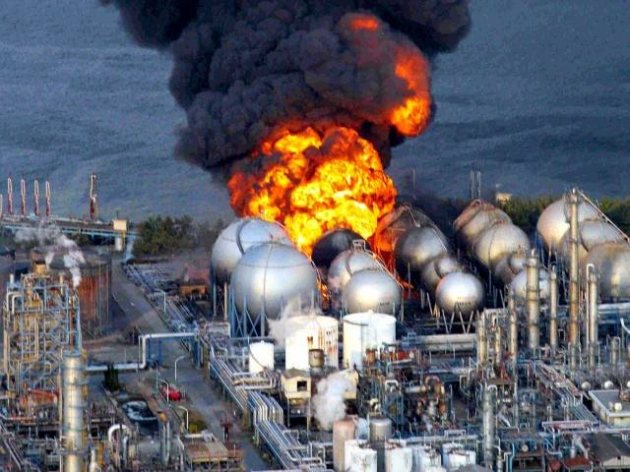
https://sites.suffolk.edu/jstraka/2015/10/30/fukushima-daiichi-nuclear-disaster/
http://www.opensourceinvestigations.com/japan/declassified-the-aftermath-of-the-fukushima-disaster/
That is a straight up lie! That photo is of an unrelated chemical fire and has nothing to do with the Fukushima accident. It is one of many outright, bald-faced, and total lies the environmental Left has pushed about Fukushima.
Fukushima will be cleaned up just like any other industrial accident has been. Three Mile Island was cleaned up and at less than half the cost of the BP Deepwater Horizon oil rig accident. But you don't see people demanding an end to oil use because of that accident...
As for Chernobyl... Chernobyl is the result of an unaccountable Leftist government building an unsafe reactor design and then operating that reactor in a deliberately unsafe way. Chernobyl was a graphite moderated, fast fission reactor. That design is not used commercially anywhere else in the world outside the Soviet Union. The only ones that existed were exclusively for the production of plutonium for nuclear weapons. That's one of the drawbacks of that design, it produces plutonium as a byproduct of operation. That was seen as a bonus in the Soviet Union though.
The design is unsafe for a number of technical reasons, and the worst drawback is probably that graphite is used as the moderator. Imaging building a nuclear reactor inside a giant charcoal brickette. That's Chernobyl.
So, it's an extremely poor example of nuclear power for commercial use. You are trying to compare apples to pineapples.
I wouldn't mind but the fool says that her son worked in the nuclear industry, make if that what you will.

You should go back and read all of your responses on this thread, and ask yourself: have I offered an argument? Have I refuted anything?
It would be enlightening.

Your ignorance of things nuclear is showing and showing badly.
Fascinating. My father was a chemist who worked on a small part of the Manhattan project. His grandson, my oldest son, was a nuclear plant engineer for the baton Rouge Entergy nuke plant. I suspect that they knew/know a lot more about the down side of nuclear energy than you do. My dad opposed it as long ago as the 60s. My son has grave concerns.
I'll listen to actual experts, not copy-n-paste political partisan dumbshits.

By all means, invite them into this discussion. I'll be happy to debate them.
So they virtue signaled against nuke power, but took the 'blood money'. Sounds like some real assholes.

Japan ' We're going to dump a million cubic meters of radioactive water into the world's seas. '
T.A. Gardner ' So ? '
Can anybody wonder why the nuclear lobby is reviled.
Even then, they are virtually safe, assuming they are typical reactor types in use like BWR or PWR reactors. Shutdown is a matter of simply scramming the reactor (dropping rods). Once done, the reactor stops producing power. It takes anywhere from say, a day to a couple of weeks to cooldown completely depending on size mostly. Once that occurs, only a small amount of residual heat is generated due to decay of unstable isotopes. This becomes steady state within a few weeks to a couple of months. After that, the rate of heat generation is pretty much constant.
At that point, assuming there is a secondary containment like all US and French (as two examples) reactors have, manned or unmanned, things are safe.
I'd say a large chemical plant could present a greater hazard than a shutdown, fueled, reactor in a proper containment would.
U Suck.
It does indeed, truly an ignorant peasant.