James Lovelock: Why are we so afraid of nuclear power?

Half of France's nuclear reactors taken offline, adding to ...https://news.sky.com › story › nearly-half-of-frances-n...
Apr 29, 2022 — On Friday 28 of France's 56 reactors were shut down due to routine maintenance or defects, forcing EDF to buy electricity from the European ...

Power plant shutdowns hinder France's 'nuclear adventure'https://www.ft.com › ... › EU economy › Nuclear energy
May 29, 2022 — Half of France's 56 reactors are offline — a record — with 12 of those shut down because of corrosion inspections. “There's a whole series of ...

Half of French Nuclear Reactors Shut for Works, Squeezing ...https://www.bloomberg.com › news › articles › half-of-...
Apr 29, 2022 — France's Nuclear Shutdown Hits 50% of Reactors, Squeezing Supply. Some 28 reactors in France are now offline for maintenance.

France Turns to Coal as Nuclear Plant Shutdowns Threaten ...https://jpt.spe.org › france-turns-to-coal-as-nuclear-plan...
Jan 10, 2022 — With 17 of the country's 56 nuclear power plants temporarily shut down for planned or emergency maintenance, the French Ministry of the ...

So? maintenance is a necessity. What happens when the wind doesn't blow and the sun doesn't shine. In Germany, there are days, and even the occasional week where that doesn't happen. Heavy overcast, snow, and no wind. What do you do when that happens? More importantly, it's going to happen pretty regularly.

Here in Arizona, our biggest solar array, Solana got hit by a microburst thunderstorm a few years back. That wrecked half the array. It took over six months to repair the damage.
 
the green energy money just agreed to by Manchin?
Do you think it would be better spent on extending life of nuke plants or buying windmills? :palm:

Building new nuke plants. The technology today is far better than in the 70's when we were last building them.
 
Why are intelligent people concerned about nuclear power?

Plutonium is a radioactive metallic element with the atomic number 94. It was discovered in 1940 by scientists studying how to split atoms to make atomic bombs. Plutonium is created in a reactor when uranium atoms absorb neutrons. Nearly all plutonium is man-made.

Plutonium predominantly emits alpha particles – a type of radiation that is easily stopped and has a short range. It also emits neutrons, beta particles and gamma rays. It is considered toxic, in part, because if it were to be inhaled it could deposit in the lungs and eventually cause damage.

photo of the NASA Cassini space craft orbiting Saturn with the caption 'Plutonium-238 powers the Cassini space craft orbiting Saturn (NASA)'There are five "common" isotopes of plutonium, Pu-238, Pu-239, Pu-240, Pu-241, and Pu-242. These are all "fissionable" – the atom's nucleus can easily split apart if it is struck by a neutron.

The different isotopes have different "half-lives" – the time it takes to lose half of its radioactivity. Pu-239 has a half-life of 24,100 years and Pu-241's half-life is 14.4 years. Substances with shorter half-lives decay more quickly than those with longer half-lives, so they emit more energetic radioactivity.

Backgrounder on Plutonium

Alsotoo, see Fukushima:

BGHYOPX.jpg


And Chernobyl:

ojTeii0.jpg


And this:

The underground fire that has been smoldering at the Bridgeton Landfill since at least December 2010 is still there. So is the World War II-era nuclear weapons waste at the adjacent West Lake Landfill.
 
There isn't one. But we've only had nukes for a few decades.

And we're talking about manning them for another few hundred thousand years.

See?

No. There's no need for "manning" a nuclear waste dump in particular. The casks used now are all but indestructible. The waste isn't particularly hazardous when stored in them and in a properly designed storage dump like Yucca Mountain. Even if the stuff began to leak say 500 years from now, so? The dump is impermeable by design, the waste isn't going to suddenly meltdown and spew massive radiation, so it's not an issue that can't be routinely handled if it occurred.
Also, we could reprocess the spent fuel and reduce the waste to a small fraction of what it currently is. That process could be refined in time where the amount of waste is minimized.
 
No. There's no need for "manning" a nuclear waste dump in particular. The casks used now are all but indestructible. The waste isn't particularly hazardous when stored in them and in a properly designed storage dump like Yucca Mountain. Even if the stuff began to leak say 500 years from now, so? The dump is impermeable by design, the waste isn't going to suddenly meltdown and spew massive radiation, so it's not an issue that can't be routinely handled if it occurred.
Also, we could reprocess the spent fuel and reduce the waste to a small fraction of what it currently is. That process could be refined in time where the amount of waste is minimized.

I'm talking about manning plants - not waste dumps.

You're downplaying the danger of waste, and thinking only in terms of timeframes we can comprehend - like decades or even centuries. No one can guarantee containment for the lengths of time we're talking about here. In fact, it's unlikely we could have any structure that WOULD contain waste safely for those timeframes.
 
So? maintenance is a necessity. What happens when the wind doesn't blow and the sun doesn't shine. In Germany, there are days, and even the occasional week where that doesn't happen. Heavy overcast, snow, and no wind. What do you do when that happens? More importantly, it's going to happen pretty regularly.

Here in Arizona, our biggest solar array, Solana got hit by a microburst thunderstorm a few years back. That wrecked half the array. It took over six months to repair the damage.

They claim it's maintenance, but they also mention unexpected corrosion problems in at least 12 plants. It is ridiculous to schedule maintenance in such a way as to cause rolling blackouts and energy shortages, shutting down half the plants at one time. That's crazy. I don't believe this is "scheduled" maintenance.

Two of the world's largest uranium mines were also shut down recently due to flooding caused by weather.

However, I agree with you that solar and wind are not reliable.
 
Last edited:
All of the issues w/ solar and wind are addressable. Eventually, we'll have panels in space for solar. We'll develop storage for wind power to compensate for periods where there is little to no wind.

None of these are gargantuan issues. We can really do anything when we set our mind to it. See: sending men to the moon.
 
All of the issues w/ solar and wind are addressable. Eventually, we'll have panels in space for solar. We'll develop storage for wind power to compensate for periods where there is little to no wind.

None of these are gargantuan issues. We can really do anything when we set our mind to it. See: sending men to the moon.

is it crucial to keep fossil fuel expensive to spur investment in renewables?

should the renewable pursuit include government investment in certain corporations to incentivize innovation?

if not, why not? (10 points)
 
All of the issues w/ solar and wind are addressable. Eventually, we'll have panels in space for solar. We'll develop storage for wind power to compensate for periods where there is little to no wind.

None of these are gargantuan issues. We can really do anything when we set our mind to it. See: sending men to the moon.

Total Bullshit.

And it currently costs $10k to send one Lb. to space.
 
is it crucial to keep fossil fuel expensive to spur investment in renewables?

should the renewable pursuit include government investment in certain corporations to incentivize innovation?

if not, why not? (10 points)

Obviously, the preference is to let renewables develop organically, without gov't investment or artificial incentives.

But, time's a wastin'. It will take decades to transition from fossil fuels - so, we're vulnerable right now. If we start to see any shortages, we are not prepared, and the consequences of that could be disastrous if our infrastructure isn't ready to transition.

I support gov't investment to accelerate the process. Private funding generally follows public.
 
Why are intelligent people concerned about nuclear power?


Backgrounder on Plutonium

Alsotoo, see Fukushima:

BGHYOPX.jpg


And Chernobyl:

ojTeii0.jpg


And this:

Your ignorance of things nuclear is showing and showing badly.

First, ALL Plutonium is man made. Plutonium doesn't occur naturally except in so miniscule an amount--as a result of natural fast fission of uranium--that you might as well ignore that. Plutonium is toxic as a metal not because it is radioactive. The radioactivity given off is alpha or beta (harmless to humans unless ingested) and gamma. Only Pu 242 is particularly long-lived at 3.73x 10^5 years. It is the one created in a breeder reactor. There are trace amounts of several others that are long-lived but they can ignored on their rarity.
Pu 239 and Pu 241 are trace elements at best.

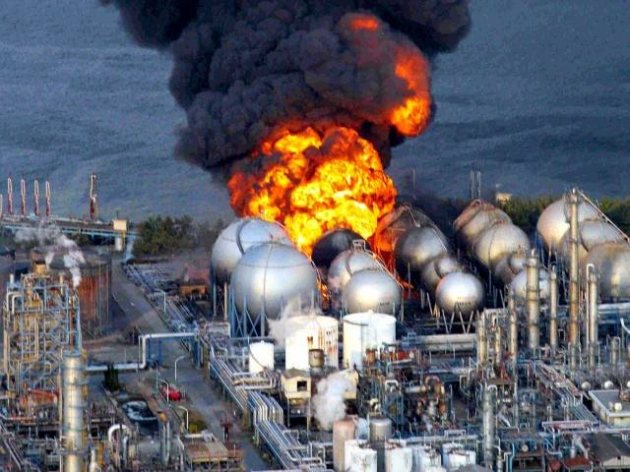
The Fukushima accident killed no one directly as a result of the reactor meltdowns there. Population in some areas were moved out of an abundance of caution. Outside of the immediate plant environ, the levels of detectable radiation from the accident are so low as to present a very minor health hazard at most. Your photo by the way has nothing--NOTHING--to do with the Fukushima nuclear plant accident so I don't understand why you posted it.

This photo is often used on radical Leftist environmental sites as depicting the Fukushima nuclear plant accident:

Fukushima-Daiichi-Nuclear-Plant.jpg

https://sites.suffolk.edu/jstraka/2015/10/30/fukushima-daiichi-nuclear-disaster/
http://www.opensourceinvestigations.com/japan/declassified-the-aftermath-of-the-fukushima-disaster/


That is a straight up lie! That photo is of an unrelated chemical fire and has nothing to do with the Fukushima accident. It is one of many outright, bald-faced, and total lies the environmental Left has pushed about Fukushima.

Fukushima will be cleaned up just like any other industrial accident has been. Three Mile Island was cleaned up and at less than half the cost of the BP Deepwater Horizon oil rig accident. But you don't see people demanding an end to oil use because of that accident...

As for Chernobyl... Chernobyl is the result of an unaccountable Leftist government building an unsafe reactor design and then operating that reactor in a deliberately unsafe way. Chernobyl was a graphite moderated, fast fission reactor. That design is not used commercially anywhere else in the world outside the Soviet Union. The only ones that existed were exclusively for the production of plutonium for nuclear weapons. That's one of the drawbacks of that design, it produces plutonium as a byproduct of operation. That was seen as a bonus in the Soviet Union though.
The design is unsafe for a number of technical reasons, and the worst drawback is probably that graphite is used as the moderator. Imaging building a nuclear reactor inside a giant charcoal brickette. That's Chernobyl.

So, it's an extremely poor example of nuclear power for commercial use. You are trying to compare apples to pineapples.
 
I'm talking about manning plants - not waste dumps.

You're downplaying the danger of waste, and thinking only in terms of timeframes we can comprehend - like decades or even centuries. No one can guarantee containment for the lengths of time we're talking about here. In fact, it's unlikely we could have any structure that WOULD contain waste safely for those timeframes.

Why would we need to do that? Once unfueled, the plant is nothing. What reason is there to continue to man it? 90% could be cut up, broken up and hauled to a dump or landfill as it wouldn't even be radioactive. The rest is really not a serious hazard. Again, mostly alpha and beta emitters at very low levels of radiation.
 
Your ignorance of things nuclear is showing and showing badly.

First, ALL Plutonium is man made. Plutonium doesn't occur naturally except in so miniscule an amount--as a result of natural fast fission of uranium--that you might as well ignore that. Plutonium is toxic as a metal not because it is radioactive. The radioactivity given off is alpha or beta (harmless to humans unless ingested) and gamma. Only Pu 242 is particularly long-lived at 3.73x 10^5 years. It is the one created in a breeder reactor. There are trace amounts of several others that are long-lived but they can ignored on their rarity.
Pu 239 and Pu 241 are trace elements at best.

The Fukushima accident killed no one directly as a result of the reactor meltdowns there. Population in some areas were moved out of an abundance of caution. Outside of the immediate plant environ, the levels of detectable radiation from the accident are so low as to present a very minor health hazard at most. Your photo by the way has nothing--NOTHING--to do with the Fukushima nuclear plant accident so I don't understand why you posted it.

This photo is often used on radical Leftist environmental sites as depicting the Fukushima nuclear plant accident:

Fukushima-Daiichi-Nuclear-Plant.jpg

https://sites.suffolk.edu/jstraka/2015/10/30/fukushima-daiichi-nuclear-disaster/
http://www.opensourceinvestigations.com/japan/declassified-the-aftermath-of-the-fukushima-disaster/


That is a straight up lie! That photo is of an unrelated chemical fire and has nothing to do with the Fukushima accident. It is one of many outright, bald-faced, and total lies the environmental Left has pushed about Fukushima.

Fukushima will be cleaned up just like any other industrial accident has been. Three Mile Island was cleaned up and at less than half the cost of the BP Deepwater Horizon oil rig accident. But you don't see people demanding an end to oil use because of that accident...

As for Chernobyl... Chernobyl is the result of an unaccountable Leftist government building an unsafe reactor design and then operating that reactor in a deliberately unsafe way. Chernobyl was a graphite moderated, fast fission reactor. That design is not used commercially anywhere else in the world outside the Soviet Union. The only ones that existed were exclusively for the production of plutonium for nuclear weapons. That's one of the drawbacks of that design, it produces plutonium as a byproduct of operation. That was seen as a bonus in the Soviet Union though.
The design is unsafe for a number of technical reasons, and the worst drawback is probably that graphite is used as the moderator. Imaging building a nuclear reactor inside a giant charcoal brickette. That's Chernobyl.

So, it's an extremely poor example of nuclear power for commercial use. You are trying to compare apples to pineapples.

You've been speaking about the 1/6 hearings for weeks like you knew everything about them. Then, yesterday, you admitted you had watched a "few minutes."

This is the same situation, I think. A little knowledge is a dangerous thing, as they say.
 
Why would we need to do that? Once unfueled, the plant is nothing. What reason is there to continue to man it? 90% could be cut up, broken up and hauled to a dump or landfill as it wouldn't even be radioactive. The rest is really not a serious hazard. Again, mostly alpha and beta emitters at very low levels of radiation.

What a great example of why nukes are a bit beyond our normal comprehension and reasoning levels.

Who is to say that they'll be unmanned by choice, or as something that is planned? I could think of dozens of scenarios, and there are probably dozens more beyond that. I.e. what if we had a more severe pandemic, that wiped out a majority of our population? Societal norms would break down quickly, and the plants could become unmanned without proper planning or unfueling.

And that's just one scenario.
 
What a great example of why nukes are a bit beyond our normal comprehension and reasoning levels.

Who is to say that they'll be unmanned by choice, or as something that is planned? I could think of dozens of scenarios, and there are probably dozens more beyond that. I.e. what if we had a more severe pandemic, that wiped out a majority of our population? Societal norms would break down quickly, and the plants could become unmanned without proper planning or unfueling.

And that's just one scenario.

Even then, they are virtually safe, assuming they are typical reactor types in use like BWR or PWR reactors. Shutdown is a matter of simply scramming the reactor (dropping rods). Once done, the reactor stops producing power. It takes anywhere from say, a day to a couple of weeks to cooldown completely depending on size mostly. Once that occurs, only a small amount of residual heat is generated due to decay of unstable isotopes. This becomes steady state within a few weeks to a couple of months. After that, the rate of heat generation is pretty much constant.

At that point, assuming there is a secondary containment like all US and French (as two examples) reactors have, manned or unmanned, things are safe.

I'd say a large chemical plant could present a greater hazard than a shutdown, fueled, reactor in a proper containment would.
 
Obviously, the preference is to let renewables develop organically, without gov't investment or artificial incentives.

But, time's a wastin'. It will take decades to transition from fossil fuels - so, we're vulnerable right now. If we start to see any shortages, we are not prepared, and the consequences of that could be disastrous if our infrastructure isn't ready to transition.

I support gov't investment to accelerate the process. Private funding generally follows public.

congratulations, you're an eco-fascist.

:magagrin:
 
Fukushima will be cleaned up just like any other industrial accident has been. .


That's the problem;

Why Japan Is Dumping Water From Fukushima Into the Sea

The Japanese utility giant Tepco is planning to release more than 1 million cubic meters of treated radioactive water -- enough to fill 500 Olympic-size swimming pools -- from the wrecked Fukushima Dai-Ichi nuclear power plant into the Pacific Ocean, part of its nearly $200 billion effort to clean up the worst atomic accident since Chernobyl. Storage tanks at the site are forecast to be full as early as mid-2022, and space for building more is scarce.

https://www.washingtonpost.com/busi...48e788-0649-11ec-b3c4-c462b1edcfc8_story.html


Haw, haw.....................haw.
 
Why would we need to do that? Once unfueled, the plant is nothing. What reason is there to continue to man it? 90% could be cut up, broken up and hauled to a dump or landfill as it wouldn't even be radioactive. The rest is really not a serious hazard. Again, mostly alpha and beta emitters at very low levels of radiation.

You have more patience than I have, he's clearly a fool.
 
Back
Top