A myth.
With every debate on taxing and spending in Washington comes inevitable references to which states send more in taxes to the federal treasury than they receive in benefits for their citizens. The figures thrown around are sourced differently and vary widely, but the point of it all is for dissembling
DEMOCRATS to point at poor, Republican states and call them hypocrites for doing exactly what
DEMOCRATS say they should: taking money from richer places.
But how much of it is true?
What is surprising is that disingenuous
DEMOCRATS act like the red states are getting away with something.
Progressive ideology has as one of its central tenets the idea that money should be transferred from the rich to the poor. In our progressive tax code, they have succeeded in enacting the first part of that equation. The only strange part is that they look askance at the poorer regions of the country for simply obeying the tax code.
How much the federal government takes in taxes is simple. How much they pay out gets more complicated.
The results are somewhat at odds with the claims on the Left that the red states are takers while the blue states are makers.
Of the ten states with the lowest percentage of funds coming from Washington, three are red, six are blue, and one is purple. The state with by far the lowest level of federal subsidization was the deeply red state of North Dakota.
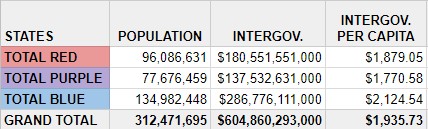
If, instead of comparing federal funds to state budgets, we look at how much the federal government spends in intergovernmental grants per resident of a state, the results are turned on their heads.
Against a national average of $1,935 in intergovernmental spending per American, red states receive just $1,879.
Blue states get considerably more, at $2,124 per resident.
Purple states see the least of their money returned to them per capita, at just $1,770.
Measured in this way, the blue states are getting quite a bit more than the red or purple.
https://thefederalist.com/2017/11/17/red-states-tax-takers-blue-states-tax-makers/