The need to reconsider the Electoral College (and it has nothing to do with Trump)

Not an insensible question, even if the answer is rather obvious.
Many rational persons (including some that post in these fora I should hope) see the world through an Ockham's Razor-colored lens.

U.S. President Trump is the most recent U.S. president, and the only currently serving U.S. president, that won the office, not because of winning the vote, but because of losing the vote, but winning the electoral college swindle.

No, he won the majority of votes in the majority of states, this is a federalist system meant to grant proportional representation to individual states at the federal level.

This is the United States of America not the United States of California, New York, and Illinois.

Furthermore; you want to change the rules after the fact, Republicans don't bother campaigning or voting in Illinois, California, or New York because they are smart enough to run the race based on the rules.
 
Yea it could. States are constitutionally empowered to decide how electoral votes are proportioned in their States. First past the post winner take all or equally proportioned. It would only take a coalition of States totaling at least 270 EV's to decide that all Electoral votes in their respective States would be delegated to the candidate who wins the national popular vote for the Electoral College to be mooted and no Constitutional Amendment would be needed. The States are perfectly with in their Constitutional Rights to make such a decision on how Electoral Votes are delegated. If enough States with enough EV's decide to form such a coalition it can be done without a Constitutional Amendment. Technically speaking the Electoral College would still exist but it would be mooted.

what do you do in the event a state which passed this proposed law voted for party #1 but party #2 reached the 270 point due to the results in a state which did NOT pass such a law. Then the state would find itself giving its electoral votes to a person who did not receive the majority of the votes of its own citizens.......doesn't that sort of fuck up the rational for passing the law in the first place?......for example, in 2016 California would have been compelled to cast its electoral votes for Trump once he hit 270 even if Michigan, Wisconsin and Pennsylvania had not passed such a statute and were not compelled to cast their votes for the California favorite.......

basically you're trying to create a system in which only the states which pass this statute are entitled to any say in who will be elected......
 
Every voter would matter and have an equal say

what do you do in the event a state which passed this proposed law voted for party #1 but party #2 reached the 270 point due to the results in a state which did NOT pass such a law. Then the state would find itself giving its electoral votes to a person who did not receive the majority of the votes of its own citizens.......doesn't that sort of fuck up the rational for passing the law in the first place?......for example, in 2016 California would have been compelled to cast its electoral votes for Trump once he hit 270 even if Michigan, Wisconsin and Pennsylvania had not passed such a statute and were not compelled to cast their votes for the California favorite.......

basically you're trying to create a system in which only the states which pass this statute are entitled to any say in who will be elected......

No.

Under National Popular Vote, every voter, everywhere, for every candidate, would be politically relevant and equal in every presidential election. Every vote would matter equally in the state counts and national count.

The bill would take effect when enacted by states possessing a majority of the electoral votes—270 of 538.
All of the presidential electors from the enacting states will be supporters of the presidential candidate receiving the most popular votes among all 50 states (and DC)—thereby guaranteeing that candidate with an Electoral College majority.


The National Popular Vote bill would give a voice to the minority party voters for president in each state. Now their votes don't matter to their candidate.

In 2012, 56,256,178 (44%) of the 128,954,498 voters were minority party voters in their states.

And now votes, beyond the one needed to get the most votes in the state, for winning in a state, are wasted and don't matter to presidential candidates.
Utah (5 electoral votes) alone generated a margin of 385,000 "wasted" votes for Bush in 2004.
Oklahoma (7 electoral votes) alone generated a margin of 455,000 "wasted" votes for Bush in 2004 -- larger than the margin generated by the 9th and 10th largest states, namely New Jersey and North Carolina (each with 15 electoral votes).
8 small western states, with less than a third of California’s population, provided Bush with a bigger margin (1,283,076) than California provided Kerry (1,235,659).

In Gallup polls since 1944 until before this election, only about 20% of the public has supported the current system of awarding all of a state's electoral votes to the presidential candidate who receives the most votes in each separate state (with about 70% opposed and about 10% undecided).

Support for a national popular vote has been strong among Republicans, Democrats, and Independent voters, as well as every demographic group in every state surveyed. In the 41 now shown on divisive maps as red, blue, and purple states surveyed, overall support has been in the 67-81% range - in rural states, in small states, in Southern and border states, in big states, and in other states polled.

In state polls of voters each with a second question that specifically emphasized that their state's electoral votes would be awarded to the winner of the national popular vote in all 50 states, not necessarily their state's winner, there was only a 4-8% decrease of support.

Question 1: "How do you think we should elect the President: Should it be the candidate who gets the most votes in all 50 states, or the current Electoral College system?"

Question 2: "Do you think it more important that a state's electoral votes be cast for the presidential candidate who receives the most popular votes in that state, or is it more important to guarantee that the candidate who receives the most popular votes in all 50 states becomes president?"

Support for a National Popular Vote
South Dakota -- 75% for Question 1, 67% for Question 2.
Connecticut -- 74% for Question 1, 68% for Question 2,
Utah -- 70% for Question 1, 66% for Question 2
 
No, he won the majority of votes in the majority of states, this is a federalist system meant to grant proportional representation to individual states at the federal level.

This is the United States of America not the United States of California, New York, and Illinois.

Furthermore; you want to change the rules after the fact, Republicans don't bother campaigning or voting in Illinois, California, or New York because they are smart enough to run the race based on the rules.

With the current system of electing the President, none of the states requires that a presidential candidate receive anything more than the most popular votes in order to receive all of the state's or district’s electoral votes.

Since 1828, one in six states have cast their Electoral College votes for a candidate who failed to win the support of 50 percent of voters in their state

The current system does not grant proportional representation to individual states at the federal level in presidential elections.
States with 3 electoral votes range in populations of less than 600,000 to almost a million.


Illinois Democrats cast 2.3% of the total national popular vote.
Illinois cast 4% of the total national popular vote.

In 2016, New York state and California Democrats together cast 9.7% of the total national popular vote.

California & New York state account for 16.7% of the voting-eligible population

Alone, they could not determine the presidency.

In total New York state and California cast 16% of the total national popular vote

In total, Florida, Texas, and Pennsylvania cast 18% of the total national popular vote.
Trump won those states.

The vote margin in California and New York wouldn't have put Clinton over the top in the popular vote total without the additional 60 million votes she received in other states.

In 2004, among the four largest states, the two largest Republican states (Texas and Florida) generated a total margin of 2.1 million votes for Bush, while the two largest Democratic states generated a total margin of 2.1 million votes for Kerry.

8 small western states, with less than a third of California’s population, provided Bush with a bigger margin (1,283,076) than California provided Kerry (1,235,659).

New York state and California together cast 15.7% of the national popular vote in 2012.
About 62% Democratic in CA, and 64% in NY.

New York and California have 15.6% of Electoral College votes. Now that proportion is all reliably Democratic.

Under a popular-vote system CA, IL, and NY would have less weight than under the current system because their popular votes would be diluted among candidates.

The National Popular Vote bill would give a voice to the minority party voters for president in each state. Now their votes don't matter to their candidate.

In 2012, 56,256,178 (44%) of the 128,954,498 voters were minority party voters in their states.

And now votes, beyond the one needed to get the most votes in the state, for winning in a state, are wasted and don't matter to presidential candidates.
 
The reason it's a question is rather obvious. Snowflakes like you are pissed your bitch lost and you have to have something to whine about.

In Gallup polls since they started asking in 1944 until this election, only about 20% of the public has supported the current system of awarding all of a state's electoral votes to the presidential candidate who receives the most votes in each separate state (not mentioned in the U.S. Constitution, but later enacted by 48 states) (with about 70% opposed and about 10% undecided).

Support for a national popular vote for President has been strong among Republicans, Democrats, and Independent voters, as well as every demographic group in every state surveyed. In the 41 red, blue, and purple states surveyed, overall support has been in the 67-81% range - in rural states, in small states, in Southern and border states, in big states, and in other states polled.

Most Americans don't ultimately care whether their presidential candidate wins or loses in their state or district. Voters want to know, that no matter where they live, even if they were on the losing side, their vote actually was equally counted and mattered to their candidate. Most Americans think it is wrong that the candidate with the most popular votes can lose. We don't allow this in any other election in our representative republic.

The National Popular Vote bill was approved in 2016 by a unanimous bipartisan House committee vote in both Georgia (16 electoral votes) and Missouri (10).
Since 2006, the bill has passed 35 state legislative chambers in 23 rural, small, medium, large, Democratic, Republican and purple states with 261 electoral votes, including one house in Arizona (11), Arkansas (6), Maine (4), Michigan (16), Nevada (6), North Carolina (15), and Oklahoma (7), and both houses in Colorado (9) and New Mexico (5).
 
so it only applies to the states that pass it......okay, that's what we have now.....but you said it would be stupid for a state to do that......

Any state that would unilaterally award a state's electoral votes to the winner of the national popular vote, would not be making every voter in the country equal and matter, nor guaranteeing the candidate with the most national popular votes wins.
States with 270 electoral votes awarding their electoral votes the winner of the national popular vote, does.
That is what the National Popular Vote does.
 
sure it would......the Constitution says the states have to decide not "enacted by states with a majority of the electoral votes—270 of 538"

States enacting the National Popular Vote bill are deciding that they want to guarantee the majority of Electoral College votes and the presidency to the candidate who receives the most popular votes in the country.
That guarantee only is achieved when states with a majority of electoral votes enact the bill.
 
is it?......can you cite that provision?.....

National Popular Vote is based on Article II, Section 1 of the U.S. Constitution, which gives each state legislature the right to decide how to appoint its own electors. Unable to agree on any particular method for selecting presidential electors, the Founding Fathers left the choice of method exclusively to the states in Article II, Section 1
“Each State shall appoint, in such Manner as the Legislature thereof may direct, a Number of Electors….”
The U.S. Supreme Court has repeatedly characterized the authority of the state legislatures over the manner of awarding their electoral votes as "plenary" and "exclusive."
 
dude.....the federal government passing a law saying how a state MUST apportion its votes is obviously a federal decision.......how can you pretend otherwise......

The federal government is NOT passing a law saying how a state must apportion its votes.

STATES are enacting the bill.

Since 2006, the bill has passed 35 state legislative chambers in 23 rural, small, medium, large, Democratic, Republican and purple states with 261 electoral votes, including one house in Arizona (11), Arkansas (6), Connecticut (7), Delaware (3), The District of Columbia, Maine (4), Michigan (16), Nevada (6), North Carolina (15), Oklahoma (7), and Oregon (7), and both houses in California, Colorado (9), Hawaii, Illinois, New Jersey, Maryland, Massachusetts, New Mexico (5), New York, Rhode Island, Vermont, and Washington.
The bill has been enacted by the District of Columbia (3), Hawaii (4), Illinois (19), New Jersey (14), Maryland (11), California (55), Massachusetts (10), New York (29), Vermont (3), Rhode Island (4), and Washington (13). These 11 jurisdictions have 165 electoral votes – 61% of the 270 necessary to bring the law into effect.

It changes state winner-take-all laws (not mentioned in the U.S. Constitution, but later enacted by 48 states), to guarantee the majority of Electoral College votes and the presidency to the candidate with the most national popular votes, without changing anything in the Constitution, using the built-in method that the Constitution provides for states to make changes.
 
"Three things Democrats want above all else:
1 - Allowing the dead to vote" U9 #155
If you have evidence Democrats have a disproportionate claim to voter fraud, please post it.

Thanks.
"3 - To win by any means possible" U9 #155
Particularly ironic coming from a partisan of the party that has not once in the new millennium populated the white house by winning the popular vote.

"People that live in glass houses ...".
 
We don't make policy based on the Gallup Poll. There has to be a strong movement among the voters to make changes and none exists. Anyone can answer a poll but few are willing to work (including even writing a letter).
 
In Gallup polls since they started asking in 1944 until this election, only about 20% of the public has supported the current system of awarding all of a state's electoral votes to the presidential candidate who receives the most votes in each separate state (not mentioned in the U.S. Constitution, but later enacted by 48 states) (with about 70% opposed and about 10% undecided).

Support for a national popular vote for President has been strong among Republicans, Democrats, and Independent voters, as well as every demographic group in every state surveyed. In the 41 red, blue, and purple states surveyed, overall support has been in the 67-81% range - in rural states, in small states, in Southern and border states, in big states, and in other states polled.

Most Americans don't ultimately care whether their presidential candidate wins or loses in their state or district. Voters want to know, that no matter where they live, even if they were on the losing side, their vote actually was equally counted and mattered to their candidate. Most Americans think it is wrong that the candidate with the most popular votes can lose. We don't allow this in any other election in our representative republic.

The National Popular Vote bill was approved in 2016 by a unanimous bipartisan House committee vote in both Georgia (16 electoral votes) and Missouri (10).
Since 2006, the bill has passed 35 state legislative chambers in 23 rural, small, medium, large, Democratic, Republican and purple states with 261 electoral votes, including one house in Arizona (11), Arkansas (6), Maine (4), Michigan (16), Nevada (6), North Carolina (15), and Oklahoma (7), and both houses in Colorado (9) and New Mexico (5).

Two things. First, if you're going to make a claim related to what you say a survey/poll showed, you should at least provide a link to it.

Secondly, if, as you claim, there is that much support for a national popular vote movement, it shouldn't be real hard for it to become an amendment to the Constitution according to how the Constitution indicates an amendment can be added.

As far as the Constitution saying anything about how a state divides it's electoral votes, you are correct. It's left up to the States how to do it. That's why Nebraska and Maine can divide theirs by congressional district rather than doing what the other 48 and D.C. do with winner take all. There's also nothing in the Constitution indicating that popular vote is used to determine who gets the electors in each State. It's also left up to the State to make that determination. States don't have to use popular vote. They CHOOSE to do so and can make that choice based on the Constitution setting up the system then allowing States to handle the rest.

States can determine the requirements of who in their state can vote, when they have to register, whether or not they have to register naming their party, the times the polls are open in their state, the polling locations and all sorts of other things related to procedural matters when voting.

Do you notice a pattern when it comes to who really controls most aspects of voting?
 
Particularly ironic coming from a partisan of the party that has not once in the new millennium populated the white house by winning the popular vote.

"People that live in glass houses ...".

First, that's incorrect.

Secondly, until popular vote determines and electoral vote no longer determines the winner, it's irrelevant. People constantly mentioning overall popular vote when it comes to electing a President prove they have little/no knowledge of how the system works nor why it was put in place.
 
The federal government is NOT passing a law saying how a state must apportion its votes.

STATES are enacting the bill.

Since 2006, the bill has passed 35 state legislative chambers in 23 rural, small, medium, large, Democratic, Republican and purple states with 261 electoral votes, including one house in Arizona (11), Arkansas (6), Connecticut (7), Delaware (3), The District of Columbia, Maine (4), Michigan (16), Nevada (6), North Carolina (15), Oklahoma (7), and Oregon (7), and both houses in California, Colorado (9), Hawaii, Illinois, New Jersey, Maryland, Massachusetts, New Mexico (5), New York, Rhode Island, Vermont, and Washington.
The bill has been enacted by the District of Columbia (3), Hawaii (4), Illinois (19), New Jersey (14), Maryland (11), California (55), Massachusetts (10), New York (29), Vermont (3), Rhode Island (4), and Washington (13). These 11 jurisdictions have 165 electoral votes – 61% of the 270 necessary to bring the law into effect.

It changes state winner-take-all laws (not mentioned in the U.S. Constitution, but later enacted by 48 states), to guarantee the majority of Electoral College votes and the presidency to the candidate with the most national popular votes, without changing anything in the Constitution, using the built-in method that the Constitution provides for states to make changes.

If that many support it, why hasn't an amendment doing away with the electoral college totally been passed?
 
what do you do in the event a state which passed this proposed law voted for party #1 but party #2 reached the 270 point due to the results in a state which did NOT pass such a law. Then the state would find itself giving its electoral votes to a person who did not receive the majority of the votes of its own citizens.......doesn't that sort of fuck up the rational for passing the law in the first place?......for example, in 2016 California would have been compelled to cast its electoral votes for Trump once he hit 270 even if Michigan, Wisconsin and Pennsylvania had not passed such a statute and were not compelled to cast their votes for the California favorite.......

basically you're trying to create a system in which only the states which pass this statute are entitled to any say in who will be elected......
Your argument is flawed. The concept is not to give your State electoral votes to whoever hits 270 EV's first but to give your State Electoral votes to the candidate that wins the National popular vote. If enough States, with a total of 270 EV's or greater were to pass such a law than the EC would be mooted and a Constitutional Amendment would not be required.

Now that's not to say that I agree with such a measure. I'm just saying it's possible to kill the Electoral College without a Constitutional Amendment.
 
"Chicago 1964 through Detroit 2016...... " PP #173
That's what I thought.
But a simple "no" would do.
"First, that's incorrect." C #175
Excellent!
Please name the Republican president that won the presidency in the new millennium by winning the popular vote.

Thanks.
"Secondly, until popular vote determines and electoral vote no longer determines the winner, it's irrelevant." C #175
It's not irrelevant in a thread titled:
"The need to reconsider the Electoral College (and it has nothing to do with Trump)"
 
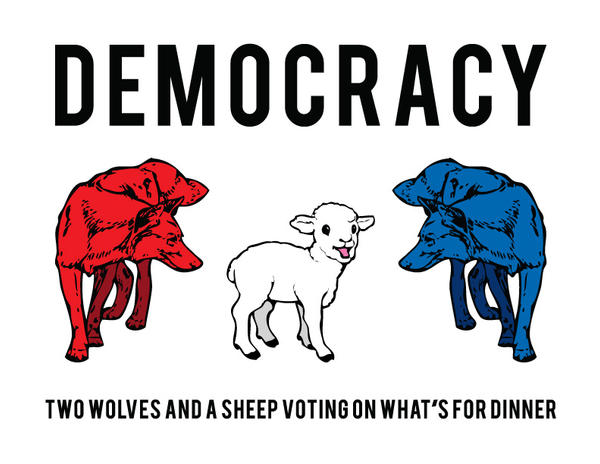
two_wolves_and_a_sheep_by_satansgoalie.jpg
 
Your argument is flawed. The concept is not to give your State electoral votes to whoever hits 270 EV's first but to give your State Electoral votes to the candidate that wins the National popular vote. If enough States, with a total of 270 EV's or greater were to pass such a law than the EC would be mooted and a Constitutional Amendment would not be required.

Now that's not to say that I agree with such a measure. I'm just saying it's possible to kill the Electoral College without a Constitutional Amendment.

Just another example of someone that doesn't understand the current system or why it was put in place.
 
Back
Top