The need to reconsider the Electoral College (and it has nothing to do with Trump)

I see the JPP liberals are still avoiding FACTS.

With all the "discussions" occurring regarding the Electoral College and the Popular Vote, I believe I have found the solution; because I don't see our Federal elections ever being decided by the "popular vote".

What I have done is broken this last election down by using what percentage of the "popular vote" to allocate how many Electoral College votes a candidate will receive.

Below is my example and if some doesn't understand the method, please ask.

Each state has a color designation as to who won that state, this year.
After each state, is the number of Electoral votes those states have.
Under that, it shows the candidate, the percentage of votes they received, then the percentage of electoral votes that number would have given them, and finally the number of electoral votes that would have been allocated.
Once the number of electoral votes for that state have been reached, the allocation ends.

Alabama - 9
Trump 62.9 / (5.6) 6
Clinton 34.6 / (3.114) 3

Alaska - 3
Trump 52.9 / (1.6) 2
Clinton 37.7 / (1.131) 1

Arizona - 11
Trump 49.5 / (5.445) 5
Clinton 45.4 / (4.994) 5
Johnson 3.9 / (0.429) 1

Arkansas - 6
Trump 60.4 / (3.624) 4
Clinton 33.8 / (2.028) 2

California - 55
Clinton 61.6 / (33.88) 34
Trump 32.8 / (18.04) 18
Johnson 3.4 / (1.87) 2
Stein 1.8 / (0.55) 1

Colorado - 9
Clinton 47.2 / (4,248) 4
Trump 44.4 / (3.996) 4
Johnson 5.0 / (0.45) 1

Connecticut - 7
Clinton 54.5 / (3.815) 4
Trump 41.2 / (2.884) 3

Delaware - 3
Clinton 53.4 / (1.602) 2
Trump 41.9 / (1.257) 1

District of Columbia - 3
Clinton 92.8 / (2.784) 3
Trump 4.1 / (0.123) 0

Florida - 29
Trump 49.1 / (14.239) 14
Clinton 47.8 / (13.862) 14
Johnson 2.2 / (0.638) 1

Georgia - 16
Trump 51.3 / (8.208) 8
Clinton 45.6 / (7.296) 7
Johnson 3.1 / (0.496) 1

Hawaii - 4
Clinton 62.3 / (2.492) 2
Trump 30.1 / (1.204) 1
Johnson 3.7 / (0.148) 1

Idaho - 4
Trump 59.2 / (2.368) 2
Clinton 27.6 / (1.104) 1
McMullin 6.8 / (0.272) 1

Illinois - 20
Clinton 55.4 / (11.08) 11
Trump 39.4 / (7.88) 8
Johnson 3.8 / (0.76) 1

Indiana - 11
Trump 57.2 / (6.292) 6
Clinton 37.9 / (4.169) 4
Johnson 4.9 / (0.539) 1

Iowa - 6
Trump 51.8 / (3.108) 3
Clinton 42.2 / (2.532) 3

Kansas - 6
Trump 57.2 / (3.432) 3
Clinton 36.2 / (2.172) 2
Johnson 4.7 / (0.282) 1

Kentucky - 8
Trump 62.5 / (5.0) 5
Clinton 32.7 / (2.616) 3

Louisiana - 8
Trump 58.1 / (4.648) 5
Clinton 38.4 / (3.072) 3

Maine - 4
Clinton 47.9 / (1.916) 2
Trump 45.2 / (1.808) 2

Maryland - 10
Clinton 60.5 / (6.05) 6
Trump 35.3 / (3.53) 4

Massachusetts - 11
Clinton 60.8 / (6.688) 7
Trump 33.5 / (3.685) 4

Michigan - 16
Trump 47.6 / (7.616) 8
Clinton 47.3 / 7.568) 8

Minnesota - 10
Clinton 46.9 / (4.69) 5
Trump 45.4 / (4.54) 5

Mississippi - 6
Trump 58.3 / (3.498) 3
Clinton 39.7 / 2.383) 2
Johnson 1.2 / (0.072) 1

Missouri - 10
Trump 57.1 / (5.71) 6
Clinton 38.0 / (3.8) 4

Montana - 3
Trump 56.5 / (1.695) 2
Clinton 36.0 / (1.08) 1

Nebraska - 5
Trump 60.3 / (3.015) 3
Clinton 34.0 / (1.7) 2

Nevada - 6
Clinton 47.9 / (2.874) 3
Trump 45.5 / (2.73) 3

New Hampshire - 4
Clinton 47.6 / (1.904) 2
Trump 47.2 / (1.888) 2

New Jersey - 14
Clinton 55.0 / (7.70) 8
Trump 41.8 / (5.852) 6

New Mexico - 5
Clinton 48.3 / (2.415) 2
Trump 40.0 / (2.00) 2
Johnson 9.3 / (0.465) 1

New York - 29
Clinton 58.8 / (17.052) 17
Trump 37.5 / (10.875) 11
Johnson 2.3 / (0.667) 1

North Carolina - 15
Trump 50.5 / (7.575) 8
Clinton 46.7 / (7.005) 7

North Dakota - 3
Trump 64.1 / (1.923) 2
Clinton 27.8 / (0.834) 1

Ohio - 18
Trump 52.1 / (9,378) 9
Clinton 43.5 / (7.83) 8
Johnson 3.2 / (0.576) 1

Oklahoma - 7
Trump 65.3 / (4.571) 5
Clinton 28.9 / (2.023) 2

Oregon - 7
Clinton 51.7 / (3.619) 4
Trump 41.1 / (2.877) 3

Pennsylvania - 20
Trump 48.8 / (9.76) 10
Clinton 47.6 / (9.52) 10

Rhode Island - 4
Clinton 55.4 / (2.216) 2
Trump 39.8 / (1.592) 2

South Carolina - 9
Trump 54.9 / (4.941) 5
Clinton 40.8 / (3.672) 4

South Dakota - 3
Trump 61.5 / (1.845) 2
Clinton 31.7 / (0.0951) 1

Tennessee - 11
Trump 61.1 / (6.721) 7
Clinton 34.9 / (3.839) 4

Texas - 38
Trump 52.6 / (19.988) 20
Clinton 43.4 / (16.492) 16
Johnson 3.2 / (1.216) 1
Stein 0.8 / 0.304) 1

Utah - 6
Trump 45.9 / (2.754) 3
Clinton 27.8 / 1.668) 2
McMullin 21.0 / (1.26) 1

Vermont - 3
Clinton 61.1 / (1.833) 2
Trump 32.6 / (0.978) 1

Virginia - 13
Clinton 49.9 / (6.487) 6
Trump 45.0 / (5.85) 6
Johnson 3.0 / (0.39) 1

Washington - 12
Clinton 54.4 / (6.528) 7
Trump 38.2 / (4.584) 5

West Virginia - 5
Trump 68.7 / (3.435) 3
Clinton 26.5 / (1.325) 1
Johnson 3.2 / (0.16) 1

Wisconsin - 10
Trump 47.9 / (4.79) 5
Clinton 46.9 / 4.69) 5

Wyoming - 3
Trump 70.1 / (2.103) 2
Clinton 22.5 / 0.675) 1


Adding all of this up, it gives us the following totals:
Trump / 268
Clinton / 250
Third party(s) / 20


This of course would need to have the 270 number eliminated or use the congressional method that is already prescribed, when one candidate doesn't reach the 270 number.
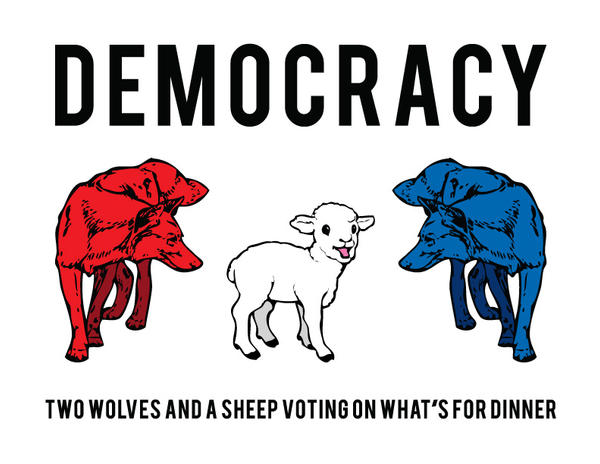
 
Popular election of the chief executive is not Pure Democracy

two_wolves_and_a_sheep_by_satansgoalie.jpg

Being a constitutional republic does not mean we should not and cannot guarantee the election of the presidential candidate with the most popular votes. The candidate with the most votes wins in every other election in the country.

Guaranteeing the election of the presidential candidate with the most popular votes and the majority of Electoral College votes (as the National Popular Vote bill would) would not make us a pure democracy.

Pure democracy is a form of government in which people vote on all policy initiatives directly.

Popular election of the chief executive does not determine whether a government is a republic or democracy.
 
I see the JPP liberals are still avoiding FACTS.

With all the "discussions" occurring regarding the Electoral College and the Popular Vote, I believe I have found the solution; because I don't see our Federal elections ever being decided by the "popular vote".

What I have done is broken this last election down by using what percentage of the "popular vote" to allocate how many Electoral College votes a candidate will receive.

Below is my example and if some doesn't understand the method, please ask.

Each state has a color designation as to who won that state, this year.
After each state, is the number of Electoral votes those states have.
Under that, it shows the candidate, the percentage of votes they received, then the percentage of electoral votes that number would have given them, and finally the number of electoral votes that would have been allocated.
Once the number of electoral votes for that state have been reached, the allocation ends.

Alabama - 9
Trump 62.9 / (5.6) 6
Clinton 34.6 / (3.114) 3

Alaska - 3
Trump 52.9 / (1.6) 2
Clinton 37.7 / (1.131) 1

Arizona - 11
Trump 49.5 / (5.445) 5
Clinton 45.4 / (4.994) 5
Johnson 3.9 / (0.429) 1

Arkansas - 6
Trump 60.4 / (3.624) 4
Clinton 33.8 / (2.028) 2

California - 55
Clinton 61.6 / (33.88) 34
Trump 32.8 / (18.04) 18
Johnson 3.4 / (1.87) 2
Stein 1.8 / (0.55) 1

Colorado - 9
Clinton 47.2 / (4,248) 4
Trump 44.4 / (3.996) 4
Johnson 5.0 / (0.45) 1

Connecticut - 7
Clinton 54.5 / (3.815) 4
Trump 41.2 / (2.884) 3

Delaware - 3
Clinton 53.4 / (1.602) 2
Trump 41.9 / (1.257) 1

District of Columbia - 3
Clinton 92.8 / (2.784) 3
Trump 4.1 / (0.123) 0

Florida - 29
Trump 49.1 / (14.239) 14
Clinton 47.8 / (13.862) 14
Johnson 2.2 / (0.638) 1

Georgia - 16
Trump 51.3 / (8.208) 8
Clinton 45.6 / (7.296) 7
Johnson 3.1 / (0.496) 1

Hawaii - 4
Clinton 62.3 / (2.492) 2
Trump 30.1 / (1.204) 1
Johnson 3.7 / (0.148) 1

Idaho - 4
Trump 59.2 / (2.368) 2
Clinton 27.6 / (1.104) 1
McMullin 6.8 / (0.272) 1

Illinois - 20
Clinton 55.4 / (11.08) 11
Trump 39.4 / (7.88) 8
Johnson 3.8 / (0.76) 1

Indiana - 11
Trump 57.2 / (6.292) 6
Clinton 37.9 / (4.169) 4
Johnson 4.9 / (0.539) 1

Iowa - 6
Trump 51.8 / (3.108) 3
Clinton 42.2 / (2.532) 3

Kansas - 6
Trump 57.2 / (3.432) 3
Clinton 36.2 / (2.172) 2
Johnson 4.7 / (0.282) 1

Kentucky - 8
Trump 62.5 / (5.0) 5
Clinton 32.7 / (2.616) 3

Louisiana - 8
Trump 58.1 / (4.648) 5
Clinton 38.4 / (3.072) 3

Maine - 4
Clinton 47.9 / (1.916) 2
Trump 45.2 / (1.808) 2

Maryland - 10
Clinton 60.5 / (6.05) 6
Trump 35.3 / (3.53) 4

Massachusetts - 11
Clinton 60.8 / (6.688) 7
Trump 33.5 / (3.685) 4

Michigan - 16
Trump 47.6 / (7.616) 8
Clinton 47.3 / 7.568) 8

Minnesota - 10
Clinton 46.9 / (4.69) 5
Trump 45.4 / (4.54) 5

Mississippi - 6
Trump 58.3 / (3.498) 3
Clinton 39.7 / 2.383) 2
Johnson 1.2 / (0.072) 1

Missouri - 10
Trump 57.1 / (5.71) 6
Clinton 38.0 / (3.8) 4

Montana - 3
Trump 56.5 / (1.695) 2
Clinton 36.0 / (1.08) 1

Nebraska - 5
Trump 60.3 / (3.015) 3
Clinton 34.0 / (1.7) 2

Nevada - 6
Clinton 47.9 / (2.874) 3
Trump 45.5 / (2.73) 3

New Hampshire - 4
Clinton 47.6 / (1.904) 2
Trump 47.2 / (1.888) 2

New Jersey - 14
Clinton 55.0 / (7.70) 8
Trump 41.8 / (5.852) 6

New Mexico - 5
Clinton 48.3 / (2.415) 2
Trump 40.0 / (2.00) 2
Johnson 9.3 / (0.465) 1

New York - 29
Clinton 58.8 / (17.052) 17
Trump 37.5 / (10.875) 11
Johnson 2.3 / (0.667) 1

North Carolina - 15
Trump 50.5 / (7.575) 8
Clinton 46.7 / (7.005) 7

North Dakota - 3
Trump 64.1 / (1.923) 2
Clinton 27.8 / (0.834) 1

Ohio - 18
Trump 52.1 / (9,378) 9
Clinton 43.5 / (7.83) 8
Johnson 3.2 / (0.576) 1

Oklahoma - 7
Trump 65.3 / (4.571) 5
Clinton 28.9 / (2.023) 2

Oregon - 7
Clinton 51.7 / (3.619) 4
Trump 41.1 / (2.877) 3

Pennsylvania - 20
Trump 48.8 / (9.76) 10
Clinton 47.6 / (9.52) 10

Rhode Island - 4
Clinton 55.4 / (2.216) 2
Trump 39.8 / (1.592) 2

South Carolina - 9
Trump 54.9 / (4.941) 5
Clinton 40.8 / (3.672) 4

South Dakota - 3
Trump 61.5 / (1.845) 2
Clinton 31.7 / (0.0951) 1

Tennessee - 11
Trump 61.1 / (6.721) 7
Clinton 34.9 / (3.839) 4

Texas - 38
Trump 52.6 / (19.988) 20
Clinton 43.4 / (16.492) 16
Johnson 3.2 / (1.216) 1
Stein 0.8 / 0.304) 1

Utah - 6
Trump 45.9 / (2.754) 3
Clinton 27.8 / 1.668) 2
McMullin 21.0 / (1.26) 1

Vermont - 3
Clinton 61.1 / (1.833) 2
Trump 32.6 / (0.978) 1

Virginia - 13
Clinton 49.9 / (6.487) 6
Trump 45.0 / (5.85) 6
Johnson 3.0 / (0.39) 1

Washington - 12
Clinton 54.4 / (6.528) 7
Trump 38.2 / (4.584) 5

West Virginia - 5
Trump 68.7 / (3.435) 3
Clinton 26.5 / (1.325) 1
Johnson 3.2 / (0.16) 1

Wisconsin - 10
Trump 47.9 / (4.79) 5
Clinton 46.9 / 4.69) 5

Wyoming - 3
Trump 70.1 / (2.103) 2
Clinton 22.5 / 0.675) 1


Adding all of this up, it gives us the following totals:
Trump / 268
Clinton / 250
Third party(s) / 20


This of course would need to have the 270 number eliminated or use the congressional method that is already prescribed, when one candidate doesn't reach the 270 number.

To eliminate the 270 number would need a constitutional amendment, and could be stopped by states with as little as 3% of the U.S. population.

There are good reasons why no state awards their electors proportionally.

Although the whole-number proportional approach might initially seem to offer the possibility of making every voter in every state relevant in presidential elections, it would not do this in practice.

The whole number proportional system sharply increases the odds of no candidate getting the majority of electoral votes needed, leading to the selection of the president by the U.S. House of Representatives, regardless of the popular vote anywhere.

It would not accurately reflect the nationwide popular vote;

It would reduce the influence of any state, if not all states adopted.

It would not improve upon the current situation in which four out of five states and four out of five voters in the United States are ignored by presidential campaigns, but instead, would create a very small set of states in which only one electoral vote is in play (while making most states politically irrelevant),

It would not make every vote equal.

It would not guarantee the Presidency to the candidate with the most popular votes in the country.

The National Popular Vote bill is the way to make every person's vote equal and matter to their candidate because it guarantees the majority of Electoral College votes to the candidate who gets the most votes among all 50 states and DC.
 
If that many support it, why hasn't an amendment doing away with the electoral college totally been passed?

The National Popular Vote bill would guarantee the majority of Electoral College votes and the presidency to the candidate who receives the most popular votes in the country. It does not abolish the Electoral College.

The U.S. Constitution says "Each State shall appoint, in such Manner as the Legislature thereof may direct, a Number of Electors . . ."
The U.S. Supreme Court has repeatedly characterized the authority of the state legislatures over the manner of awarding their electoral votes as "plenary" and "exclusive."

The normal way of changing the method of electing the President is not a federal constitutional amendment, but changes in state law.

Historically, major changes in the method of electing the President have come about by state legislative action. For example, the people had no vote for President in most states in the nation's first election in 1789. However, now, as a result of changes in the state laws governing the appointment of presidential electors, the people have the right to vote for presidential electors in 100% of the states.

In 1789, only 3 states used the winner-take-all method (awarding all of a state's electoral vote to the candidate who gets the most votes in the state). However, as a result of changes in state laws, the winner-take-all method is now currently used by 48 of the 50 states.

In 1789, it was necessary to own a substantial amount of property in order to vote; however, as a result of changes in state laws, there are now no property requirements for voting in any state.

In other words, neither of the two most important features of the current system of electing the President (namely, that the voters may vote and the winner-take-all method) are in the U.S. Constitution. Neither was the choice of the Founders when they went back to their states to organize the nation's first presidential election.

The normal process of effecting change in the method of electing the President is specified in the U.S. Constitution, namely action by the state legislatures. This is how the current system was created, and this is the built-in method that the Constitution provides for making changes. The abnormal process is to go outside the Constitution, and amend it.
 
Two things. First, if you're going to make a claim related to what you say a survey/poll showed, you should at least provide a link to it.

Secondly, if, as you claim, there is that much support for a national popular vote movement, it shouldn't be real hard for it to become an amendment to the Constitution according to how the Constitution indicates an amendment can be added.

As far as the Constitution saying anything about how a state divides it's electoral votes, you are correct. It's left up to the States how to do it. That's why Nebraska and Maine can divide theirs by congressional district rather than doing what the other 48 and D.C. do with winner take all. There's also nothing in the Constitution indicating that popular vote is used to determine who gets the electors in each State. It's also left up to the State to make that determination. States don't have to use popular vote. They CHOOSE to do so and can make that choice based on the Constitution setting up the system then allowing States to handle the rest.

States can determine the requirements of who in their state can vote, when they have to register, whether or not they have to register naming their party, the times the polls are open in their state, the polling locations and all sorts of other things related to procedural matters when voting.

Do you notice a pattern when it comes to who really controls most aspects of voting?

The National Popular Vote bill retains the constitutionally mandated Electoral College and state control of elections, and uses the built-in method that the Constitution provides for states to make changes.
 
will demonstrate that they want their will to be imposed on other states in the union.....

States not enacting the National Popular Vote bill can award their electors however they want.

Unable to agree on any particular method for selecting presidential electors, the Founding Fathers left the choice of method exclusively to the states in Article II, Section 1
“Each State shall appoint, in such Manner as the Legislature thereof may direct, a Number of Electors….”
The U.S. Supreme Court has repeatedly characterized the authority of the state legislatures over the manner of awarding their electoral votes as "plenary" and "exclusive."

Because each state has independent power to award its electoral votes in the manner it sees fit, it is difficult to see what "adverse effect" might be claimed by one state from the decision of another state to award its electoral votes in a particular way. It is especially unclear what adverse "political" effect might be claimed, given that the National Popular Vote compact would treat votes cast in all 50 states and the District of Columbia equally. A vote cast in a compacting state is, in every way, equal to a vote cast in a non-compacting state. The National Popular Vote compact does not confer any advantage on states belonging to the compact as compared to non-compacting states. A vote cast in a compacting state would be, in every way, equal to a vote cast in a non-compacting state. The National Popular Vote compact certainly would not reduce the voice of voters in non-compacting states relative to the voice of voters in member states.

Because of state-by-state winner-take-all laws, not mentioned, much less endorsed, in the Constitution. . .

In 2000, 537 popular votes in Florida determined that the candidate who had 537,179 less national popular votes would win.

Less than 80,000 votes in 3 states determined the 2016 election, where there was a lead of over 2,8oo,ooo popular votes nationwide.

Since World War II, a shift of a few thousand votes in 1, 2, or 3 states would have elected a 2nd-place candidate in 6 of the 18 presidential elections
 
We don't make policy based on the Gallup Poll. There has to be a strong movement among the voters to make changes and none exists. Anyone can answer a poll but few are willing to work (including even writing a letter).

Actually, the Founding Fathers left the choice of method exclusively to the states in Article II, Section 1
“Each State shall appoint, in such Manner as the Legislature thereof may direct, a Number of Electors….”
The U.S. Supreme Court has repeatedly characterized the authority of the state legislatures over the manner of awarding their electoral votes as "plenary" and "exclusive."

The National Popular Vote bill was approved in 2016 by a unanimous bipartisan House committee vote in both Georgia (16 electoral votes) and Missouri (10).
Since 2006, the bill has passed 35 state legislative chambers in 23 rural, small, medium, large, Democratic, Republican and purple states with 261 electoral votes, including one house in Arizona (11), Arkansas (6), Connecticut (7), Delaware (3), The District of Columbia, Maine (4), Michigan (16), Nevada (6), North Carolina (15), Oklahoma (7), and Oregon (7), and both houses in California, Colorado (9), Hawaii, Illinois, New Jersey, Maryland, Massachusetts, New Mexico (5), New York, Rhode Island, Vermont, and Washington.
 
Being a constitutional republic does not mean we should not and cannot guarantee the election of the presidential candidate with the most popular votes. The candidate with the most votes wins in every other election in the country.

Guaranteeing the election of the presidential candidate with the most popular votes and the majority of Electoral College votes (as the National Popular Vote bill would) would not make us a pure democracy.

Pure democracy is a form of government in which people vote on all policy initiatives directly.

Popular election of the chief executive does not determine whether a government is a republic or democracy.

Where did you see the word "PURE"??
 
Last edited:
To eliminate the 270 number would need a constitutional amendment, and could be stopped by states with as little as 3% of the U.S. population.

There are good reasons why no state awards their electors proportionally.

Although the whole-number proportional approach might initially seem to offer the possibility of making every voter in every state relevant in presidential elections, it would not do this in practice.

The whole number proportional system sharply increases the odds of no candidate getting the majority of electoral votes needed, leading to the selection of the president by the U.S. House of Representatives, regardless of the popular vote anywhere.

It would not accurately reflect the nationwide popular vote;

It would reduce the influence of any state, if not all states adopted.

It would not improve upon the current situation in which four out of five states and four out of five voters in the United States are ignored by presidential campaigns, but instead, would create a very small set of states in which only one electoral vote is in play (while making most states politically irrelevant),

It would not make every vote equal.

It would not guarantee the Presidency to the candidate with the most popular votes in the country.

The National Popular Vote bill is the way to make every person's vote equal and matter to their candidate because it guarantees the majority of Electoral College votes to the candidate who gets the most votes among all 50 states and DC.

Then we should push for nationwide voter IDs.
 
The National Popular Vote bill would guarantee the majority of Electoral College votes and the presidency to the candidate who receives the most popular votes in the country. It does not abolish the Electoral College.

The U.S. Constitution says "Each State shall appoint, in such Manner as the Legislature thereof may direct, a Number of Electors . . ."
The U.S. Supreme Court has repeatedly characterized the authority of the state legislatures over the manner of awarding their electoral votes as "plenary" and "exclusive."

The normal way of changing the method of electing the President is not a federal constitutional amendment, but changes in state law.

Historically, major changes in the method of electing the President have come about by state legislative action. For example, the people had no vote for President in most states in the nation's first election in 1789. However, now, as a result of changes in the state laws governing the appointment of presidential electors, the people have the right to vote for presidential electors in 100% of the states.

In 1789, only 3 states used the winner-take-all method (awarding all of a state's electoral vote to the candidate who gets the most votes in the state). However, as a result of changes in state laws, the winner-take-all method is now currently used by 48 of the 50 states.

In 1789, it was necessary to own a substantial amount of property in order to vote; however, as a result of changes in state laws, there are now no property requirements for voting in any state.

In other words, neither of the two most important features of the current system of electing the President (namely, that the voters may vote and the winner-take-all method) are in the U.S. Constitution. Neither was the choice of the Founders when they went back to their states to organize the nation's first presidential election.

The normal process of effecting change in the method of electing the President is specified in the U.S. Constitution, namely action by the state legislatures. This is how the current system was created, and this is the built-in method that the Constitution provides for making changes. The abnormal process is to go outside the Constitution, and amend it.

If you understood the current system and why it was put in place, you'd understand that what you support goes directly against what the founders intended with the EC system.
 
The National Popular Vote bill retains the constitutionally mandated Electoral College and state control of elections, and uses the built-in method that the Constitution provides for states to make changes.

It negates the very reason the founders put the current system into place. If you understood why, you'd realize that what you support does that.
 
The Founders

If you understood the current system and why it was put in place, you'd understand that what you support goes directly against what the founders intended with the EC system.

Prior to arriving at the eventual wording of section 1 of Article II, the Constitutional Convention specifically voted against a number of different methods for selecting the President, including
● having state legislatures choose the President,
● having governors choose the President, and
● a national popular vote.
After these (and other) methods were debated and rejected, the Constitutional Convention decided to leave the entire matter to the states.

National Popular Vote is based on Article II, Section 1 of the U.S. Constitution, which gives each state legislature the right to decide how to appoint its own electors. Unable to agree on any particular method for selecting presidential electors, the Founding Fathers left the choice of method exclusively to the states in Article II, Section 1
“Each State shall appoint, in such Manner as the Legislature thereof may direct, a Number of Electors….”
The U.S. Supreme Court has repeatedly characterized the authority of the state legislatures over the manner of awarding their electoral votes as "plenary" and "exclusive."

The Constitution does not prohibit any of the methods that were debated and rejected. Indeed, a majority of the states appointed their presidential electors using two of the rejected methods in the nation's first presidential election in 1789 (i.e., appointment by the legislature and by the governor and his cabinet). Presidential electors were appointed by state legislatures for almost a century.

Neither of the two most important features of the current system of electing the President (namely, universal suffrage, and the 48 state-by-state winner-take-all method) are in the U.S. Constitution. Neither was the choice of the Founders when they went back to their states to organize the nation's first presidential election.

In 1789, in the nation's first election, a majority of the states appointed their presidential electors by appointment by the legislature or by the governor and his cabinet, the people had no vote for President in most states, and in states where there was a popular vote, only men who owned a substantial amount of property could vote, and only three states used the state-by-state winner-take-all method to award electoral votes.

In the nation’s first presidential election in 1789 and second election in 1792, the states employed a wide variety of methods for choosing presidential electors, including
● appointment of the state’s presidential electors by the Governor and his Council,
● appointment by both houses of the state legislature,
● popular election using special single-member presidential-elector districts,
● popular election using counties as presidential-elector districts,
● popular election using congressional districts,
● popular election using multi-member regional districts,
● combinations of popular election and legislative choice,
● appointment of the state’s presidential electors by the Governor and his Council combined with the state legislature, and
● statewide popular election.

The current winner-take-all method of awarding electoral votes is not in the U.S. Constitution. It was not debated at the Constitutional Convention. It is not mentioned in the Federalist Papers. It was not the Founders’ choice. It was used by only three states in 1789, and all three of them repealed it by 1800. It is not entitled to any special deference based on history or the historical meaning of the words in the U.S. Constitution. The actions taken by the Founding Fathers make it clear that they never gave their imprimatur to the winner-take-all method. The winner-take-all method of awarding electoral votes became predominant until 1880 -- almost a century after the U.S. Constitution was written, after the states adopted it, one-by-one, in order to maximize the power of the party in power in each state.

The constitutional wording does not encourage, discourage, require, or prohibit the use of any particular method for awarding a state's electoral votes.

As a result of changes in state laws enacted since 1789, the people have the right to vote for presidential electors in 100% of the states, there are no property requirements for voting in any state, and the state-by-state winner-take-all method is used by 48 of the 50 states. States can, and have, changed their method of awarding electoral votes over the years.
 
Prior to arriving at the eventual wording of section 1 of Article II, the Constitutional Convention specifically voted against a number of different methods for selecting the President, including
● having state legislatures choose the President,
● having governors choose the President, and
● a national popular vote.
After these (and other) methods were debated and rejected, the Constitutional Convention decided to leave the entire matter to the states.

National Popular Vote is based on Article II, Section 1 of the U.S. Constitution, which gives each state legislature the right to decide how to appoint its own electors. Unable to agree on any particular method for selecting presidential electors, the Founding Fathers left the choice of method exclusively to the states in Article II, Section 1
“Each State shall appoint, in such Manner as the Legislature thereof may direct, a Number of Electors….”
The U.S. Supreme Court has repeatedly characterized the authority of the state legislatures over the manner of awarding their electoral votes as "plenary" and "exclusive."

The Constitution does not prohibit any of the methods that were debated and rejected. Indeed, a majority of the states appointed their presidential electors using two of the rejected methods in the nation's first presidential election in 1789 (i.e., appointment by the legislature and by the governor and his cabinet). Presidential electors were appointed by state legislatures for almost a century.

Neither of the two most important features of the current system of electing the President (namely, universal suffrage, and the 48 state-by-state winner-take-all method) are in the U.S. Constitution. Neither was the choice of the Founders when they went back to their states to organize the nation's first presidential election.

In 1789, in the nation's first election, a majority of the states appointed their presidential electors by appointment by the legislature or by the governor and his cabinet, the people had no vote for President in most states, and in states where there was a popular vote, only men who owned a substantial amount of property could vote, and only three states used the state-by-state winner-take-all method to award electoral votes.

In the nation’s first presidential election in 1789 and second election in 1792, the states employed a wide variety of methods for choosing presidential electors, including
● appointment of the state’s presidential electors by the Governor and his Council,
● appointment by both houses of the state legislature,
● popular election using special single-member presidential-elector districts,
● popular election using counties as presidential-elector districts,
● popular election using congressional districts,
● popular election using multi-member regional districts,
● combinations of popular election and legislative choice,
● appointment of the state’s presidential electors by the Governor and his Council combined with the state legislature, and
● statewide popular election.

The current winner-take-all method of awarding electoral votes is not in the U.S. Constitution. It was not debated at the Constitutional Convention. It is not mentioned in the Federalist Papers. It was not the Founders’ choice. It was used by only three states in 1789, and all three of them repealed it by 1800. It is not entitled to any special deference based on history or the historical meaning of the words in the U.S. Constitution. The actions taken by the Founding Fathers make it clear that they never gave their imprimatur to the winner-take-all method. The winner-take-all method of awarding electoral votes became predominant until 1880 -- almost a century after the U.S. Constitution was written, after the states adopted it, one-by-one, in order to maximize the power of the party in power in each state.

The constitutional wording does not encourage, discourage, require, or prohibit the use of any particular method for awarding a state's electoral votes.

As a result of changes in state laws enacted since 1789, the people have the right to vote for presidential electors in 100% of the states, there are no property requirements for voting in any state, and the state-by-state winner-take-all method is used by 48 of the 50 states. States can, and have, changed their method of awarding electoral votes over the years.

Cutting and pasting doesn't show you understand anything. It proves you can cut and paste.

There is a reason using a nationwide popular vote wasn't chosen. If you understood why, you wouldn't continue pushing for such a system.
 
Because of The Current System - Not Designed, Anticipated, or Favored by Founders

It negates the very reason the founders put the current system into place. If you understood why, you'd realize that what you support does that.

Because of state-by-state winner-take-all laws, not mentioned, much less endorsed, in the Constitution. . .

Wisconsin Gov. Scott Walker in 2015 was correct when he said
"The nation as a whole is not going to elect the next president,"
“The presidential election will not be decided by all states, but rather just 12 of them.

Candidates have no reason to poll, visit, advertise, organize, campaign, or care about the voter concerns in the dozens of states where they are safely ahead or hopelessly behind.

With the end of the primaries, without the National Popular Vote bill in effect, the political relevance of 70% of all Americans was finished for the presidential election.

In the 2016 general election campaign

Over half (57%) of the campaign events were held in just 4 states (Florida, North Carolina, Pennsylvania, and Ohio).

Virtually all (94%) of the campaign events were in just 12 states (containing only 30% of the country's population).

Over 87% of both Romney and Obama campaign offices were in just the then 12 swing states. The few campaign offices in the 38 remaining states were for fund-raising, volunteer phone calls, and arranging travel to battleground states.

Because of state-by-state winner-take-all laws, not mentioned, much less endorsed, in the Constitution. . .

Issues of importance to 38 non-battleground states are of so little interest to presidential candidates that they don’t even bother to poll them individually.

Charlie Cook reported in 2004:
“Senior Bush campaign strategist Matthew Dowd pointed out yesterday that the Bush campaign hadn’t taken a national poll in almost two years; instead, it has been polling [the then] 18 battleground states.”

Bush White House Press Secretary Ari Fleischer acknowledging the reality that [then] more than 2/3rds of Americans were ignored in the 2008 presidential campaign, said in the Washington Post on June 21, 2009:
“If people don’t like it, they can move from a safe state to a swing state.”

Because of state-by-state winner-take-all laws, not mentioned, much less endorsed, in the Constitution. . .

In 2000, 537 popular votes in Florida determined that the candidate who had 537,179 less national popular votes would win.

Less than 80,000 votes in 3 states determined the 2016 election, where there was a lead of over 2,8oo,ooo popular votes nationwide.

Since World War II, a shift of a few thousand votes in 1, 2, or 3 states would have elected a 2nd-place candidate in 6 of the 18 presidential elections

In the 2012 presidential election, 1.3 million votes decided the winner in the ten states with the closest margins of victory.

After the 2012 election, Nate Silver calculated that "Mitt Romney may have had to win the national popular vote by three percentage points on Tuesday to be assured of winning the Electoral College."

In 2012, under the current state-by-state winner-take-all system (not mentioned in the U.S. Constitution, but later enacted by 48 states), voters in just 60 counties and DC could have elected the president in 2012 – even though they represented just 26.3% of voters.

Now, a presidential candidate could lose despite winning 78%+ of the popular vote and 39 states.

With the current state-by-state winner-take-all system of awarding electoral votes (not mentioned in the U.S. Constitution, but later enacted by 48 states), it could only take winning a bare plurality of popular votes in only the 11 most populous states, containing 56% of the population of the United States, for a candidate to win the Presidency with less than 22% of the nation's votes!

Because of state-by-state winner-take-all laws, not mentioned, much less endorsed, in the Constitution. . .

Policies important to the citizens of the 38 non-battleground states are not as highly prioritized as policies important to ‘battleground’ states when it comes to governing.

“Battleground” states receive 7% more presidentially controlled grants than “spectator” states, twice as many presidential disaster declarations, more Superfund enforcement exemptions, and more No Child Left Behind law exemptions.

Compare the response to hurricane Katrina (in Louisiana, a "safe" state) to the federal response to hurricanes in Florida (a "swing" state) under Presidents of both parties. President Obama took more interest in the BP oil spill, once it reached Florida's shores, after it had first reached Louisiana. Some pandering policy examples include ethanol subsidies, steel tariffs, and Medicare Part D. Policies not given priority, include those most important to non-battleground states - like water issues in the west.

The interests of battleground states shape innumerable government policies, including, for example, steel quotas imposed by the free-trade president, George W. Bush, from the free-trade party.

Parochial local considerations of battleground states preoccupy presidential candidates as well as sitting Presidents (contemplating their own reelection or the ascension of their preferred successor).

Even travel by sitting Presidents and Cabinet members in non-election years has been skewed to battleground states
 
Because of state-by-state winner-take-all laws, not mentioned, much less endorsed, in the Constitution. . .

Wisconsin Gov. Scott Walker in 2015 was correct when he said
"The nation as a whole is not going to elect the next president,"
“The presidential election will not be decided by all states, but rather just 12 of them.

Candidates have no reason to poll, visit, advertise, organize, campaign, or care about the voter concerns in the dozens of states where they are safely ahead or hopelessly behind.

With the end of the primaries, without the National Popular Vote bill in effect, the political relevance of 70% of all Americans was finished for the presidential election.

In the 2016 general election campaign

Over half (57%) of the campaign events were held in just 4 states (Florida, North Carolina, Pennsylvania, and Ohio).

Virtually all (94%) of the campaign events were in just 12 states (containing only 30% of the country's population).

Over 87% of both Romney and Obama campaign offices were in just the then 12 swing states. The few campaign offices in the 38 remaining states were for fund-raising, volunteer phone calls, and arranging travel to battleground states.

Because of state-by-state winner-take-all laws, not mentioned, much less endorsed, in the Constitution. . .

Issues of importance to 38 non-battleground states are of so little interest to presidential candidates that they don’t even bother to poll them individually.

Charlie Cook reported in 2004:
“Senior Bush campaign strategist Matthew Dowd pointed out yesterday that the Bush campaign hadn’t taken a national poll in almost two years; instead, it has been polling [the then] 18 battleground states.”

Bush White House Press Secretary Ari Fleischer acknowledging the reality that [then] more than 2/3rds of Americans were ignored in the 2008 presidential campaign, said in the Washington Post on June 21, 2009:
“If people don’t like it, they can move from a safe state to a swing state.”

Because of state-by-state winner-take-all laws, not mentioned, much less endorsed, in the Constitution. . .

In 2000, 537 popular votes in Florida determined that the candidate who had 537,179 less national popular votes would win.

Less than 80,000 votes in 3 states determined the 2016 election, where there was a lead of over 2,8oo,ooo popular votes nationwide.

Since World War II, a shift of a few thousand votes in 1, 2, or 3 states would have elected a 2nd-place candidate in 6 of the 18 presidential elections

In the 2012 presidential election, 1.3 million votes decided the winner in the ten states with the closest margins of victory.

After the 2012 election, Nate Silver calculated that "Mitt Romney may have had to win the national popular vote by three percentage points on Tuesday to be assured of winning the Electoral College."

In 2012, under the current state-by-state winner-take-all system (not mentioned in the U.S. Constitution, but later enacted by 48 states), voters in just 60 counties and DC could have elected the president in 2012 – even though they represented just 26.3% of voters.

Now, a presidential candidate could lose despite winning 78%+ of the popular vote and 39 states.

With the current state-by-state winner-take-all system of awarding electoral votes (not mentioned in the U.S. Constitution, but later enacted by 48 states), it could only take winning a bare plurality of popular votes in only the 11 most populous states, containing 56% of the population of the United States, for a candidate to win the Presidency with less than 22% of the nation's votes!

Because of state-by-state winner-take-all laws, not mentioned, much less endorsed, in the Constitution. . .

Policies important to the citizens of the 38 non-battleground states are not as highly prioritized as policies important to ‘battleground’ states when it comes to governing.

“Battleground” states receive 7% more presidentially controlled grants than “spectator” states, twice as many presidential disaster declarations, more Superfund enforcement exemptions, and more No Child Left Behind law exemptions.

Compare the response to hurricane Katrina (in Louisiana, a "safe" state) to the federal response to hurricanes in Florida (a "swing" state) under Presidents of both parties. President Obama took more interest in the BP oil spill, once it reached Florida's shores, after it had first reached Louisiana. Some pandering policy examples include ethanol subsidies, steel tariffs, and Medicare Part D. Policies not given priority, include those most important to non-battleground states - like water issues in the west.

The interests of battleground states shape innumerable government policies, including, for example, steel quotas imposed by the free-trade president, George W. Bush, from the free-trade party.

Parochial local considerations of battleground states preoccupy presidential candidates as well as sitting Presidents (contemplating their own reelection or the ascension of their preferred successor).

Even travel by sitting Presidents and Cabinet members in non-election years has been skewed to battleground states

It's potentially 12 of them. It's, in reality, many more.

That 12 could potentially do it proves that using nationwide popular vote isn't a good idea and supports the reasons the founders didn't use it.
 
Cutting and pasting doesn't show you understand anything. It proves you can cut and paste.

There is a reason using a nationwide popular vote wasn't chosen. If you understood why, you wouldn't continue pushing for such a system.

The Constitution does not prohibit any of the methods that were debated and rejected. Indeed, a majority of the states appointed their presidential electors using two of the rejected methods in the nation's first presidential election in 1789 (i.e., appointment by the legislature and by the governor and his cabinet). Presidential electors were appointed by state legislatures for almost a century.

There is nothing in the Constitution that prevents states from making the decision now that winning the national popular vote is required to win the presidency.
 
but but.......... then Putin has no chance to hand elections to insane racists the republican party picks
 
The Constitution does not prohibit any of the methods that were debated and rejected. Indeed, a majority of the states appointed their presidential electors using two of the rejected methods in the nation's first presidential election in 1789 (i.e., appointment by the legislature and by the governor and his cabinet). Presidential electors were appointed by state legislatures for almost a century.

There is nothing in the Constitution that prevents states from making the decision now that winning the national popular vote is required to win the presidency.

You still don't get why a nationwide popular vote wasn't used and isn't a good idea. I don't think you can't learn, I know you don't want to learn. You're made your bitch Hillary lost and you have to have something to whine about.
 
Back
Top