sub's hull was made with carbon fiber from Boeing that was past its airplane shelf li

Guno צְבִי

We fight, We win, Am Yisrael Chai
The stunning claim came in a series of articles by Travel Weekly's editor in chief, Arnie Weissmann, who this week chronicled his experiences with the deep-sea-diving company.

Weissmann wrote that he was due to board the Titan to view the Titanic in May but the trip was stopped by weather. In fact, just a couple of weeks stood between his would-be voyage and the trip that ended in tragedy this week when the vessel imploded, killing all five on board, he wrote.

In general, he said, he was impressed by "what appeared to be a risk-averse operation."

But one thing concerned him, he wrote.

Rush told Weissmann that "he had gotten the carbon fiber used to make the Titan at a big discount from Boeing because it was past its shelf life for use in airplanes," Weissmann wrote.

In his recollection, he asked Rush whether that was a problem, but he said he was told that the shelf-life dates "were set far before they had to be."

Both OceanGate and Boeing declined to comment on Weissmann's claims. Insider was unable to independently verify the source of the Titan's carbon fiber.

OceanGate's website previously claimed that the vessel was designed and engineered "in collaboration" with Boeing.

Boeing has denied any involvement in the design of the Titan.

https://www.insider.com/oceangate-ceo-said-titan-made-old-material-bought-boeing-report-2023-6
 
The stunning claim came in a series of articles by Travel Weekly's editor in chief, Arnie Weissmann, who this week chronicled his experiences with the deep-sea-diving company.

Weissmann wrote that he was due to board the Titan to view the Titanic in May but the trip was stopped by weather. In fact, just a couple of weeks stood between his would-be voyage and the trip that ended in tragedy this week when the vessel imploded, killing all five on board, he wrote.

In general, he said, he was impressed by "what appeared to be a risk-averse operation."

But one thing concerned him, he wrote.

Rush told Weissmann that "he had gotten the carbon fiber used to make the Titan at a big discount from Boeing because it was past its shelf life for use in airplanes," Weissmann wrote.

In his recollection, he asked Rush whether that was a problem, but he said he was told that the shelf-life dates "were set far before they had to be."

Both OceanGate and Boeing declined to comment on Weissmann's claims. Insider was unable to independently verify the source of the Titan's carbon fiber.

OceanGate's website previously claimed that the vessel was designed and engineered "in collaboration" with Boeing.

Boeing has denied any involvement in the design of the Titan.

https://www.insider.com/oceangate-ceo-said-titan-made-old-material-bought-boeing-report-2023-6

It appears that they were cutting corners.


" “This was a company that was already defying much of what we already know about submersible design,” Rachel Lance, a Duke University biomedical engineer who has studied physiological requirements of survival underwater, said on CNN Thursday. She noted some of the vessel’s design materials “were already large red flags to people who have worked in this field."

https://www.cnn.com/2023/06/23/us/oceangate-submersible-titanic-safety-invs/index.html
 
He said he cut corners to build it

It was structural sound for many trips but what they didn’t do was maintain proper testing of it to ensure it stayed that way
 
If I understand correctly this stuff was modeled after SpaceX in that it was supposed to make subs affordable. Sometimes it doesnt work out. Sometimes it works out to such a degree that spacex is making rockets a generation or two ahead of NASA and all space programs pretty much have to buy from them.
 
In his recollection, he asked Rush whether that was a problem, but he said he was told that the shelf-life dates "were set far before they had to be."

Both OceanGate and Boeing declined to comment on Weissmann's claims. Insider was unable to independently verify the source of the Titan's carbon fiber.

OceanGate's website previously claimed that the vessel was designed and engineered "in collaboration" with Boeing.

Boeing has denied any involvement in the design of the Titan.

https://www.insider.com/oceangate-ceo-said-titan-made-old-material-bought-boeing-report-2023-6
Silly Libs and their silly government regulations. LOL
 
The stunning claim came in a series of articles by Travel Weekly's editor in chief, Arnie Weissmann, who this week chronicled his experiences with the deep-sea-diving company.

Weissmann wrote that he was due to board the Titan to view the Titanic in May but the trip was stopped by weather. In fact, just a couple of weeks stood between his would-be voyage and the trip that ended in tragedy this week when the vessel imploded, killing all five on board, he wrote.

In general, he said, he was impressed by "what appeared to be a risk-averse operation."

But one thing concerned him, he wrote.

Rush told Weissmann that "he had gotten the carbon fiber used to make the Titan at a big discount from Boeing because it was past its shelf life for use in airplanes," Weissmann wrote.

In his recollection, he asked Rush whether that was a problem, but he said he was told that the shelf-life dates "were set far before they had to be."

Both OceanGate and Boeing declined to comment on Weissmann's claims. Insider was unable to independently verify the source of the Titan's carbon fiber.

OceanGate's website previously claimed that the vessel was designed and engineered "in collaboration" with Boeing.

Boeing has denied any involvement in the design of the Titan.

https://www.insider.com/oceangate-ceo-said-titan-made-old-material-bought-boeing-report-2023-6
The now dead CEO not only ignored years of warnings from everyone else in the deep dive industry, he bragged about cutting corners.
 
If I understand correctly this stuff was modeled after SpaceX in that it was supposed to make subs affordable. Sometimes it doesnt work out. Sometimes it works out to such a degree that spacex is making rockets a generation or two ahead of NASA and all space programs pretty much have to buy from them.
I think the issue was weight as opposed to cost. By using lighter material, he was able to make a bigger sub that could (potentially) kill more people. I believe a 5 passenger sub was the biggest in the industry.
 
I think the issue was weight as opposed to cost. By using lighter material, he was able to make a bigger sub that could (potentially) kill more people. I believe a 5 passenger sub was the biggest in the industry.

It was cost. Titanium hulls are expensive. Bargain basement carbon fiber from Boeing was cheap. Weight isn't as much of a factor as it is with flight.
 
I'd say it wasn't the carbon fiber that could have been a problem, but the resin (epoxy) used to bond it. They would have to mix a shit load of resin for bonding. It's really easy to get air bubbles in it during the mixing process. To a degree these can be removed by deaeration using a vacuum chamber. But you still have to be careful not to get bubbles when the resin is poured into the mold. It would be next to impossible to ensure that there were no air bubbles in it.

Every bubble represents a weak point in the carbon fiber. I don't think they did rigorous testing and inspection to ensure that there were no bubbles present.

Another issue could well be the carbon fiber body and the titanium end caps moved at different rates as the pressure increased. Again, just a small difference that allowed for the smallest of leaks and you're finished.
 
I'd say it wasn't the carbon fiber that could have been a problem, but the resin (epoxy) used to bond it. They would have to mix a shit load of resin for bonding. It's really easy to get air bubbles in it during the mixing process. To a degree these can be removed by deaeration using a vacuum chamber. But you still have to be careful not to get bubbles when the resin is poured into the mold. It would be next to impossible to ensure that there were no air bubbles in it.

Every bubble represents a weak point in the carbon fiber. I don't think they did rigorous testing and inspection to ensure that there were no bubbles present.

Another issue could well be the carbon fiber body and the titanium end caps moved at different rates as the pressure increased. Again, just a small difference that allowed for the smallest of leaks and you're finished.

Both the carbon fiber and resin have a shelf life the most important being the resin and should be cured in an Autoclave or Vacuum bagging under certain pressure
 
I'd say it wasn't the carbon fiber that could have been a problem, but the resin (epoxy) used to bond it. They would have to mix a shit load of resin for bonding. It's really easy to get air bubbles in it during the mixing process. To a degree these can be removed by deaeration using a vacuum chamber. But you still have to be careful not to get bubbles when the resin is poured into the mold. It would be next to impossible to ensure that there were no air bubbles in it.

Every bubble represents a weak point in the carbon fiber. I don't think they did rigorous testing and inspection to ensure that there were no bubbles present.

Another issue could well be the carbon fiber body and the titanium end caps moved at different rates as the pressure increased. Again, just a small difference that allowed for the smallest of leaks and you're finished.

Bingo!! You can't just super glue that stuff together and think it was going to hold.

Fiber doesn't give, it starts to deteriorate over a period of time under pressure, it doesn't give, and can fail.

I think the crew heard the thing starting to make noises and they knew something was wrong, and knew they were in trouble, as someone said they deliberately dropped their lowering weights about half-way down. They may have had time for a last prayer.

Had the pressure cabin been one piece- entirely made out of titanium, it would have given a little under that kind of pressure, but without deteriorating or imploding.

But, I like you, think it was in the bonding that failed rather than the fibrous section itself. I think pictures taken by the search sub shows the fibrous middle still in tack with the titanium endcap and the aft tailpiece laying nearby separated from the middle part.

I hope they can raise this thing and prove it though- before someone else thinks they know more about physics than Donald Trump!
 
Last edited:
I'm in the hull penetration failed category myself. The way that sub was assembled, the joints and penetrations represent serious weak spots in the hull. At depth, one little leak and you're finished.

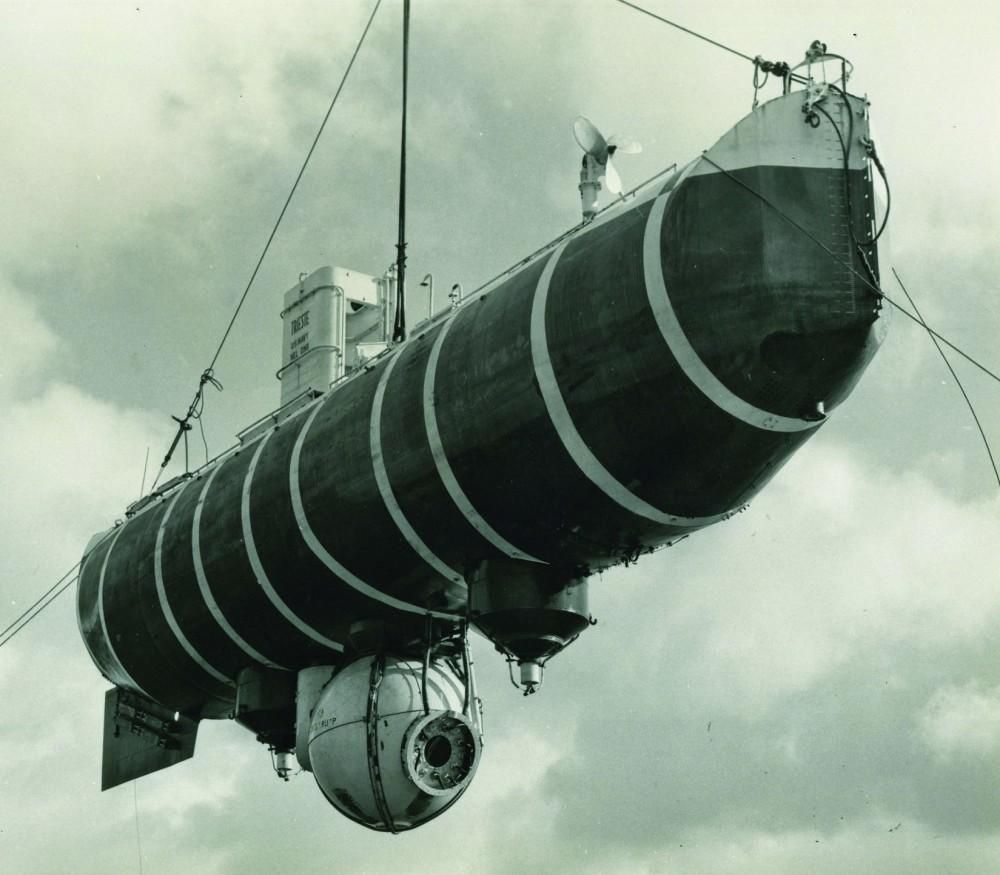
I don't see the porthole as that big an issue on its own. Even the bathyscaphe, Trieste had one back in the 60's and it went to the bottom of the Mariana trench.

image.jpg


It worked on the principle of a helium balloon. The big hull was filled with avgas that is lighter than water and incompressible. There were two lead shot tanks and two ballast tanks that you used to keep it at a certain depth. The two-man sphere on the bottom was where things were controlled from. Being a sphere, it was going to be the strongest shape possible.
 
Back
Top