Iran’s foreign minister’s regional trip to three destinations—
Islamabad, Muscat, and Moscow—took place at a time when each of these capitals plays an important role in current developments, from mediating talks between Iran and the United States to serving as Tehran’s strategic partners.
The visit came as the political and media atmosphere was heavily shaped by claims and narratives promoted by the U.S. president—an environment that appeared less a reflection of reality than a form of calculated propaganda. Nevertheless, Iran entered these consultations with a measured approach grounded in clearly defined principles.
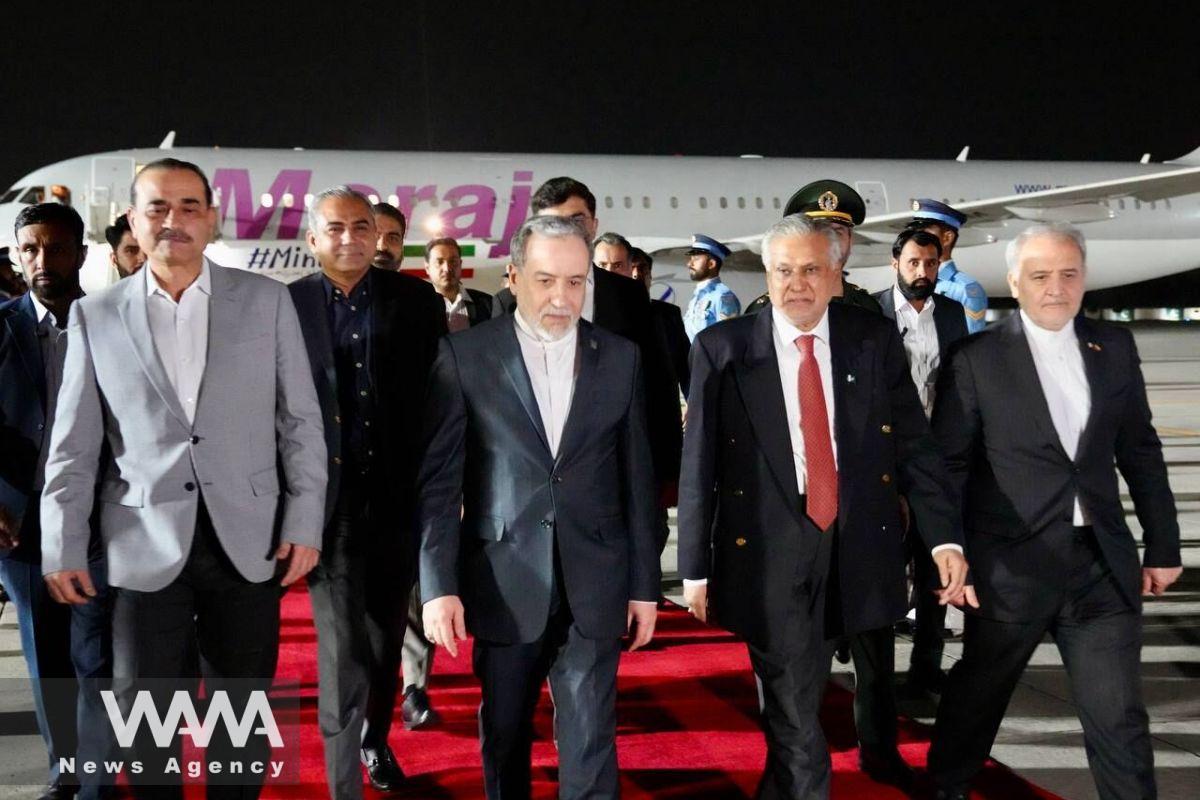
Late Friday evening, Iran’s foreign minister departed Tehran for Pakistan and arrived in Islamabad hours later at the head of a political delegation. Upon arrival, he was welcomed by senior Pakistani officials.
The purpose of the trip was described as strengthening bilateral coordination and consulting on regional developments. During the visit, meetings were held with top Pakistani officials, including the prime minister, while Islamabad’s role in mediation efforts and attempts to reduce tensions was acknowledged and appreciated.
Araghchi’s Trip to Pakistan on Apr 24, 2026. Social media/ WANA News Agency
From Tehran’s perspective, the outcome of this short but intensive trip was considered positive. Iran’s foreign minister described Pakistan as a country whose brotherly efforts to restore peace to the region carry significant importance.
He also outlined a practical and workable framework for permanently ending the war against Iran, while raising the question of whether the United States genuinely possesses the will to advance the diplomatic track.
With this stage completed, the foreign minister traveled on to Muscat. The move coincided with new claims by the U.S. president, including an announcement that envoys’ visits to Pakistan had been canceled—even though no official or confirmed trip had ever been announced in the first place. These assertions, made as the Iranian delegation arrived in Oman, were accompanied by a new wave of statements that once again dominated media coverage.
In Muscat, a meeting with the Sultan of Oman topped the agenda. During the talks, appreciation was expressed for Oman’s constructive role in supporting diplomatic efforts, while the country’s responsible approach to regional developments was also praised.
At the same time, the presence of U.S. forces in the region was criticized as a source of insecurity and widening divisions. According to prior planning, Moscow was the next destination of the trip, although additional consultations in
Islamabad were expected beforehand in order to receive Washington’s views on Iran’s declared positions.
Meanwhile, what drew even more attention than the diplomatic activity itself was the broad wave of media speculation surrounding the negotiations. From the earliest days after the ceasefire announcement, reports circulated in media outlets and on social networks about visits by American representatives to Pakistan. Some reports even included supposed flight details and the presence of specific figures.
Yet by the time talks officially began, no U.S. delegation had actually arrived in Islamabad. The pattern continued in the following days and was repeatedly amplified by various media outlets and even by the U.S. president himself.
In the latest example, although no concrete plan existed for meetings between Iranian and American officials, details of possible travel by certain U.S. figures were repeatedly reported.
Later, the U.S. president claimed that a trip had been canceled—a trip for which no plan had ever been officially announced. He also asserted that Iran’s initial proposal in negotiations had been unacceptable, but that Tehran revised it after the cancellation. Such claims fit the same recurring pattern of narrative management.
This style of storytelling had already been visible during earlier military developments—from claims of destroying Iran’s defense systems to assertions of controlling the Strait of Hormuz, even as field reports and international accounts presented a different picture.
The repetition of contradictory claims in recent weeks has raised a serious question:
are these statements part of a deliberate strategy, or evidence of confusion in decision-making and communication?
In this environment, public messaging about negotiations has also been distorted. Focus has shifted away from core issues—such as the content of agreements and proposals from both sides—to side stories like travel schedules or the composition of delegations.
This diversion does not enhance transparency; instead, it deepens complexity and uncertainty in the diplomatic arena, making it harder even for many countries to predict U.S. behavior and decisions.
By contrast, Iran’s position has remained steady and based on its declared principles. From Tehran’s perspective, the ceasefire that began on April 8 must lead to a definitive and lasting end to the war, rather than becoming an exhausting cycle of war, ceasefire, and negotiations.
In Iran’s view, the experience of recent weeks has shown that the country has not been weakened by pressure, but has instead projected a different image of its capabilities and standing.
Accordingly, Iran has repeatedly stressed that its purpose in negotiations is to achieve a logical and durable agreement—not to accept conditions based on coercion or imposed pressure. At the same time, escalating threats and the beginning of a naval siege, coinciding with Iran’s firm positions, have created serious obstacles for the talks.
Under these circumstances, Washington proposed an unlimited ceasefire while maintaining pressure—a formula that Tehran does not regard as a viable basis for constructive dialogue.
Iran has made continued negotiations conditional on the cessation of threats and the lifting of the siege, and this position has been conveyed to mediators through diplomatic channels. It has been emphasized that as long as hostile measures continue, rebuilding trust and making progress through dialogue will remain extremely limited.
Ultimately, one clear reality emerges from these developments: diplomacy cannot be advanced through media propaganda. The wider the gap between reality and narrative becomes, the smaller the chance of reaching an agreement.
Negotiation requires consistency in decision-making, honesty in words, and transparency in action—elements without which even the busiest diplomatic shuttle efforts will fail to produce a lasting result.