No-nonsense judge makes example of gun-wielding teenager who attacked convenience store clerk during holdup

Prove it.
Simple logic proves it.

The stats only list the race of the victim and homicides per 100,000 in that race. That means that the perpetrator could be any race since there is no mention of the race of the perpetrator. Therefore, based on the lack of evidence in this, it is possible that all murders of blacks were committed by whites.

Do you understand simple logic?
 
Simple logic proves it.

The stats only list the race of the victim and homicides per 100,000 in that race. That means that the perpetrator could be any race since there is no mention of the race of the perpetrator. Therefore, based on the lack of evidence in this, it is possible that all murders of blacks were committed by whites.

Do you understand simple logic?
1773956645622.png

1773957116884.png


Blacks are just 13% of the population
 
Last edited:
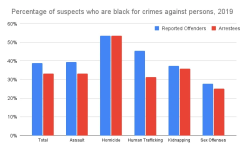
  • The dashboard compares the race of 16,724 homicide offenders and 16,447 homicide victims.
  • For offenders, "Black or African American" individuals represent 52% of the data, while "White" individuals account for 34%.
 
I understand logic, I just don't accept "because @Poor Richard Saunders said so" as proof.

As it happens, you were right. I performed an image search and read the source material, which I can cite: https://www.researchgate.net/figure...-by-Race-and-Ethnicity-Age-and_fig2_389399990

How come you didn't?

If you're going to make claims, back 'em up.
I did. It seems you don't understand what pulling one graph out means when it comes to logic and support for one's position.
 
So you say. Prove it.


I'll be happy to.
  • Saying something is simply the act of making an assertion or claim (uttering or writing a statement). It requires no evidence, verification, or logical support—it can be true, false, mistaken, or even fabricated. For example, anyone can say “The Earth is flat” or “I am innocent” without any basis.
  • Proving something requires demonstrating the truth of that claim through evidence, reasoning, data, or repeatable verification that meets an objective standard (e.g., logical deduction, empirical data, or legal burden of proof). It is an additional, distinct process that the mere assertion does not fulfill.
If saying and proving were the same act, then every uttered statement would automatically constitute proof, meaning contradictions could not exist (e.g., both “The sky is blue” and “The sky is green” would be simultaneously proven true). This violates the law of non-contradiction and leads to absurdity. Therefore, by reductio ad absurdum, the two are necessarily distinct.

This everyday distinction is explicitly recognized in public discourse. A verifiable historical source is the April 17, 1992 Chicago Tribune article “Daley Aide Reyes Denies Tunnel Responsibility,” in which Chicago General Services Commissioner Benjamin Reyes stated verbatim:
”But saying something and proving it are two different things.”

Full article (publicly archived and verifiable): https://www.chicagotribune.com/1992/04/17/daley-aide-reyes-denies-tunnel-responsibility/

The quote appears in the context of Reyes denying personal responsibility for a city tunnel flood scandal, underscoring that accusations (mere statements) do not equal substantiated proof. This usage confirms the phrase as a standard acknowledgment of the logical gap between assertion and demonstration.
 
Back
Top