Althea
Althea told me...
Natural selectionBe careful putting your saw to a dead standing tree. The tops/dead limbs have been know to drop of them.
We call them widow makers here.
Natural selectionBe careful putting your saw to a dead standing tree. The tops/dead limbs have been know to drop of them.
We call them widow makers here.
Yea...Ash/most oak is a breeze. We have those rock maple with grain that grows in a spiral. Of course, getting wood from a dense forest typically offers tall straight trees. Sadly...a lot of my wood comes from places with trees that are twisted.I have a 27 ton and it rips through hickory which can be the knottiest pain in the ass.
Using a maul and hammer is good for maple and oak. Hands down a splitter is the way to go
This is from the pellet fuel industry, which might be at the opposite end of the spectrum where I'm sure you will go for info.
Somewhere in the middle lies the truth. Or perhaps you're talking about Europe?
http://www.woodpellets.com/heating-fuels/pellet-sources.aspx

As opposed to what you posted?
WTF??? ... there is no percentage listed at that site. No wonder you wouldn't post the pertinent figures HERE![]()
As opposed to what you posted?
It's been so cold here, I had to put a heat gun on my propane regulator. Must have been a little moisture from the summer in there. My water heater kept needing re lighting, and my stove would go out while I was making coffee in the morning.Well, for the lower part of the country, hopefully. We live in the UP on the shores of Lake Superior.
You claimed that 35% was coming from recycled wood. Show me where you got that number. Pellet manufacturers WANT sawdust...not trees.Go ahead ... post your numbers.
Here is a prime example of classic greenwash in action, I really do not understand how this is even allowed to happen.
A loophole in carbon-accounting rules is spurring a boom in burning wood pellets in European power plants. The result has been a surge in logging, particularly in the U.S. South, and new doubts about whether Europe can meet its commitments under the Paris accord.
It was once one of Europe’s largest coal-burning power stations. Now, after replacing coal in its boilers with wood pellets shipped from the U.S. South, the Drax Power Station in Britain claims to be the largest carbon-saving project in Europe. About 23 million tons of carbon dioxide goes up its stacks each year. But because new trees will be planted in the cut forests, the company says the Drax plant is carbon-neutral.
There is one problem. Ecologists say that the claims of carbon neutrality, which are accepted by the European Union and the British government, do not stand up to scrutiny. The forests of North Carolina, Louisiana, and Mississippi — as well as those in Europe — are being destroyed to sustain a European fantasy about renewable energy. And with many power plants in Europe and elsewhere starting to replace coal with wood, the question of who is right is becoming ever more important.
Since 2009, the 28 nations of the European Union have embarked on a dramatic switch to generating power from renewable energy. While most of the good-news headlines have been about the rise of wind and solar, much of the new “green” power has actually come from burning wood in converted coal power stations. Wood burning is booming from Britain to Romania. Much of the timber is sourced locally, which is raising serious concerns among European environmentalists about whether every tree cut down for burning is truly replaced by a new one. But Drax’s giant wood-burning boilers are fueled almost entirely by 6.5 million tons of wood pellets shipped annually across the Atlantic.
Some 200 scientists wrote to the EU insisting that “bioenergy is not carbon-neutral” and calling for tighter rules to protect forests and their carbon. In September, some 200 scientists wrote to the EU insisting that “bio-energy [from forest biomass] is not carbon-neutral” and calling for tighter rules to protect forests and their carbon. Yet just a month later, EU ministers rubber-stamped the existing carbon accounting rules, reaffirming that the burning of wood pellets is renewable energy.
Under the terms of both the UN Paris climate agreement and Europe’s internal rules, carbon losses from forests supplying power stations should be declared as changes to the carbon storage capacity of forest landscapes. But such changes are seldom reported in national inventories. And there is no system either within the EU or at the UN for reporting actual changes in carbon stocks on land, so the carbon is not accounted for at either end — when trees are cut, or when the wood is burned.
Wood burning is turning into a major loophole in controlling carbon emissions. The U.S. could be the next country to take advantage. A federal spending bill that passed the House of Representatives earlier this year directed the Environmental Protection Agency to establish policies “that reflect the carbon neutrality of biomass” and to “encourage private investment throughout the forest biomass supply chain,” paving the way for a boom in American pellet burning.
![]()
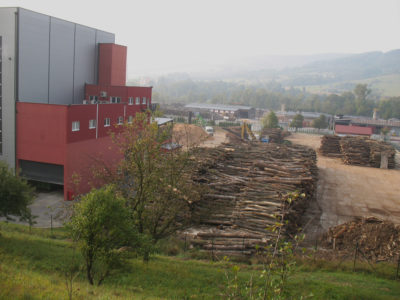
Logs await processing at a wood pellet plant in Bardejov, Slovakia. An estimated 10 million cubic meters of wood is logged each year from the country's forests.
http://e360.yale.edu/features/carbon-loophole-why-is-wood-burning-counted-as-green-energy
And the U.S.’s own CO2 emissions could resume their upward path even quicker than President Donald Trump intends.
It's writing like this that causes me to question the author's agenda:
It makes next to no sense to log a tree, turn it into pellets, ship it across the Atlantic and burn it to make electricity. The amount of energy consumed in each step has to be more than is produced at the end plant. I question that this is actually occuring.
It's writing like this that causes me to question the author's agenda:
It makes next to no sense to log a tree, turn it into pellets, ship it across the Atlantic and burn it to make electricity. The amount of energy consumed in each step has to be more than is produced at the end plant. I question that this is actually occuring.
I don't understand you, this is exactly what is happening. Drax power station has converted over to 50% wood pellets. However they now seem to have cold feet and are looking into using gas for the remaining 50%.It's writing like this that causes me to question the author's agenda:
It makes next to no sense to log a tree, turn it into pellets, ship it across the Atlantic and burn it to make electricity. The amount of energy consumed in each step has to be more than is produced at the end plant. I question that this is actually occuring.
It's been so cold here, I had to put a heat gun on my propane regulator. Must have been a little moisture from the summer in there. My water heater kept needing re lighting, and my stove would go out while I was making coffee in the morning.
It's all great now!
Be careful putting your saw to a dead standing tree. The tops/dead limbs have been know to drop of them.
We call them widow makers here.
You claimed that 35% was coming from recycled wood. Show me where you got that number. Pellet manufacturers WANT sawdust...not trees.
Yea...Ash/most oak is a breeze. We have those rock maple with grain that grows in a spiral. Of course, getting wood from a dense forest typically offers tall straight trees. Sadly...a lot of my wood comes from places with trees that are twisted.
Now that I have the splitter...I don't care! When I lived in Vt. there was still some elm alive. That was the worst to split.
I don't understand you, this is exactly what is happening. Drax power station has converted over to 50% wood pellets. However they now seem to have cold feet and are looking into using gas for the remaining 50%.
Sent from my Lenovo K8 using Tapatalk
Not much different from coal.
We are subsidising those pellet imports to the tune of £1.5 million per day at Drax power station, it is the economics of the madhouse. Drax is the biggest biomass power station in the world.
Sent from my Lenovo K8 using Tapatalk

That's a huge gov't subsidy ... and that's just one plant![]()
This has been the news for a long time now. If you don't believe me then maybe you will believe the Drax website. By the way, the power station is not very far from me and I've seen the huge silos that were constructed to hold the woodchips.Don't you realize how much fakenews is out there nowadays? This doesn't make sense economically, so the article doesn't pass the stink test.