What god did Einstein believe in?

Cypress

Well-known member

What god did Einstein believe in, anyway?​

Einstein “was a pantheist who maintained certain Jewish traditions,” and he preferred to be called an agnostic and disliked militant atheists.
"I want to know God’s thoughts,” Albert Einstein once said. “The rest are mere details.” True quote. But what did Einstein mean by “God”?​

He was raised a Jew, and likely believed in the God of Abraham . . . at least for a while. So folk like to claim him as one of their “own.” But then, so do atheists.

In truth, Einstein was likely at neither extreme, according to this new article at Big Think. The article cites a 1936 letter a sixth-grade girl wrote to Einstein, asking, “Do scientists pray, and what do they pray for?”

In his reply, Einstein wrote, “Everyone who is seriously involved in the pursuit of science becomes convinced that some spirit is manifest in the laws of the universe, one that is vastly superior to that of man. In this way the pursuit of science leads to a religious feeling of a special sort, which is surely quite different from the religiosity of someone more naive.”

Scholars generally agree that the theoretical physicist was an actual pantheist, believing that God is “in everything,” or that all is “at one with God.” In particular, as Einstein once told a rabbi, “I believe in Spinoza’s God, who reveals himself in the harmony of all that exists, not in a God who concerns himself with the fate and the doings of mankind.”

Big Think concludes that Einstein “was a pantheist who maintained certain Jewish traditions,” and that he “preferred to be called an agnostic and disliked militant atheists.

 
...Scholars generally agree that the theoretical physicist was an actual pantheist, believing that God is “in everything,” or that all is “at one with God.” In particular, as Einstein once told a rabbi, “I believe in Spinoza’s God, who reveals himself in the harmony of all that exists, not in a God who concerns himself with the fate and the doings of mankind.”

Big Think concludes that Einstein “was a pantheist who maintained certain Jewish traditions,” and that he “preferred to be called an agnostic and disliked militant atheists.


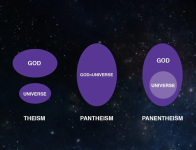
Spinoza's God is logical, fitting for a person like Einstein. Panentheism might be a better belief.

Throughout the history of philosophy, many theorists have attempted to explain the meaning and cause of people’s sorrows. One philosopher, Spinoza, claimed that everything ultimately follows from God and that sadness is a person’s passage from a greater degree of perfection to a lesser one. 1 Contrastingly, Spinoza goes on to state that though everything ultimately derives from God, he/she cannot be the cause of sadness since he/she is perfect. 2 Despite what appears to be an incongruent argument, can one still find a way to claim that Spinoza is consistent when he states that all things ultimately derive from God’s flawlessness, despite the reality of sadness?

1769262941942.png
 
Spinoza's God is logical, fitting for a person like Einstein. Panentheism might be a better belief.

Throughout the history of philosophy, many theorists have attempted to explain the meaning and cause of people’s sorrows. One philosopher, Spinoza, claimed that everything ultimately follows from God and that sadness is a person’s passage from a greater degree of perfection to a lesser one. 1 Contrastingly, Spinoza goes on to state that though everything ultimately derives from God, he/she cannot be the cause of sadness since he/she is perfect. 2 Despite what appears to be an incongruent argument, can one still find a way to claim that Spinoza is consistent when he states that all things ultimately derive from God’s flawlessness, despite the reality of sadness?

View attachment 71854
Agree that pantheism is rational.

I don't know how you explain a mathematically rational, lawfully organized, intelligible universe by pointing to random chance.

Einstein's comment was interesting that anyone who seriously practices science is convinced that some spirit or rational agency that's superior to humans manifests itself in the laws of nature.
The professional militant new atheists by and large are not scientists. Except for Dawkins, who is only a zoologist and doesn't really have a grip on physics or the hard physical sciences.
 

What god did Einstein believe in, anyway?​

Einstein “was a pantheist who maintained certain Jewish traditions,” and he preferred to be called an agnostic and disliked militant atheists.
"I want to know God’s thoughts,” Albert Einstein once said. “The rest are mere details.” True quote. But what did Einstein mean by “God”?​

He was raised a Jew, and likely believed in the God of Abraham . . . at least for a while. So folk like to claim him as one of their “own.” But then, so do atheists.

In truth, Einstein was likely at neither extreme, according to this new article at Big Think. The article cites a 1936 letter a sixth-grade girl wrote to Einstein, asking, “Do scientists pray, and what do they pray for?”

In his reply, Einstein wrote, “Everyone who is seriously involved in the pursuit of science becomes convinced that some spirit is manifest in the laws of the universe, one that is vastly superior to that of man. In this way the pursuit of science leads to a religious feeling of a special sort, which is surely quite different from the religiosity of someone more naive.”

Scholars generally agree that the theoretical physicist was an actual pantheist, believing that God is “in everything,” or that all is “at one with God.” In particular, as Einstein once told a rabbi, “I believe in Spinoza’s God, who reveals himself in the harmony of all that exists, not in a God who concerns himself with the fate and the doings of mankind.”

Big Think concludes that Einstein “was a pantheist who maintained certain Jewish traditions,” and that he “preferred to be called an agnostic and disliked militant atheists.


right.

he probably evaluated religions by bureacracy quality like you, dipshit.
 
It was, of course, a lie what you read about my religious convictions, a lie which is being systematically repeated. I do not believe in a personal God and I have never denied this but have expressed it clearly. If something is in me which can be called religious then it is the unbounded admiration for the structure of the world so far as our science can reveal it.
-- Albert Einstein, 1954, from Albert Einstein: The Human Side, edited by Helen Dukas and Banesh Hoffman, Princeton University Press

“My position concerning God is that of an agnostic. I am convinced that a vivid consciousness of the primary importance of moral principles for the betterment and ennoblement of life does not need the idea of a law-giver, especially a law-giver who works on the basis of reward and punishment.”

Albert Einstein in a letter to M. Berkowitz, October 25, 1950; Einstein Archive 59-215; from Alice Calaprice, ed., The Expanded Quotable Einstein, Princeton, New Jersey: Princeton University Press, 2000, p. 216.
 
It was, of course, a lie what you read about my religious convictions, a lie which is being systematically repeated. I do not believe in a personal God and I have never denied this but have expressed it clearly. If something is in me which can be called religious then it is the unbounded admiration for the structure of the world so far as our science can reveal it.
-- Albert Einstein, 1954, from Albert Einstein: The Human Side, edited by Helen Dukas and Banesh Hoffman, Princeton University Press

“My position concerning God is that of an agnostic. I am convinced that a vivid consciousness of the primary importance of moral principles for the betterment and ennoblement of life does not need the idea of a law-giver, especially a law-giver who works on the basis of reward and punishment.”

Albert Einstein in a letter to M. Berkowitz, October 25, 1950; Einstein Archive 59-215; from Alice Calaprice, ed., The Expanded Quotable Einstein, Princeton, New Jersey: Princeton University Press, 2000, p. 216.
stfu, idiot.

masonic bullshit.
 

What god did Einstein believe in, anyway?​

Einstein “was a pantheist who maintained certain Jewish traditions,” and he preferred to be called an agnostic and disliked militant atheists.
"I want to know God’s thoughts,” Albert Einstein once said. “The rest are mere details.” True quote. But what did Einstein mean by “God”?​

He was raised a Jew, and likely believed in the God of Abraham . . . at least for a while. So folk like to claim him as one of their “own.” But then, so do atheists.

In truth, Einstein was likely at neither extreme, according to this new article at Big Think. The article cites a 1936 letter a sixth-grade girl wrote to Einstein, asking, “Do scientists pray, and what do they pray for?”

In his reply, Einstein wrote, “Everyone who is seriously involved in the pursuit of science becomes convinced that some spirit is manifest in the laws of the universe, one that is vastly superior to that of man. In this way the pursuit of science leads to a religious feeling of a special sort, which is surely quite different from the religiosity of someone more naive.”

Scholars generally agree that the theoretical physicist was an actual pantheist, believing that God is “in everything,” or that all is “at one with God.” In particular, as Einstein once told a rabbi, “I believe in Spinoza’s God, who reveals himself in the harmony of all that exists, not in a God who concerns himself with the fate and the doings of mankind.”

Big Think concludes that Einstein “was a pantheist who maintained certain Jewish traditions,” and that he “preferred to be called an agnostic and disliked militant atheists.


YHWH! First and foremost Einstein was a Jew.
 
Agree that pantheism is rational.

I don't know how you explain a mathematically rational, lawfully organized, intelligible universe by pointing to random chance.

Einstein's comment was interesting that anyone who seriously practices science is convinced that some spirit or rational agency that's superior to humans manifests itself in the laws of nature.
The professional militant new atheists by and large are not scientists. Except for Dawkins, who is only a zoologist and doesn't really have a grip on physics or the hard physical sciences.
Einstein was smart enough to recognize that the Universe is rational; logical and explainable. It's simply a matter of working out the math. The Grand Unified Theory (GUT) sought to do just that.

It's just one small step from there to understand that everything with an inside has an outside. Hence, Panentheism over Pantheism.

Grand Unified Theories (GUTs) are theoretical frameworks that aim to unify the three gauge groups of the standard model and reduce the number of representations needed, consolidating fundamental particles into fewer categories. An example is the Pati-Salam GUT, which organizes all five standard model representations into two representations based on handedness.
 
Agree that pantheism is rational.

I don't know how you explain a mathematically rational, lawfully organized, intelligible universe by pointing to random chance.

Einstein's comment was interesting that anyone who seriously practices science is convinced that some spirit or rational agency that's superior to humans manifests itself in the laws of nature.
The professional militant new atheists by and large are not scientists. Except for Dawkins, who is only a zoologist and doesn't really have a grip on physics or the hard physical sciences.
pantheism is rational, but morality isn't .

your brain is cooked and you're a complete idiot.


so fucking dumb.

:truestory:
 
Einstein was smart enough to recognize that the Universe is rational; logical and explainable. It's simply a matter of working out the math. The Grand Unified Theory (GUT) sought to do just that.

It's just one small step from there to understand that everything with an inside has an outside. Hence, Panentheism over Pantheism.

Grand Unified Theories (GUTs) are theoretical frameworks that aim to unify the three gauge groups of the standard model and reduce the number of representations needed, consolidating fundamental particles into fewer categories. An example is the Pati-Salam GUT, which organizes all five standard model representations into two representations based on handedness.
^^ A good logical inference to the best explanation.

Technically, GUT doesn't incorporate gravity. That's the next step, a Theory of Everything.

As for panentheism, I don't have any problem with an abstract immaterial reality that transcends time, space, and matter.
We can already demonstrate such realities exist.
 
Last edited:
^^ A good logical inference to the best explanation.

Technically, GUT doesn't incorporate gravity. That's the next step, a Theory of Everything.

As for panentheism, I don't have any problem with an abstract immaterial reality that transcends time, space, and matter.
We can already demonstrate such realities exist.
Agreed on the difference between a universe we can prove and others that are theoretical.

The logic I go with is threefold:
1. Everything with an inside has an outside.
2. The Universe had a specific origin and all current evidence points to a definite end, the Big Chill, not an oscillating universe.
3. Like finding a weed in one's yard or a cockroach in a restaurant, despite the factual evidence, or lack thereof, there's no reason to believe there's only one.
 
Agreed on the difference between a universe we can prove and others that are theoretical.

The logic I go with is threefold:
1. Everything with an inside has an outside.
2. The Universe had a specific origin and all current evidence points to a definite end, the Big Chill, not an oscillating universe.

no it doesn't.

got a link?
3. Like finding a weed in one's yard or a cockroach in a restaurant, despite the factual evidence, or lack thereof, there's no reason to believe there's only one.
 
Back
Top