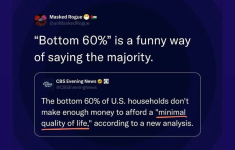
Media and Leftists conclusion: Trump created an affordability crisis

You asked whether corporations took advantage of inflation and continued raising prices even after supply chains normalized. The evidence from multiple sectors indicates that this did happen to a measurable degree. During 2021–2023, companies in energy, food processing, transportation, and consumer goods publicly reported record margins at the same time that their input costs were stabilizing. Federal Reserve analyses, Census Bureau profit data, and industry earnings reports all showed that a portion of price growth came not from ongoing supply shocks, but from firms maintaining higher markups once consumers had accepted the elevated price levels created during the disruption period.

This does not replace the structural causes I already described—pandemic shutdown effects, supply chain failures, stimulus-driven demand, and the global energy shock from the Ukraine war. Those were the primary drivers of the initial surge. But after those pressures eased, parts of the corporate sector kept prices higher than pre-pandemic cost structures alone would justify. That behavior has been documented in official economic data and does not depend on partisan interpretation.

My earlier explanation was about why the inflation peak occurred when it did. This answer addresses your follow-up question about corporate behavior afterward. The two points are consistent.
I understand, and agree with your original post. You are far more patient than I when it comes to spending keystrokes in an attempt to explain the obvious to those who refuse to admit it.

But in the midst of rising inflation, it gives one pause when the corporations crying so much about costs are doing share buybacks and enjoying record profits.
 
trump's inflation was over 3 percent last month. He has ended reporting, so we will not have monthly reports of his incompetence. He was told tariffs are inflationary. He does not care.

Investors are keenly interested in this economic marker. What non-governmental entities track inflation, do you know?
 
I understand, and agree with your original post. You are far more patient than I when it comes to spending keystrokes in an attempt to explain the obvious to those who refuse to admit it.

But in the midst of rising inflation, it gives one pause when the corporations crying so much about costs are doing share buybacks and enjoying record profits.
Yep, I see that. Executive compensation, private jets, luxury homes, and shareholder payouts keep rising while ordinary households are struggling to cover mortgages, rent, utilities, groceries, school costs, and basic living expenses. That contrast is not just emotional; it reflects a widening structural gap in how gains are distributed in the post-pandemic economy. The same years that produced record corporate profits also produced the highest household cost pressures in decades, and those pressures fell hardest on the people with the least margin to absorb them.

Executives benefit through stock-based compensation that rises with profits, buybacks, and elevated margins, while workers and consumers experience those margins as persistent price burdens. That imbalance is a core part of the "affordability" problem. It is a corporate-structure problem, driven by concentrated pricing power and incentives that reward profit expansion regardless of the wider economic impact. At some point, it becomes reasonable to say that sustained markups, record buybacks, and widening profit margins deserve regulatory examination. The question is not partisan; it is about whether the system is producing outcomes that are sustainable for all of us who ultimately bears the cost.
 
Yes, spending is a problem. The Chinese Disease lockdown was kind of unique as an occurrence. Much of the economic loss there was due to the lockdown rather than new spending, or at least as much so.

Biden came into office and rather than show fiscal conservativism, immediately started spending trillions in new borrowing.
Idiot. Stop redacting key issues as you try and rewrite history.
 
Yep, I see that. Executive compensation, private jets, luxury homes, and shareholder payouts keep rising while ordinary households are struggling to cover mortgages, rent, utilities, groceries, school costs, and basic living expenses. That contrast is not just emotional; it reflects a widening structural gap in how gains are distributed in the post-pandemic economy. The same years that produced record corporate profits also produced the highest household cost pressures in decades, and those pressures fell hardest on the people with the least margin to absorb them.

Executives benefit through stock-based compensation that rises with profits, buybacks, and elevated margins, while workers and consumers experience those margins as persistent price burdens. That imbalance is a core part of the "affordability" problem. It is a corporate-structure problem, driven by concentrated pricing power and incentives that reward profit expansion regardless of the wider economic impact. At some point, it becomes reasonable to say that sustained markups, record buybacks, and widening profit margins deserve regulatory examination. The question is not partisan; it is about whether the system is producing outcomes that are sustainable for all of us who ultimately bears the cost.
Sadly, Harris directly addressed this during the campaign. It fell on deaf ears. There are videos/transcripts of CEOs addressing investors where they brag about 'strength of pricing' that will not stop as long as consumers continue to pay the prices.

We can agree that profits are not bad, and CEO perks/compensation is not inherently evil as long as they perform a valuable service for the company.

After decades of record profits, though, there comes a time when we enter the 'price gouging' realm. Especially when nothing matters more than share price. As you stated, there is always a focus by upper echelon mgmt. to inflate share price in order to make their compensation yield much higher. So they charge more for their products, take the profits and buy shares of the company.

Ironically, they negatively affect casual investors as share price drops (sometimes significantly) when they take their long term gains after 366 days.
 
Last edited:
Fuel prices are a world commodity. Presidents do not “jack up” those prices.

What’s messed up is your cognitive skills
MAGAT morons seem to have a lot of difficulty understanding economics, esp. things like oil being a global commodity sold on the global market. It doesn't matter how often that is explained to them; they simply refuse to believe it.

If the #CorruptCarrot has the power to control oil prices, why isn't gasoline cheaper? It's been up and down here, but generally the same as it's been for the last couple of years.
 
Althea, I will disagree with you when I think I am right.

I that this forum is for that.
That's why we come here. However, altering posts in order to change the meaning will earn you a vacation. You aren't disagreeing with me. You are simply altering the gist of my posts because you aren't really serious.

And you lack an understanding of the topic, as seen by one of your earlier comments aimed at me. No worries, your posts are inconsequential to the topic, and will be regarded in the same fashion. There are enough adults participating, and I will just focus on them .
 
Yep, I see that. Executive compensation, private jets, luxury homes, and shareholder payouts keep rising while ordinary households are struggling to cover mortgages, rent, utilities, groceries, school costs, and basic living expenses. That contrast is not just emotional; it reflects a widening structural gap in how gains are distributed in the post-pandemic economy. The same years that produced record corporate profits also produced the highest household cost pressures in decades, and those pressures fell hardest on the people with the least margin to absorb them.

Executives benefit through stock-based compensation that rises with profits, buybacks, and elevated margins, while workers and consumers experience those margins as persistent price burdens. That imbalance is a core part of the "affordability" problem. It is a corporate-structure problem, driven by concentrated pricing power and incentives that reward profit expansion regardless of the wider economic impact. At some point, it becomes reasonable to say that sustained markups, record buybacks, and widening profit margins deserve regulatory examination. The question is not partisan; it is about whether the system is producing outcomes that are sustainable for all of us who ultimately bears the cost.

Good post. And a breath of fresh air around here where simple economics remain a baffling subject to our RW friends. Thanks.
 
Yes, spending is a problem. The Chinese Disease lockdown was kind of unique as an occurrence. Much of the economic loss there was due to the lockdown rather than new spending, or at least as much so.

Biden came into office and rather than show fiscal conservativism, immediately started spending trillions in new borrowing.
If what you meant is simply that the first identified cluster of COVID-19 cases appeared in China, then yes—that is historically accurate. The earliest confirmed reports were from Wuhan in late 2019, and that is where global surveillance first detected the outbreak. If the reference to “the Chinese disease lockdown” is only meant to describe the location of the initial cases, then I understand that point and do not dispute the geography of the first reports.

The clarification I offered is not about disputing where the outbreak was first recognized. It is about avoiding language that unintentionally implies national ownership or responsibility for the virus itself. The scientific and public-health communities have examined the origins extensively, and while some uncertainties remain, several core findings are well established enough to correct the broader misconceptions.

First, there is no verified evidence that the Chinese government engineered, manipulated, or intentionally released the virus. Independent genomic analyses by international virologists show that the structure of SARS-CoV-2 is consistent with natural zoonotic spillover—the same biological pattern seen in SARS, MERS, Ebola, and many other outbreaks. A lab-related accident has been examined because Wuhan hosts a major virology institute, but no credible investigation has found proof of deliberate release or engineered design. Both natural spillover and accidental exposure remain scientifically possible; intentional causation does not.

Second, although the first cases were detected in China, the economic and social damage was global. Europe, the United States, India, Africa, South America, and Asia all experienced shutdowns, supply-chain failures, overwhelmed hospitals, labor disruptions, and domestic policy responses. The economic contraction did not come from China alone; it came from the worldwide spread of a virus through interconnected systems.

Third, pandemics do not have national identities. The 1918 influenza likely originated in Kansas. H1N1 emerged in North America. Ebola outbreaks have begun in multiple African regions. Viruses follow ecological and biological pathways, not political borders. Assigning national labels to global pathogens obscures the real structural vulnerabilities—public-health readiness, supply-chain fragility, and economic exposure—that determine how far and how fast a disease spreads.

So the distinction is simple:
• Yes, the first recorded cases were in China.
• No, the virus is not inherently “Chinese.”
• No, there is no verified evidence of intentional release.
• Yes, the consequences were global and driven by global systems.

Keeping the terminology precise prevents unintended implications and keeps the conversation aligned with what the evidence actually supports.

This leads to the related question raised earlier about why Biden added trillions to the deficit—because the fiscal environment he entered was shaped by that same global chain of events.

According to the non-partisan Committee for a Responsible Federal Budget (CRFB), Biden approved legislation and executive actions with a combined projected cost of roughly $4.7 trillion in new ten-year borrowing during his term. This figure is grounded in recorded legislative scoring, not speculation. The American Rescue Plan alone accounted for approximately $2.06 trillion of that total. Other contributors included the Honoring Our PACT Act, discretionary appropriations, infrastructure legislation, and various supplemental bills. These numbers are all documented in CRFB’s published fiscal analyses.

At the same time, a large share of the fiscal environment Biden inherited came directly from the 2020 pandemic response enacted under the prior administration: roughly $3.5 trillion of emergency spending that carried multi-year obligations forward into 2021 and 2022. Those costs were already baked into the baseline deficit before Biden took office.

In conclusion:
Biden added trillions to the deficit because he approved several major legislative packages—especially the American Rescue Plan—but he also inherited the largest peacetime deficit in U.S. history, driven by emergency pandemic spending and the structural economic damage of the global shutdown. The accurate statement is not that “Biden alone created the deficit,” but that his administration enacted roughly $4.7 trillion in new borrowing on top of an unprecedented fiscal baseline set in motion before he arrived.

This is the factual record, grounded in the public data and the legislative scores that are a matter of record.

This is a situation that Trump, Biden, and now Trump again are inheriting from one another, and it will not end with either of them. The fiscal and economic consequences of the pandemic, the supply-chain collapse, global energy shocks, long-term structural deficits, and the rising cost of an aging population are not the work of a single administration. They will be the responsibility of the next several presidents, regardless of party. This is a hundred-year struggle for stability in a system that has been accumulating structural pressures for decades, and it will take many terms of leadership to square it away. Trump did not ask for the pandemic, but he had to expand the deficit to keep households and businesses afloat. Biden inherited that same emergency baseline and had to operate within it. And the next administrations—Republican or Democratic—will face the same long arc of work, because the problem is larger than any one presidency and larger than any one political moment.
 
Investors are keenly interested in this economic marker. What non-governmental entities track inflation, do you know?
Several non-governmental institutions track inflation because investors rely on independent data to understand price pressures. The Conference Board publishes business and consumer indicators tied to inflation trends. The University of Michigan’s Survey of Consumers provides one of the most influential measures of inflation expectations. The National Bureau of Economic Research produces independent research on price dynamics and long-term inflation patterns. Major financial firms and rating agencies—such as Moody’s Analytics, S&P Global, Goldman Sachs, BlackRock, and JPMorgan—maintain their own inflation models and issue forecasts that markets follow closely. Independent research groups like Oxford Economics, Capital Economics, and Bloomberg Economics also track pricing conditions and release regular inflation analyses.
 
Back
Top