Looks like the writing is on the wall for Tesla

If Tesla collapses, the failure will represent a remarkable destruction of US taxpayer’s funds. In 2015 LA Times reported Tesla had received over $4.6 billion in government subsidies. Public money which could have been spent repairing roads or helping poor people, ended up being used as green corporate welfare for a private company building cars for rich people.

Sent from my Lenovo K8 using Tapatalk
 
What you say is true the only caveat I would point out is research is going to come up with the next newest greatest so watch for that.

Manufacturers are increasing the amount of energy a battery can store by 18% a year. Electric cars are the future. Internal combustion engines are extremely inefficient, cost more to maintain
and pollute the environment. There is no comparison. Internal combustion engines will be obsolete by 2030.
 
Manufacturers are increasing the amount of energy a battery can store by 18% a year. Electric cars are the future. Internal combustion engines are extremely inefficient, cost more to maintain
and pollute the environment. There is no comparison. Internal combustion engines will be obsolete by 2030.
Toyota would disagree with you, hydrogen is the future.

Electric vehicles will impose massive strains on the electricity supply network. In addition, they will never become ubiquitous unless and until battery swapping is a routine procedure. This requires batteries to be standardised across all electric carmakers, globally.

The technology within can be specific but the exterior physical dimensions, electronic connector standardisation, battery electrical output (volts/amps), and safety standards for the external housing construction needs to be common to all. That is not going to happen anytime soon.

https://www.geek.com/news/chief-toyota-engineer-says-electric-cars-are-not-practical-1620539/

Sent from my Lenovo K8 using Tapatalk
 
Toyota would disagree with you, hydrogen is the future.

Electric vehicles will impose massive strains on the electricity supply network. In addition, they will never become ubiquitous unless and until battery swapping is a routine procedure. This requires batteries to be standardised across all electric carmakers, globally.

The technology within can be specific but the exterior physical dimensions, electronic connector standardisation, battery electrical output (volts/amps), and safety standards for the external housing construction needs to be common to all. That is not going to happen anytime soon.

https://www.geek.com/news/chief-toyota-engineer-says-electric-cars-are-not-practical-1620539/

Sent from my Lenovo K8 using Tapatalk

Consumer demand will drive the market. People want electric cars. Battery technology will evolve and accelerate to satisfy the consumer demand.
Hydrogen technology may eventually take hold but car manufacturers have known about hydrogen for years, decades. Why hasn't it become more mainstream?
One reason is because there aren't a lot of Hydrogen fuel stations around. With electric cars, you can charge them in your garage. Therein lies the main difference. Until Hydrogen refueling stations become as ubiquitous as gasoline stations, the hydrogen car as an alternative to electric cars is just a fantasy.

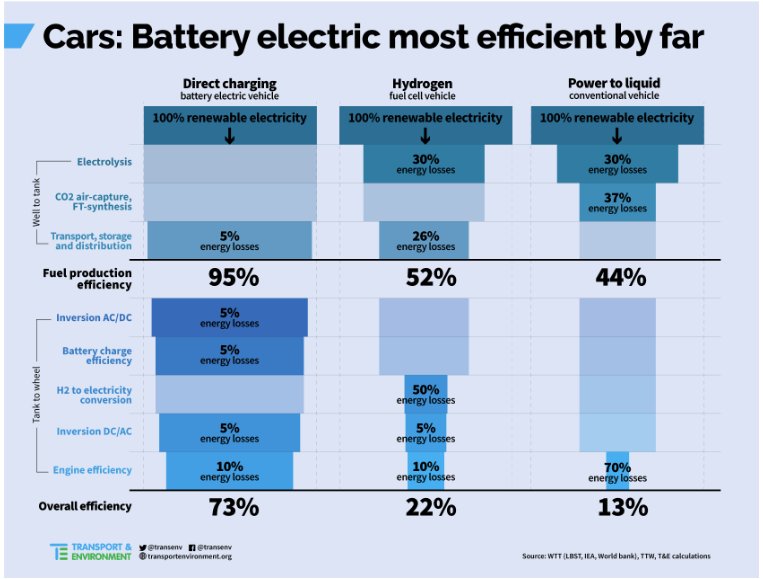
uks-transport-environment-says-that-electric-cars-are-the-most-efficient_100626958_l.jpg
 
Havana poon and his fellow travelers may as well think the earth is flat, sits on elephants sitting on a turtle swimming in an ocean, for fuck sake.
He doesn't respect evidence or science. Climate science doesn't care about his outdated myths. And real scientists don't care either.
Frauds like him and his religious oily blogs of right wing tards can spew falsehoods forever. Knowledge is being increased despite these losers.
 
"A 2008 Technology Review article stated, "Electric cars—and plug-in hybrid cars—have an enormous advantage over hydrogen fuel-cell vehicles in utilizing low-carbon electricity. That is because of the inherent inefficiency of the entire hydrogen fueling process, from generating the hydrogen with that electricity to transporting this diffuse gas long distances, getting the hydrogen in the car, and then running it through a fuel cell—all for the purpose of converting the hydrogen back into electricity to drive the same exact electric motor you'll find in an electric car."[132] Thermodynamically, each additional step in the conversion process decreases the overall efficiency of the process."

A 2008 Technology Review article stated, "Electric cars—and plug-in hybrid cars—have an enormous advantage over hydrogen fuel-cell vehicles in utilizing low-carbon electricity. That is because of the inherent inefficiency of the entire hydrogen fueling process, from generating the hydrogen with that electricity to transporting this diffuse gas long distances, getting the hydrogen in the car, and then running it through a fuel cell—all for the purpose of converting the hydrogen back into electricity to drive the same exact electric motor you'll find in an electric car."[132] Thermodynamically, each additional step in the conversion process decreases the overall efficiency of the process.[133][134]

A 2013 comparison of hydrogen and battery electric vehicles agreed with the 25% figure from Ulf Bossel in 2006 and stated that the cost of an electric vehicle battery "is rapidly coming down, and the gap will widen further", while there is little "existing infrastructure to transport, store and deliver hydrogen to vehicles and would cost billions of dollars to put into place, everyone's household power sockets are "electric vehicle refueling" station and the "cost of electricity (depending on the source) is at least 75% cheaper than hydrogen."[135] In 2013 the National Academy of Sciences[

wiki
 
Manufacturers are increasing the amount of energy a battery can store by 18% a year. Electric cars are the future. Internal combustion engines are extremely inefficient, cost more to maintain
and pollute the environment. There is no comparison. Internal combustion engines will be obsolete by 2030.


You completely missed my point. Obviously internal combustion is going the way of the buggy whip. Batteries of the future may not be based on lithium ion it all is my point. In a few years all of the lithium ion mines would could be closed... Or not.
 
Consumer demand will drive the market. People want electric cars. Battery technology will evolve and accelerate to satisfy the consumer demand.
Hydrogen technology may eventually take hold but car manufacturers have known about hydrogen for years, decades. Why hasn't it become more mainstream?
One reason is because there aren't a lot of Hydrogen fuel stations around. With electric cars, you can charge them in your garage. Therein lies the main difference. Until Hydrogen refueling stations become as ubiquitous as gasoline stations, the hydrogen car as an alternative to electric cars is just a fantasy.

uks-transport-environment-says-that-electric-cars-are-the-most-efficient_100626958_l.jpg
You are not really telling the full story. Compare the weight of a hydrogen fuel cell, typically around 80kg, with a battery module of around 400kg. Electric vehicles have been around for 170 years, so why haven't they take off before now?

I will grant you that hydrogen infrastructure is thin on the ground now but that can, and will, change dramatically. The huge cost of upgrading electricity supply networks to cope with rapid recharging will dawn on people sooner or later. How many people want to wait even 30 minutes to recharge, which could well be a lot more if you include waiting for a charging point to become available.

Sent from my Lenovo K8 using Tapatalk
 
Last edited:
You are not really telling the full story. Compare the weight of a hydrogen fuel cell, typically around 80kg, with a battery module of around 400kg. Electric vehicles have been around for 170 years, so why haven't they take off before now?

I will grant you that hydrogen infrastructure is thin on the ground now but that can, and will, change dramatically. The huge cost of upgrading electricity supply networks to cope with rapid recharging will dawn on people sooner or later. How many people want to wait even 30 minutes to recharge, which could well including waiting for a charging point to become available.

Sent from my Lenovo K8 using Tapatalk

Where did you get your idea that there will be "huge cost of upgrading electricity supply networks to cope with rapid recharging"?
The large majority of people with electric cars will charge them in their garage overnight when electricity demand is at its lowest point.
 
Where did you get your idea that there will be "huge cost of upgrading electricity supply networks to cope with rapid recharging"?
The large majority of people with electric cars will charge them in their garage overnight when electricity demand is at its lowest point.

So what about all those people that do shift work? All those trucks that hit the roads overnight, RVs in the summer months. Americans are not exactly noted for their patience, are they.
 
Last edited:
Okay, now I get it. You're just making shit up. Thanks for the clarification.

Oh dear, whatever floats your boat! I might also point out that lithium ion batteries can lose up to 25% of their charge in cold weather which combined with running the heater results in far less range in winter. I bet the Tesla sales rep doesn't tell you that.

Sent from my Lenovo K8 using Tapatalk
 
Oh dear, whatever floats your boat! I might also point out that lithium ion batteries can lose up to 25% of their charge in cold weather which combined with running the heater results in far less range in winter. I bet the Tesla sales rep doesn't tell you that.

Sent from my Lenovo K8 using Tapatalk

All forms of energy have their shortcomings. Gasoline is extremely flammable and when burned, releases poisonous carbon monoxide. Compressed hydrogen tanks can explode on impact. Oh, the humanity!
Regardless, consumer demand will drive the market and consumers are waiting in line to buy Teslas. I've test driven a Tesla and I've made up my mind that the next car I buy will be a Tesla.
 
All forms of energy have their shortcomings. Gasoline is extremely flammable and when burned, releases poisonous carbon monoxide. Compressed hydrogen tanks can explode on impact. Oh, the humanity!
Regardless, consumer demand will drive the market and consumers are waiting in line to buy Teslas. I've test driven a Tesla and I've made up my mind that the next car I buy will be a Tesla.
OK fair enough, but there is a very good chance that you'll be left with a very expensive dinosaur that nobody wants to buy.

Sent from my Lenovo K8 using Tapatalk
 
All forms of energy have their shortcomings. Gasoline is extremely flammable and when burned, releases poisonous carbon monoxide. Compressed hydrogen tanks can explode on impact. Oh, the humanity!
Regardless, consumer demand will drive the market and consumers are waiting in line to buy Teslas. I've test driven a Tesla and I've made up my mind that the next car I buy will be a Tesla.

Ah yes, and batteries are much safer when involved in auto collisions...gotcha.
 
OK fair enough, but there is a very good chance that you'll be left with a very expensive dinosaur that nobody wants to buy.

Sent from my Lenovo K8 using Tapatalk

Ok, fair enough. Your opinion is duly noted, although methinks it's highly exaggerated and has little connection with reality.
 
Back
Top