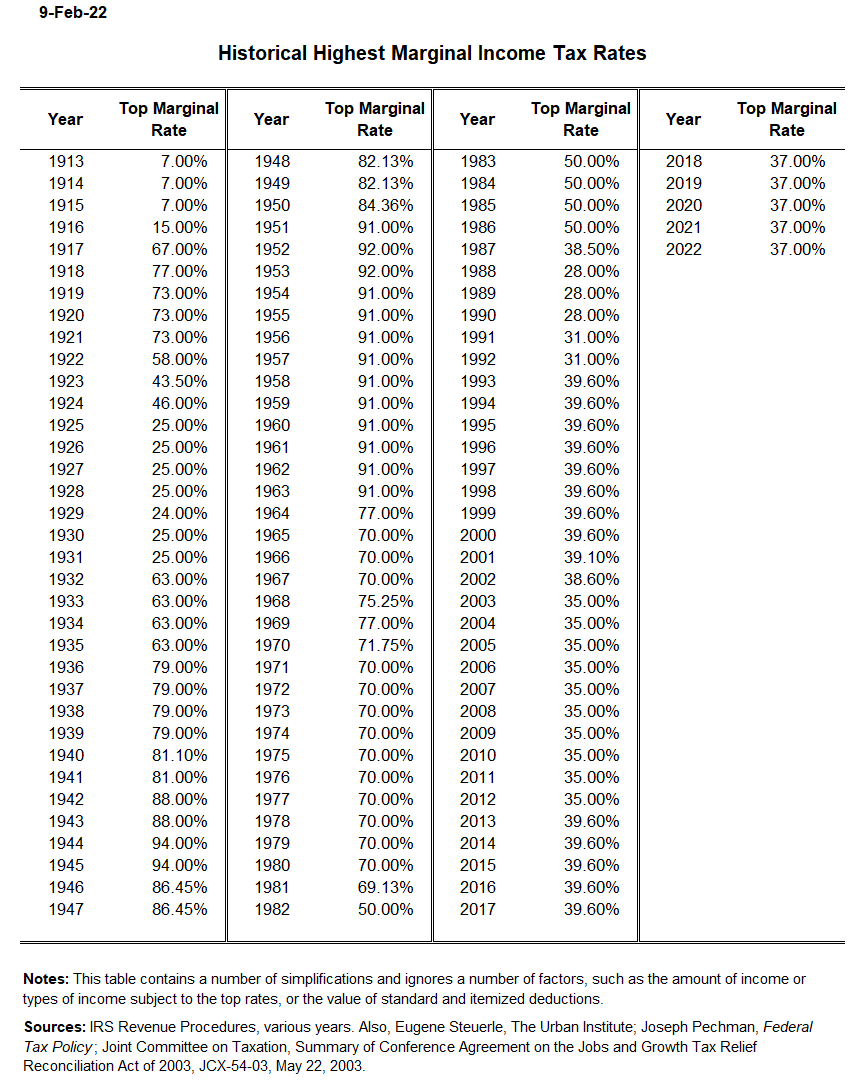
I see you decided to now just ignore the numbers and make up your own version of what they mean.
Individual income taxes made up 50.5% of revenues in 2021. SS and Medicare made up 32.5% of revenues.
https://www.whitehouse.gov/omb/budget/historical-tables/ Table 2.1
Social Security and Medicare do not go into a trustee account. That money has been "loaned" to the general fund for decades. The only way to pay back that loan is with income taxes that contribute to the general fund. Instead, the government has paid back the loan by borrowing.
So which person pays the higher tax rate in this example I gave using the actual tax rates from 2021?
Someone with no wage income making $500,000 on income in Capital gains is paying $70,847 in federal income taxes.
Someone making $250,000 in wages is paying $83,387 in income tax and FICA taxes. ($96,300 if you include the employers FICA.)
While the quintiles with higher incomes pay more as a percentage of their income, it isn't nearly as progressive as you want to make it out to be. The biggest problem is the way the tax code allows the rich to obtain wealth and never have to pay any tax on it at all or very little depending on what the current estate tax is when they die if they haven't used some other tax avoidance scheme.
Then you have to understand that if you are using the numbers from the IRS you are only counting what has been reported to them as income. There are many ways to have money to spend but not have it be income.
If I had purchased $1,000 of Apple stock in 1983 and never sold it, that stock would be worth $1,505,000 today. I would not have paid a single dollar of income tax on that $1.5 million. I can bequeath that stock to my heirs and they won't have to pay a penny of income tax on it since it's value for calculating capital gains when they receive it would be the current value. The 1.5 million would also be well under any estate tax limit. I would be getting about $10,000 a year in income from dividends from that stock but I can easily borrow $50,000 a year against the stock and not have to pay income tax on the money I borrow. Essentially I would have an income of $60,000 per year and owe zero in income tax.
The argument that taxes are paid for by consumers is a lazy argument. One could argue that all taxes are paid by consumers since employees are paid out of what a company gets from consumers. But the consumers can only consume if they are employed and being paid. So it all becomes one big circle that is never ending. Arguing that one part pays for another part ignores that it is a complete circle.