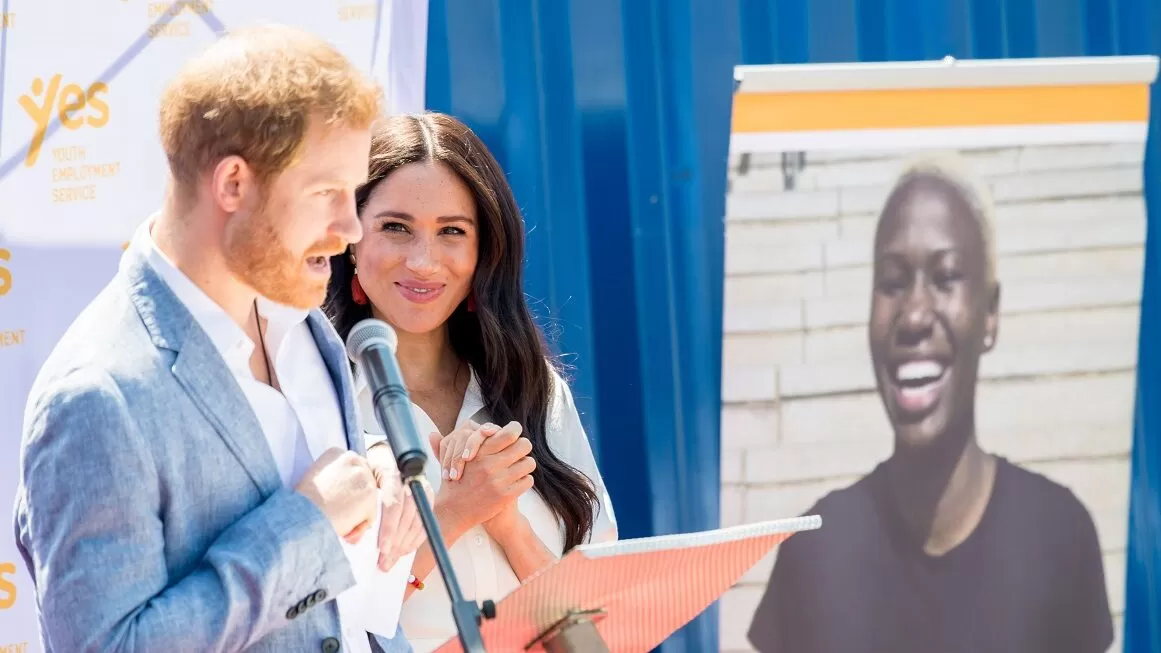
TWO OF THE PEOPLE IN THIS PHOTO ARE WHITE
The appropriate reaction to criticism of constitutionally protected rights by a member of the British royal family is certainly an eye-roll.
After all, we fought a revolution to make sure British aristocrats would no longer have a say over the freedoms Americans exercise, so the reminder that we dodged a bullet on that front is no surprise.
What is concerning, though, is that opposition to free speech is widely shared among people who are in a position to impose the disgruntled prince's vision of good policy on the world at large.
Harry's old-school dismissal of free speech protections finds its echo among equally sniffy modern legal theorists who agree with inconvenienced aristocrats that the First Amendment is a Very Bad Thing and that speech should be subject to greater restrictions.
"Instead of thinking about content moderation through an individualistic lens typical of constitutional jurisprudence, platforms, regulators, and the public at large need to recognize that the First Amendment–inflected approach to online speech governance that dominated the early internet no longer holds," writes Harvard Law School lecturer Evelyn Douek in an April 2021
Columbia Law Review article. "Instead, platforms are now firmly in the business of balancing societal interests and choosing between error costs on a systemic basis."
The catalyst for this shift away from First Amendment-style speech protection by the tech giants was COVID-19, claims the academic, who approves of the transformation.
She sees lasting effects beyond social media. "The state of emergency that platforms invoked during the COVID-19 pandemic is subsiding, and lawmakers are poised to transform the regulatory landscape," Douek adds.
Douek cites a paper by Harvard Law School's Jonathan Zittrain who unintentionally anticipated the impact of COVID-19 when he observed that the treatment of speech is moving to a "public health framework much more geared around risks and benefits than around individual rights."
Among the lawmakers treating speech as a health threat are French President Emmanuel Macron and New Zealand Prime Minister Jacinda Ardern, who have joined together with tech leaders to demand tighter regulation of online speech.
New Zealand's prime minister, in particular, wants digital media companies to implement "ethical algorithms" to steer people away from material of which the authorities disapprove and toward content that they prefer.
"Let's have that conversation around the ethical use of algorithms, and how they can use be used in a positive way and for positive interventions," Ardern told a conference which advocates for greater control over online content.
The European Union has long been on-board with speech controls and had no objection to endorsing the effort.
Over 50 governments and most of the big tech companies have also signed on.
"YouTube is committed," CEO Susan Wojcicki tweeted May 14. "We continue to strengthen our policies, improve transparency, and restrict borderline content."
"The United States endorses the Call to Action to Eliminate Terrorist and Violent Extremist Content Online, formally joining those working together to prevent terrorists and violent extremists from exploiting the Internet," Joe Biden's U.S. State Department announced on May 7.
https://reason.com/2021/05/21/prince-harrys-first-amendment-aversion-is-funny-the-governments-that-agree-are-scary/