Pulic: TESLA WAS NAMED THE CHEAPEST LUXURY CAR BRAND TO MAINTAIN. MAGA WETS PANTIES.

Into the Night

Verified User
Yet another thread started by a lame Democrat that figures you can get away with censorship. Bringing it out for public discussion.

The OP:


Joe Capitalist said:
TESLA WAS NAMED THE CHEAPEST LUXURY CAR BRAND TO MAINTAIN, AND THE INTERNET HAS THOUGHTS: ‘I WILL NEVER OWN A GAS CAR AGAIN’
“I haven’t spent a dime in seven years.”
by Laurelle Stelle*/*March 10, 2023

In a recent study by The Clunker Junker, Tesla vehicles claimed the victory of being the cheapest luxury car brand to maintain.
The outlet looked at data from CarEdge about the 185 most popular models in the U.S., covering the last 10 years up to September 2022. It analyzed each car’s maintenance costs over that time period as a percentage of its purchase price and divided the results into standard and luxury categories.

Tesla’s prices put it in the luxury group, where the company’s rock-bottom maintenance costs won the top spot on the chart — not just among electric vehicles, but among all vehicles in that class.

Tesla’s average maintenance cost was 7.09% of the car’s value, compared to 12.28% for the next best, Lexus. The best individual car was a Tesla Model S at 4.58%, followed by the Model X in second place and the Model 3 in fourth.
This is great news for Tesla buyers, who can expect easy maintenance over their next decade of driving. It’s also good news for reducing pollution in our communities. Because they don’t use gasoline, electric vehicles reduce the need for extensive oil drilling that pollutes nearby water and soil, according to the U.S. Energy Information Administration.
EVs also don’t give off toxic exhaust or heat-trapping gases like combustion engines do, as the EPA notes. This is healthy for our planet and lungs in general, and for the improvement of city air quality in particular, so even the average person on the street will benefit as more drivers switch to EVs.

Obviously, this just more cut and paste from an EV magazine propaganda piece. This kind of cut and pasting is mindless.

Lithium prices are rising. The shortages are already appearing. Worse, the car is totaled even in minor collisions, since the battery pack is damaged and it's too costly to replace it. This is the reason insurance rates for these cars are so high.
EVs also 'pollute' more than the gasoline car, since they use almost twice the energy to charge and drive the EV the same distance as a similar sized gasoline car. Power plants producing this power are generally coal, oil, or natural gas. MORE carbon dioxide is emitted because of the presence of EVs.

Turns out charging them ain't particularly cheap either, not with rising electricity prices. In several places, such as the SDTC (formerly California), power simply isn't available reliably to charge the car. Blackouts are quite commonplace there, due to lack of power generating capacity. They import almost all their power from the WRIC now, and those lines are heavily overloaded.

Oil drilling need not pollute any nearby water or soil. Indeed, once the well is drilled, these pumps quietly work away across the countryside, surrounded by farms and wildlands. Crops grow quite happily right next to them.
 
Electric Car Sales Showed a Massive Spike of 234% on a YoY basis
November 20, 2021
Automobile industry saw a massive spike in sales of electric cars from April 2021 to September 2021. This new record-breaking sale grew by 234 percent on a Year-on-Year (YoY) basis for this year.

Again, Joe here is chanting made up sales figures (using special pleading and just making up numbers), trying to flap his belief in this religion.

Less than 1% of the cars on the road are EVs. There's a reason.
 
Thats so hard to imagine, considering the quality issues Tesla faces, and the large number of recalls. Consumer Reports ranks Tesla near the bottom when it comes to reliability.

Here, floridafan actually brings up a good point. Tesla does issue a lot of recalls. All the EV manufacturers do. Usually it's for some software update or some issue with the various devices like doors, brakes, defects in wiring, etc.

Not much point in issuing a recall for a lithium-oxide battery fire though. Nothing to save.
 
LurchAddams said:
Tesla's in a bit of trouble right now. One of the cars in self-drive just crashed into a fire truck killing a passenger and a several are being recalled due to the steering wheel coming off.
Yeah, there were 2 cases and no accidents. How will they survive?

Nordberg is obviously trying to refer to a crash into a fire truck as 'not an accident'. :rolleyes:
 
Yeah, I'd much rather drive a car that needs motor oil, coolant, AutoTrans fluid and carries over 10 gallons of highly explosive, flammable liquid.

I guess Joe doesn't realize that Tesla cars have motor oil, coolant, various other fluids, and 1000 lbs of highly explosive, flammable solid.
 
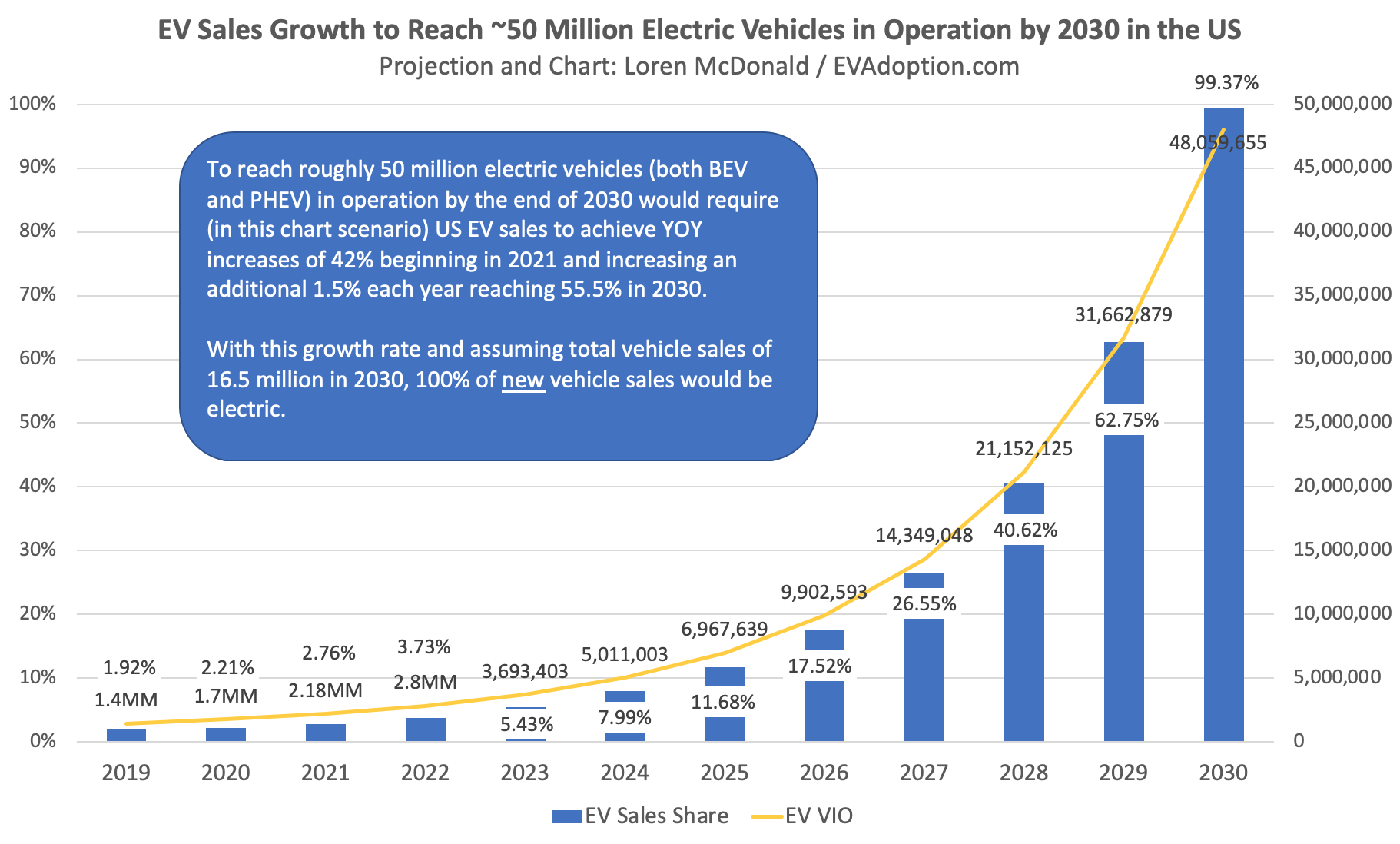
EV-Sales-Growth-to-Reach-50-MM-VIO-by-2030-US.png

Another graph of made up numbers. First, there are NO sales figures for anything past 2022. This graph is pure speculation. It appears from time to time to try to bolster the EV religion. It was originally generated by EV propaganda websites.

Less than 1% of the cars on the road are EVs.
 
The fact remains that electric cars will be cheaper to make, and maintain... Once they are fully developed.

I like this one. EVs have been around since the last 1800's. The lithium ion battery has been around since the mid 80's. I guess they're not fully developed yet! I'm not sure whether he is referring to the long charge times, the heavy weight of these batteries reducing payload capacity, or the high cost of these batteries as being 'improved' (none of them have).

Meanwhile, since the 80's, the gasoline car engine has undergone tremendous changes. FADEC is most commonplace now, thanks to cheap microprocessors. The fuel efficiency of this system, combined with the higher precision of engine components, have done much to make gasoline cars lighter and much more fuel efficient without sacrificing utility. EGR systems have been installed in all cars now, which are the most effective way of reducing NOx gases that is one of the main components of smog. Because of the increased fuel efficiency, unburned fuel or soot going out the tailpipe is not nearly the problem it was, another major component of smog.
 
EVS KEEP GETTING CHEAPER — AND THIS ALL-NEW, SOLAR-POWERED SUV IS PROOF OF IT
This three-row, four-wheel-drive vehicle will feature a solar panel built into the hood.

2023 is the year of the electric vehicle. EVs now make up 10% of all new cars sold worldwide, and recent price drops from Tesla and Ford are only making these cars more appealing.*

https://apple.news/AIVtbwMClR9OJqOU0gGArig

An interesting gimmick from KIA for a 2024 car (not yet built). Charging strictly from solar panels, of course, simply cannot produce sufficient watts to charge an EVE battery in anything less than several days. Perhaps the solar panel will be used to run cabin heat and the lighting system instead?? Maybe provide a very slow trickle charge??
 
I like this one. EVs have been around since the last 1800's. The lithium ion battery has been around since the mid 80's. I guess they're not fully developed yet! I'm not sure whether he is referring to the long charge times, the heavy weight of these batteries reducing payload capacity, or the high cost of these batteries as being 'improved' (none of them have).

Meanwhile, since the 80's, the gasoline car engine has undergone tremendous changes. FADEC is most commonplace now, thanks to cheap microprocessors. The fuel efficiency of this system, combined with the higher precision of engine components, have done much to make gasoline cars lighter and much more fuel efficient without sacrificing utility. EGR systems have been installed in all cars now, which are the most effective way of reducing NOx gases that is one of the main components of smog. Because of the increased fuel efficiency, unburned fuel or soot going out the tailpipe is not nearly the problem it was, another major component of smog.

Maybe he's thinking that some day the batteries will be recyclable and cheaper or something... Not happing with the increased use of fire retardant foam potting in them any time soon...

OIP.kPdW9i0_luisv4USAtHxwgHaEK
 
pretty low bar to surpass.

I remember my dad's dismay when he got the bill to replace the headlight lens on his Caddy that had gotten damaged. This was like 40 years ago so factor in inflation but it was $500.

Luxury cars have always been very expensive to maintain.

I would thank him here. He makes a good point. Headlight lenses on a lot of cars are considered a body part, and you have to get the correct exact year and model for replacing that part.
 
It took you about an hour and a half to make a fool of yourself. Every car has a transmission!
A car cannot run without one, Einstein.

Again, floridafan is correct here. Basically, every car has a transmission, even electric golf carts. Even electric fork lifts. Even diesel-electric locomotives. Even fully electric commuter trains. The only exception I've found is linear motor vehicles (some commuter trains and chainless rollercoasters.
 
And I bet you think Trump won the 2020 election, too.

https://www.cars.com/articles/do-electric-vehicles-have-transmissions-445825/

Do Electric Vehicles Have Transmissions?

As a general rule, electric vehicles don’t have conventional multispeed transmissions as gas-powered cars do, with nearly all having just a single speed. That’s largely because electric motors produce their full power as soon as they start to turn (meaning, from a dead stop) and continue producing it over a wide rev range.
Peak power doesn’t sustain, but motors rev as high as 20,000 rpm in some vehicles. By contrast, gas engines typically top out (aka redline) around 6,000 or 7,000 rpm; have to be “revved up” to make their maximum power; and are most efficient, based on load, within a fairly narrow rev range. They require more than one speed to operate at low and high road speeds, especially with greater efficiency. A multispeed transmission that’s of value in a gas vehicle isn’t normally worth the considerable increase in weight, cost and complexity in an EV, but EVs still have a transmission of sorts.
Even EVs with just one speed still need gears that change the electric motor’s drive-gear ratio and transfer power to a differential, which splits that power between the wheels. Furthermore, they may have a device that locks the gears when Park is engaged. In most EVs, selecting Reverse simply makes the electric motor spin in the opposite direction, so separate gears for that aren’t needed.

While the transmission of an electric car is a fixed gear transmission (simpler than the transmissions of gasoline and diesel cars), the whole thing is really a strawman. Transmissions rarely give trouble, unless you abuse them.
Most EVs don't have a differential. They are not needed, since each traction wheel has it's own drive motor. Everything else just freewheels.

The parking pawl is still applied to the gears in the transmission, even on EVs.

Reverse is usually done electronically with EVs, reversing the phase of the windings. In Teslas, you can hear a typical whine from the motors as they turn against their forward design phase. Windings in a Tesla motor are set to be most efficient at high forward speeds, when back EMF is accounted for (such as sustained highway speed). This physical timing internally in the motor is fixed, and is a bit simpler than the physical timing of a gasoline engine (using a chain or belt).

Timing belts usually need replacing (or at least should be checked) after 100,000 miles. Chains last longer (assuming no defective components) and can often go for as long as 150,000 miles.
Tesla batteries, on the other hand, are guaranteed only to 100,000 miles. Li-ion batteries lose their ability to hold a charge little by little each time they are charged (the initial charge reduces battery capacity by HALF, done at the factory so the user doesn't see it!). After 100,000 miles or so, the battery pack will need to be replaced. This is extremely expensive (much more expensive than replacing a timing chain or belt!), even to the point of effectively totaling the car.

EVs generally have poor resale value with mileage this high due to this reason.
 
You asked me what transmission does my EV have.

As a general rule, electric vehicles don’t have conventional multispeed transmissions as gas-powered cars do

So, tell me, what transmissions do EVs have? Name a couple.
Or just one, if you're so fucking smart (which no one on this forum thinks you are).

A non-answer from you will speak volumes.

BTW, do you believe Trump won the 2020 election?

Once again, A non-answer from you will speak volumes.

Actualy, floridafan (who Joe is responding to) never asked this question. I guess Joe wanted to chant this again, once again denying that EVs have transmissions (they do).

It didn't take long, but once again Trump and the election that never took place in 2020 is mentioned again as a 'conspiracy theory' (the Democrat party is a conspiracy). This is totally unrelated to the conversation, and I see TDS like this brought up more and more as time goes on with a liberal poster. I will call this Night's Law:

The longer a conversation goes on a forum, the greater chance that Trump will be mentioned.

Like Godwin's Law for the mention of Nazis, but for Trump (okay, I hit Godwin's Law here! :D).
 
In the report, Consumer Reports finds that Tesla is the second-worst brand for reliability overall.
https://www.torquenews.com/1083/sec...lete Consumer Reports reliability%2 0surveys.

Consumer Reports Still Ranks Tesla Reliability 27th Out Of 28
https://insideevs.com/news/549130/consumerreports-tesla-reliability-poor-2021/

Tesla crushed in Consumer Reports reliability rankings despite improvement
https://www.teslarati.com/tesla-placed-bottom-consumer-reports-reliability-rankings/

J.D. Power and Consumer Reports both rank Tesla at the bottom of the pack when reliability is tested. It's reported that Tesla vehicles have an average of 171 mechanical issues per 100 vehicles. For reference, the average number for most automakers hovers around 120 issues per 100 vehicles.
https://www.topspeed.com/tesla-reliability-and-repair-costs-the-true-story/


A shitty "luxury" car that is unreliable and comes off as a cheap product from GM or Chrystler...
 
Tesla is no longer a luxury brand.
Is that what FoxNews told you? Or was it Infowars?

Haw...haw.............................................................................................................................................................haw

Really?? A semantics argument?? I'm going to have to expand Night's Law to include mentioning FOX news or Infowars as an act of bulverism.
 
Joe Capital was completely right. EVs usually do not have "conventional multispeed transmissions."

Every car would have a transmission of some sort, but most EVs would have what is called a single speed transmission. It is a much simpler device than the multi-speed transmission of an ICE. What car people would generally call a transmission(a complex system of multiple gears to allow constant torque at different speeds) are generally not needed for EV's.

This all makes for a simpler vehicle that could be cheaper, and more reliable. It is the reason that almost all modern diesel trains are actually diesel electric trains. Pure diesel engines have too many transmission problems for trains.

This is hilarious. Here Walt is describing a diesel-electric locomotive as an example of an EV!
He is also apparently unaware that steam engines still run on some lines even today. They don't have transmissions either!
 
That is odd, we do agree. When I said "could" I meant a few years down the road. EVs still have teething issues, but theoretically they will be cheaper, and more reliable without the complex multi-speed transmission. As with any theoretical thing about the future, it might not come to be.

I will point out that electric motors have done well on trains, to the point they run pretty much all modern trains. Diesel electric trains are cheaper, more reliable than just diesel trains, because the diesel engine runs at one speed, and is not directly connected to the wheels. Getting rid of most of the transmission was a very good idea with trains. An even better idea is all electric trains.

Trains are bigger, and need more torque, so the move to electric happened decades earlier.

Like I said, transmissions rarely give trouble unless you abuse them. This whole thing is a strawman.

Here Walt tries to compare a diesel engine to an EV! He then compounds his idiocy by trying to compare fully electric locomotives with an EV, despite that fact that electric locomotives have no battery!
False equivalencies are among Walt's favorite of fallacies.
 
He technically said


A normal EV does not have what the normal complex transmission. It has a barebones transmission that is a lot simpler to build and maintain.

Let me put it like this. Technically, a ICE has a single speed transmission to transmit the power from the multi-speed transmission to the wheels. No mechanic calls that single speed transmission a "transmission." When they say "transmission" they mean only the multi-speed transmission, and nothing else.

Another favorite fallacy by Walt, the omniscience fallacy. Here he claims to speak for all mechanics, as if he were an expert mechanic.

A gasoline car uses a multi-ratio transmission. Many today transmit that power through a pusher belt, rather than through clutches and planetary gear systems. Manual transmissions are quite rare, with their linear spur gear arrangement. All transmissions today, including those in EVs, use helical gears to reduce noise, even though it generates more heat.

Reverse gear on cars with manual transmissions are typically straight gears, which are better at transmitting power with a smaller gear. They do make that 'gear whine' sound when running though. They are noisy straight cut spur gears.

Tesla cars DO have a characteristic whine when running in reverse, due to the motor windings being physically timed for better forward direction performance. This typically sounds like a fixed frequency hum. It is caused by reversing the winding phases with the inverter.
 
Back
Top