Why are you upset that they pointed out the hate groups?Hilariously silly attempt to lie about what the SPLC did....just ridiculous.

Why are you upset that they pointed out the hate groups?Hilariously silly attempt to lie about what the SPLC did....just ridiculous.

But they don't try and hide it and wash the money through shell accounts do they? Fight all you want...........those nasty bastards are FUCKED and that's a good thing.Already a thread on this. The police and the FBI have used paid informants too.
For pointing out the haters? Welp then half of JPP is fucked, if not all.But they don't try and hide it and wash the money through shell accounts do they? Fight all you want...........those nasty bastards are FUCKED and that's a good thing.

.Read the original article
Summary of the Daily Wire article
The article reports on a 2026 U.S. Department of Justice indictment against the Southern Poverty Law Center (SPLC). Its main claims:
- The DOJ alleges the SPLC paid informants inside white supremacist groups using donor funds.
- One informant (“F-37”) was:
- Paid over $270,000 (2015–2023)
- Involved in planning the 2017 “Unite the Right” rally in Charlottesville
- Participated in group chats, made racist posts, and helped coordinate logistics
- The article emphasizes that the informant:
- Attended the rally “at the direction of the SPLC”
- It frames the rally as a major political event, noting:
- It turned deadly when a white supremacist killed a counter-protester in a car attack
The article’s core implication:
An “anti-hate” organization (SPLC) may have indirectly contributed to organizing extremist activity through paid informants.
More neutral outlets (AP, Washington Post) report similar basic facts of the indictment, but with added nuance:
What other sources confirm (important context)
- The DOJ alleges SPLC paid over $3 million to informants in extremist groups (AP News)
- These informants included people connected to:
- Ku Klux Klan
- Neo-Nazi organizations
- Charlottesville rally planning (The Washington Post)
- SPLC’s defense:
- Payments were for intelligence gathering and safety monitoring, a long-standing practice
- The indictment is politically motivated (The Washington Post)
- The case is allegations in an indictment, not proven facts.
- There is dispute over whether informants were “helping” extremism or infiltrating it.
Bias and framing analysis
1) Loaded language
The Daily Wire article uses emotionally charged wording:
This signals ideological positioning rather than neutral reporting.
- “Lefty ‘Anti-Hate’ Group”
- Emphasis on hypocrisy and political framing
2) Selective emphasis
The article:
This is a form of selection bias.
- Highlights the most damaging interpretation (SPLC helped plan the rally)
- Downplays or omits:
- SPLC’s explanation (informants used for intelligence)
- The broader, common use of informants in law enforcement contexts
3) Lack of uncertainty framing
The Daily Wire article leans toward certainty, which can mislead readers about the legal status.
- The indictment is presented in a way that can feel like established fact, rather than allegations.
- Neutral outlets explicitly emphasize:
- “allegedly”
- “according to prosecutors”
- SPLC denial
4) Political narrative insertion
The article adds:
This is not necessary to explain the indictment and serves to:
- Commentary about Democrats blaming Republicans for Charlottesville
- Reinforce a partisan narrative
- Shift focus from legal facts to political context
5) What the article gets right
To be fair:
- The core factual claim (DOJ alleges an informant tied to Charlottesville planning was paid) is supported by other reporting.
- The payment figure (~$270k) and informant role appear consistent with the indictment details.
Bottom line
- Accurate core:
There is a DOJ indictment alleging SPLC paid informants, including one connected to the Charlottesville rally.- Where it’s misleading:
- Frames allegations as near-certainties
- Omits key counterpoints and context
- Uses politically loaded language
- Emphasizes the most scandalous interpretation
Poor meme.
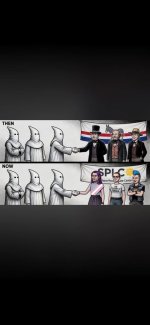
This image is a “then vs now” political meme, and it contains several clear forms of ideological and framing bias.
Don't expect them to understand.This image is a “then vs now” political meme, and it contains several clear forms of ideological and framing bias.
1. Selective comparison (cherry-picking)
The top row (“THEN”) shows hooded figures resembling KKK-style imagery shaking hands with well-dressed historical figures. The bottom row (“NOW”) shows those same hooded figures shaking hands with modern progressive or LGBTQ+-associated figures and an SPLC banner.
This creates a selective comparison: it handpicks extreme or symbolic representations on both sides to imply a continuity of meaning.
2. False equivalence
The structure suggests that:
This is a false equivalence, because it implies moral or ideological equivalence between groups without evidence of comparable intent, ideology, or behavior.
- “Past elites” were aligned with extremist groups, and
- “Modern progressive groups” are similarly aligned with them
3. Guilt by association
By placing modern figures (and an organization labeled SPLC) in a handshake with KKK-like figures, the image uses guilt by association—suggesting those modern individuals or groups are connected to, or equivalent to, extremist ideology simply through visual juxtaposition.
4. Loaded symbolism
Both rows rely heavily on emotionally charged imagery:
This encourages an emotional reaction rather than a factual interpretation.
- KKK-style robes evoke racism and terror
- Modern figures are stylized to represent gender and LGBTQ+ activism
5. Narrative framing (decline/degeneration story)
The “THEN → NOW” format implies a decline narrative: that society has shifted from one perceived “acceptable” alignment to a negative or corrupted one. This is a common rhetorical framing in propaganda-style messaging.
6. Oversimplification
Complex historical and political realities are reduced into a simple binary:
This removes context, nuance, and differences in time periods, institutions, and ideologies.
- “Then = one kind of alliance”
- “Now = another kind of alliance”
Bottom line
The image is not neutral comparison—it is a persuasive meme using symbolism, selective pairing, and emotional cues to promote a particular political interpretation. It’s designed to influence perception more than to inform.
Or Read....I knowDon't expect them to understand.
Nice propaganda and gaslighting.
Nice story.
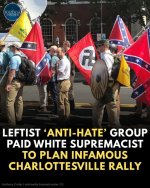
This image is making a very strong factual claim, and there is no credible evidence supporting it.
This implies:“Leftist ‘anti-hate’ group paid white supremacist to plan infamous Charlottesville rally”
 Absence of sourcing Loaded framing Implausible incentive structure
 The claim is not supported by any credible evidence It contradicts established reporting on the Charlottesville rally’s origins It is best classified as misinformation / conspiracy content
 The actual rally was organized by far-right and white supremacist groups themselves
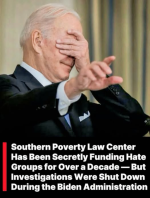
This image makes a serious allegation against the Southern Poverty Law Center (SPLC) and the Biden administration. It is not supported by credible evidence.
“Southern Poverty Law Center has been secretly funding hate groups for over a decade — but investigations were shut down during the Biden administration”
No evidence of SPLC funding hate groups No record of such investigations Conspiracy framing No verifiable details Recycled misinformation pattern No evidence SPLC funds hate groups No evidence of suppressed investigations under the Biden administration The claim appears to be fabricated or misinformation SPLC is a real organization that is often politically controversial, but not implicated in the actions described