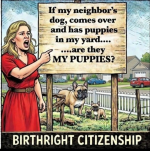
I don't like anchor babies. This is how I would fix it.

Or....we fix it by returning to a model of governance that doesn't create the problem in the first place

Return to a system of rugged individualism, personal responsibility, no forced charity, and actual capitalism - and all of a sudden you don't care
We never were a society of that.
 
What part of it you do not understand? Don't be afraid to ask.

Of course those born in the US are citizens and subject to the laws.
Indians were not citizens from the passing of the 14th amendment till the Snyder Act was passed in 1924 regardless of if they were born on or off the reservation. Elk of Elk V Wilkins decided by the SCOTUS in 1884 said Elk was not a US citizen. The reason the majority opinion gave was because Indians owed their allegiance to another government.

Now explain to me how they differ from the baby of two Mexican illegal aliens.
 
Indians were not citizens from the passing of the 14th amendment till the Snyder Act was passed in 1924 regardless of if they were born on or off the reservation. Elk of Elk V Wilkins decided by the SCOTUS in 1884 said Elk was not a US citizen. The reason the majority opinion gave was because Indians owed their allegiance to another government.

Now explain to me how they differ from the baby of two Mexican illegal aliens.
You're making a classic erroneous argument. You're pointing to misapplications of law or misunderstandings, that were to be corrected, as "what is correct today." Japanese Americans were imprisoned during WWII. Your logic holds that that is the way it should be today because that is what happened in the past. Blacks were lynched in the past; your logic holds that that is what should be done today.

All who are born on US soil, who aren't children of diplomats or children born of hostile occupiers within a hostile occupation (i.e. subject to US jurisdiction), are citizens.

Nobody gets to strip US citizenship through name-calling.
 
You're making a classic erroneous argument. You're pointing to misapplications of law or misunderstandings, that were to be corrected, as "what is correct today." Japanese Americans were imprisoned during WWII. Your logic holds that that is the way it should be today because that is what happened in the past. Blacks were lynched in the past; your logic holds that that is what should be done today.

All who are born on US soil, who aren't children of diplomats or children born of hostile occupiers within a hostile occupation (i.e. subject to US jurisdiction), are citizens.

Nobody gets to strip US citizenship through name-calling.
What about the about to be born who's mothers are on US soil. Do they have rights as citizens too?

Asking for an unborn human.
 
You're making a classic erroneous argument. You're pointing to misapplications of law or misunderstandings, that were to be corrected, as "what is correct today." Japanese Americans were imprisoned during WWII. Your logic holds that that is the way it should be today because that is what happened in the past. Blacks were lynched in the past; your logic holds that that is what should be done today.

All who are born on US soil, who aren't children of diplomats or children born of hostile occupiers within a hostile occupation (i.e. subject to US jurisdiction), are citizens.

Nobody gets to strip US citizenship through name-calling.
So Bingham diplomats and invading armies specifically but everyone else that is born here is a citizen right? So why did he include the clause "and subject to the jurisdiction there of" since that would be everyone else in the country according to you. Why include the clause at all? Can we draft illegal aliens and do they have the right to vote like you and me? Do illegal aliens have the right to stay in the United States like you and I do? The rest of your arguments about Japanese and Blacks are just red herrings.
 
So Bingham diplomats and invading armies specifically but everyone else that is born here is a citizen right? So why did he include the clause "and subject to the jurisdiction there of" since that would be everyone else in the country according to you. Why include the clause at all? Can we draft illegal aliens and do they have the right to vote like you and me? Do illegal aliens have the right to stay in the United States like you and I do? The rest of your arguments about Japanese and Blacks are just red herrings.
If he's "the man" he should be able to answer some simple questions in a logical and compelling fashion right?

Not holding my breath though. :ROFLMAO:
 
So Bingham diplomats and invading armies specifically but everyone else that is born here is a citizen right? So why did he include the clause "and subject to the jurisdiction there of" since that would be everyone else in the country according to you. Why include the clause at all? Can we draft illegal aliens and do they have the right to vote like you and me? Do illegal aliens have the right to stay in the United States like you and I do? The rest of your arguments about Japanese and Blacks are just red herrings.
Exactly!!! it is about "subject to the jurisdiction thereof" - not about magic soil as these morons want to claim

If you break in and steal a wallet you might find yourself in trouble - is that all it takes to be subject to the jurisdiction?

FUCK NO!! Only morons would claim such a thing

You can't be punished for treason and you can't be drafted into the U.S. military. So you clearly are not subject to the jurisdiction thereof as citizens are
 
Exactly!!! it is about "subject to the jurisdiction thereof" - not about magic soil as these morons want to claim

If you break in and steal a wallet you might find yourself in trouble - is that all it takes to be subject to the jurisdiction?

FUCK NO!! Only morons would claim such a thing

You can't be punished for treason and you can't be drafted into the U.S. military. So you clearly are not subject to the jurisdiction thereof as citizens are
Exactly!!! Horace Gray was a supreme court justice on Wong Kim Ark case and on the Elk case and wrote the majority opinion on both. In the opinion on Wong's case
he said Wong was a citizen because Wong's parents were legal residents at the time of his birth. In the Elk decision he said Elk's parents were legal citizens of a foreign government so he owed his allegiance to a foreign government.

So if you are here as a legal permanent citizen your kids born here are LEGAL US citizens. If you are not here legally you aren't a US citizen. Congress had to pass the 1924 Indian Citizenship Act (Snyder Act) to finally grant the Indians citizenship 56 years after the 14th was ratified in 1868.
 
Exactly!!! Horace Gray was a supreme court justice on Wong Kim Ark case and on the Elk case and wrote the majority opinion on both. In the opinion on Wong's case
he said Wong was a citizen because Wong's parents were legal residents at the time of his birth. In the Elk decision he said Elk's parents were legal citizens of a foreign government so he owed his allegiance to a foreign government.

So if you are here as a legal permanent citizen your kids born here are LEGAL US citizens. If you are not here legally you aren't a US citizen. Congress had to pass the 1924 Indian Citizenship Act (Snyder Act) to finally grant the Indians citizenship 56 years after the 14th was ratified in 1868.
the first time the Supreme Court mentioned the citizenship clause of the Fourteenth Amendment, though, was 12 years earlier, in the 1872 Slaughter-house Cases, just four years after the amendment was ratified. So just four years after the Amendment's ratification, the Court said that "the phrase 'subject to its jurisdiction' was intended to exclude from its operation children of ministers, consuls and citizens or subjects of foreign states born within the United States."
 
the first time the Supreme Court mentioned the citizenship clause of the Fourteenth Amendment, though, was 12 years earlier, in the 1872 Slaughter-house Cases, just four years after the amendment was ratified. So just four years after the Amendment's ratification, the Court said that "the phrase 'subject to its jurisdiction' was intended to exclude from its operation children of ministers, consuls and citizens or subjects of foreign states born within the United States."
It is also interesting that John Bingham was very politically active in 1884 when the SCOTUS decided the Elk case and yet he said nothing like "they got it wrong" .
 
It is also interesting that John Bingham was very politically active in 1884 when the SCOTUS decided the Elk case and yet he said nothing like "they got it wrong" .
Certainly more interesting than that dolts lame ass take

Elk is not comparable to lynching or Japanese internment. Those were acts of brutality or panic. His is just a sad straw man. Elk was a direct Supreme Court interpretation of the Citizenship Clause, and it held that birth on U.S. soil was not enough when allegiance was owed elsewhere. You can argue that Wong Kim Ark later adopted a broader rule for children of foreign nationals. Fine. Then make that argument honestly. But do not pretend Elk is irrelevant when it addressed the exact words “subject to the jurisdiction thereof.” And if the earlier view was so obviously wrong, why did Congress need the 1924 Indian Citizenship Act at all?
 
Back
Top