Evangelicals Abandon Trump

Leonthecat

Racism Watchdog
‘There’s nobody left’: Evangelicals feel abandoned by GOP after Trump’s ascent

images


LINCOLN, Neb. — Pastor Gary Fuller planned a Sunday service focused on involving Christians in the political process and featuring a speech by the pastor father of Sen. Ted Cruz. But after a week in which Cruz abruptly dropped out of the race, his father scrapped his appearance here and Donald Trump became the Republican Party’s standard-bearer, a dismayed Fuller kept the political portion short.

“Vote according to your convictions,” Fuller told congregants at Gentle Shepherd Baptist Church who will cast ballots in Nebraska’s presidential primary Tuesday. “What you believe is the right thing to vote for, according to the Scriptures.”

He told congregants that the church can’t and won’t promote one candidate over another. But Fuller has a hard time stomaching Trump as the Republican nominee and plans to vote for Cruz on Tuesday, even though the senator has dropped out of the race.

“In a sense, we feel abandoned by our party,” Fuller said. “There’s nobody left.”

Fuller and other conservatives whose voting decisions are guided by their Christian faith find themselves dismayed and adrift now that Trump has wrested control of the Republican Party. It is a sentiment that reaches from the small, aluminum-sided church with a large white cross on its front that Fuller and his wife built on the Nebraska plains to the highest levels of American religious life. Even progressive Christians — evangelicals and Catholics, among others — who don’t necessarily vote Republican are alarmed that Trump is attracting many voters who call themselves religious. A coalition of nearly 60 Christian leaders — many progressive and some conservative — published an open letter last week asking voters of faith to reject Trump and his “vulgar racial and religious demagoguery,” warning that the nation faces a “moral threat” from the candidate.

Trump divides South Carolina's evangelicals Play Video2:58
Donald Trump won South Carolina's presidential primary with strong evangelical support. Yet evangelicals remain bitterly divided, as many question his stance on social issues ranging from abortion to gay marriage. (Dalton Bennett/The Washington Post)
“Certain kinds of political appeals and certain kinds of political developments are fundamentally antithetical to the Christian faith and must be named as such,” said David Gushee, a professor of ethics at Mercer University who signed the letter.

There is consternation about the hard line Trump takes on immigrants and about the morality of a thrice-married man who has long bragged about his sexual conquests. But another factor is at work as well: The traditional social and cultural positions that drive many religious conservative voters, including same-sex marriage and abortion, have been cast aside by a candidate who seems to have little interest in fighting the culture wars.

In the past, Trump has espoused social views to the left of his party, including a longtime acceptance of gay rights, although he has since moved right on many of them. He has praised Planned Parenthood for helping millions of women. He is running as an antiabortion candidate but had said in the past that he supported abortion rights and would not ban the procedure known as partial-birth abortion.

And while he says he is against same-sex marriage, he has attended a same-sex wedding and is opposed to a North Carolina law — aimed at transgender people — that requires people to use bathrooms that correspond with the gender on their birth certificate. He said transgender activist Caitlyn Jenner could use the women’s room at his properties.

“This year the Republican Party has not just surrendered on the culture wars, they’ve joined the other side. And that’s a unique situation,” said Russell Moore, president of the Ethics and Religious Liberty Commission of the Southern Baptist Convention.

Cruz crusaded for social issues, making opposition to the transgender bathroom law one of his biggest fights at the end of his candidacy. The gambit failed when the senator from Texas lost badly to Trump in Indiana, a state that passed a controversial religious freedom law last year that led to a heated fight few want to relitigate.

https://www.washingtonpost.com/politics/theres-nobody-left-evangelicals-feel-abandoned-by-gop-after-trumps-ascent/2016/05/08/a133991e-130f-11e6-8967-7ac733c56f12_story.html
 
Liberty Students Issue Anti-Trump Statement After Falwell Reaffirms Support For Trump
Falwell-2006.01.08-b.jpg

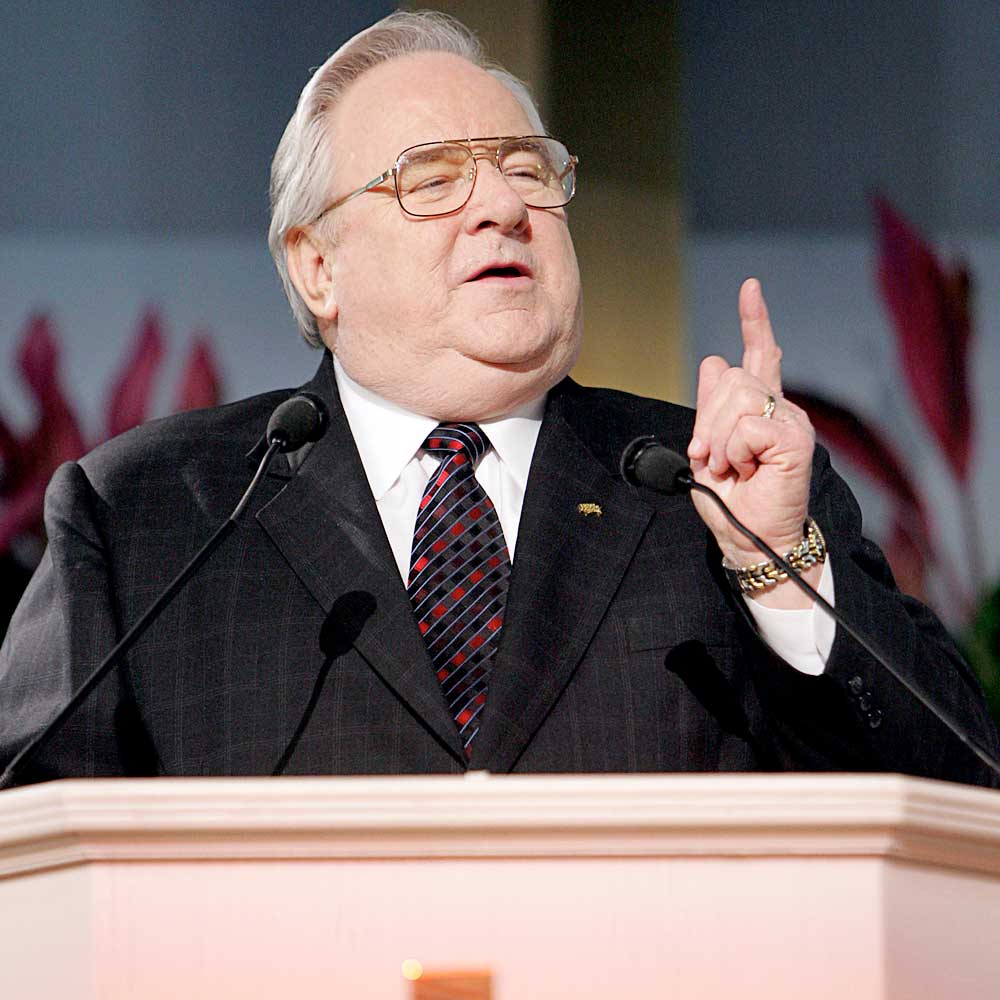
Jerry Falwell, Jr's dad, Jerry Falwell, Sr.

Jerry Falwell, Jr., president of Liberty University, endorsed Donald Trump on January 26, 2016. Since then, Falwell has continued to voice his support of the candidate, even as allegations Trump sexually assaulted multiple women began to emerge.

On Wednesday, Falwell, speaking on CNN, said that he would continue to support Trump for president, even if the allegations against him turned out to be true:


This, for some Liberty University students, was the last straw. A coalition of students dubbing themselves "Liberty University Against Trump" released a statement distancing themselves from Falwell's endorsement and from Trump's candidacy.

The statement in full:

In the months since Jerry Falwell Jr. endorsed him, Donald Trump has been inexorably associated with Liberty University. We are Liberty students who are disappointed with President Falwell’s endorsement and are tired of being associated with one of the worst presidential candidates in American history. Donald Trump does not represent our values and we want nothing to do with him.
A majority of Liberty students, faculty, and staff feel as we do. Donald Trump received a pitiful 90 votes from Liberty students in Virginia’s primary election, a colossal rejection of his campaign. Nevertheless, President Falwell eagerly uses his national platform to advocate for Donald Trump. While he occasionally clarifies that supporting Trump is not the official position of Liberty University, he knows it is his title of president of the largest Christian university in the world that gives him political credentials.
Associating any politician with Christianity is damaging to the Gospel of Jesus Christ. But Donald Trump is not just any politician. He has made his name by maligning others and bragging about his sins. Not only is Donald Trump a bad candidate for president, he is actively promoting the very things that we as Christians ought to oppose.
A recently uncovered tape revealed his comments bragging about sexually assaulting women. Any faculty or staff member at Liberty would be terminated for such comments, and yet when Donald Trump makes them, President Falwell rushes eagerly to his defense – taking the name “Liberty University” with him. “We’re all sinners,” Falwell told the media, as if sexual assault is a shoulder-shrugging issue rather than an atrocity which plagues college campuses across America, including our own.
It is not enough to criticize these kinds of comments. We must make clear to the world that while everyone is a sinner and everyone can be forgiven, a man who constantly and proudly speaks evil does not deserve our support for the nation’s highest office.
Jesus tells a story in the Bible about a man who tries to remove a speck of dust from his brother’s eye, while he has a log stuck in his own. “You hypocrite,” Jesus says, “first take the log out of your own eye, and then you will see clearly to take the speck out of your brother’s eye.”
We Liberty students are often told to support Donald Trump because the other leading candidate is a bad option. Perhaps this is true. But the only candidate who is directly associated with Liberty University is Donald Trump.
Because our president has led the world to believe that Liberty University supports Donald Trump, we students must take it upon ourselves to make clear that Donald Trump is absolutely opposed to what we believe, and does not have our support.
We are not proclaiming our opposition to Donald Trump out of bitterness, but out of a desire to regain the integrity of our school. While our president Jerry Falwell Jr. tours the country championing the log in his eye, we want the world to know how many students oppose him. We don’t want to champion Donald Trump; we want only to be champions for Christ.
k,
 
Evangelicals Accuse Trump Supporters of Abandoning Faith

341286_5_.jpg


Anti-Trump evangelicals have not quite questioned the faith of Trump voters. But they’ve come close, arguing that Trump supporters are not applying Christian thinking and values to their decisions at the polls.
 
Utah’s Top Mormons in ‘All-Out Revolt’ Against Donald Trump

10MORMONS1-master768.jpg

As Republicans across the country contend with the fallout from a newly released recording in which Donald J. Trump made vulgar and sexually degrading comments about women, perhaps nowhere was reaction more swift and decisive than in Utah, home to a sizable Mormon population already deeply unsettled by a sense of the candidate’s moral shortcomings.

Within hours of the video’s release on Friday, a number of top Republican officials in the state yanked their endorsements, including Gov. Gary Herbert, a Mormon, who declared Mr. Trump’s statements “beyond offensive and despicable.” Representative Jason Chaffetz, who is also Mormon, said that if he voted for Mr. Trump he would no longer be able to look his 15-year-old daughter in the eye.

On Saturday, the Deseret News, a media outlet owned by the Church of Jesus Christ of Latter Day Saints, broke with an 80-year tradition of refraining from presidential endorsements to publish an editorial calling on Mr. Trump to step aside.

“We prefer to stand for something rather than against someone,” Deseret’s editorial board wrote. “But this is one of those rare moments where it is necessary to take a clear stand against the hucksterism, misogyny, narcissism and latent despotism that infect the Trump campaign.”

It is too early to say how the lewd video will affect Mr. Trump’s standing in Utah, which has not backed a Democrat for president since Lyndon B. Johnson in 1964. Polls taken before the video was released showed Mr. Trump with a comfortable lead, and many Republicans outraged by his remarks have vowed never to support his rival, Hillary Clinton.

Still, the scale of the rebellion by Utah Republicans against their party’s presidential candidate is practically unheard-of, said Chris Karpowitz, a director of Brigham Young University’s Center for the Study of Elections and Democracy. Almost the entire congressional delegation has vowed not to vote for Mr. Trump in November.

“The Republican establishment in the state of Utah is in all-out revolt against the Trump candidacy,” Mr. Karpowitz said. “I don’t think we’ve ever seen that before.”

http://www.nytimes.com/2016/10/10/us/politics/utah-mormons-republicans-donald-trump.html

Trumpf needed every republican vote he could muster. But the religious right are abandoning him in droves.
 
The First Republicans to Break With Trump Over His Groping Tape Were Mormons


Does this give Clinton a chance in Utah?

Dump_Trump_rtr_img.jpg


After the news broke on Friday about Donald Trump’s boasting on tape of sexual assault, the first politicians to withdraw their endorsements of Trump and call on him to abandon the race were Mormons. Over the weekend, the chorus grew among Republicans of other religions—but many of these later calls for Trump to withdraw came from candidates facing strong Democratic opposition, like New Hampshire’s Senator Kelly Ayotte. Others were party leaders concerned about the political effect on down-ticket races, like Senator John Thune of South Dakota, chairman of the Republican conference. The Mormon politicians, in contrast, all come from totally safe Republican districts and were not acting out of political expediency or fear. Why was it Mormons, and not evangelical Protestants or Catholics, who went first and took a principled stand against Trump’s boasts about being a sexual predator?
The first Mormon politicians to call on Trump to withdraw were all from Utah: Senator Mike Lee, Representative Chris Stewart and former Governor Jon Huntsman. Utah Governor Gary Herbert and Representative Jason Chaffetz were the first after The Washington Post’s revelations to say they would not vote for Trump. The next day they were joined by other Mormon Republicans in Congress, Idaho Senator Mike Crapo and Utah Representative Mia Love. And of course some Mormon leaders had always refused to endorse Trump, long before these latest reports—notably Mitt Romney and Arizona Senator Jeff Flake.

In contrast, prominent evangelical Protestants like Texas Senator Ted Cruz and VP candidate Mike Pence—who famously says, “I’m a Christian, a conservative and a Republican, in that order”—are sticking with Trump. Of course, they objected to the statements on the tape; Ted Cruz called Trump’s comments “crude and inappropriate,” but then tweeted that it was time to “move along” to Hillary’s problems. The Mormons are not moving along; instead, they have drawn a line and are refusing to cross it.

“Trump’s Mormon Problem” was noted long before his groping tape surfaced. In a mid-September poll in Utah, he got only 34 percent, which the Salt Lake City Tribune called “an abysmal number for a Republican in one of the most conservative states in the nation.” In 2012 Mitt Romney got 73 percent.

It’s not hard to see why Trump was doing so poorly. The Mormon Church itself condemned his remarks on Muslims. “The Church of Jesus Christ of Latter-day Saints [LDS] is neutral in regard to party politics and election campaigns,” an official statement declared back in December. “However it is not neutral in relation to religious freedom.” Mormons know their history, which helps explain why they rejected Trump’s call for a ban on Muslim immigration. “Early Latter-day Saints spent much of the mid-19th century being chased into the desert by bigots and demagogues,” McKay Coppins wrote in a New York Times op-ed. “Propagandists painted them as a nefarious foreign race.” And, in a striking anticipation of this year’s politics, the secretary of state in 1879 proposed restricting Mormon immigration to the United States, on the grounds that the nation had to be protected from “prospective lawbreakers.” That history is a prime reason the LDS announced an immigration relief effort in April. “Their story is our story,” Elder Patrick Kearon said, “not that many years ago.”
It wasn’t just Trump’s call for a government religious test that provoked Mormon opposition. Mormons also objected to his isolationism. Mormon men (and women) are encouraged to do missionary work, many in faraway parts of the world, so Mormons are familiar with the wide world and see it as a place to which they are connected. And Trump’s promise to “make America great again” doesn’t resonate in Mormon America at all. Mormon areas are prosperous and growing, and Mormons have higher educational levels, higher incomes, and more stable families than most of evangelical America. Most Mormons are not downwardly mobile angry white men.

But while those aspects of Trump’s politics turned many Mormon voters against him during the primary season—Trump got only 14 percent in the Utah caucuses (Ted Cruz got 69 percent)—most of the Republican elected leaders who were Mormons endorsed him once he got the nomination. Why did the groping tape mark the point of no return for them, when his position on banning Muslim immigration and his isolationism didn’t?

The Mormon Church is rigidly patriarchal. Women are not allowed to be priests, and the church teaches that “fathers are to preside over their families.” But patriarchy everywhere involves an obligation for men to protect women. Mormon men in politics seem to take patriarchy more seriously than evangelicals, at least the part about men’s obligation to protect women—which includes protecting them from aggressive sexual predators like Donald Trump.

And there’s also a theological dimension to Mormon politicians’ rejection of Trump after his boasts of sexual predation. “In Mormon theology, women are essential to men’s salvation and spiritual progression,” says Judith Freeman, author of new memoir The Latter Days about growing up Mormon in the Utah of the 1950s and ’60s. “I’m not sure that same sensibility exists in the evangelical world. In order for a Mormon man to attain the highest celestial realm, he has to have a family with a wife who is a spiritual partner. Mormon men are taught to protect, revere, honor, and almost worship women as mothers and latter-day saints. That’s why Trump’s debasement of women became such a problem for the Mormon politicians.”

There are, of course, some Mormon elected officials who have not turned against Trump. The most prominent is Utah Senator Orrin Hatch, who criticized Trump’s recorded statements but said he would still vote for him. Hatch has been a Washington insider for a long time—maybe too long. (He was first elected to the Senate in 1976—40 years ago, making him the second-longest-serving senator this term.)

The big political question, of course, is whether Mormons’ revulsion over Trump gives Hillary Clinton a chance in Utah. The obstacles are massive: Mormons are the most Republican religious group in America—70 percent Republican and only 20 percent Democratic. That mid-September poll put Clinton at 25 percent in Utah. As for the rest, Libertarian candidate Gary Johnson got 13 percent, with 12 percent for independent conservative Evan McMullin, a Mormon who has based his campaign in Utah. Eight percent said they intended to write in a name.

But there are reasons for Hillary to be optimistic. Salt Lake City this year elected a lesbian woman Democrat—Jackie Biskupski—as mayor, something that would have been unthinkable until recently. In the ’50s and ’60s Salt Lake City was probably 90 percent Mormon; now Mormons are no longer a majority in the state’s largest city. Statewide, only 63 percent of people in Utah are members of the LDS, and, according to a Pew study, only about 40–50 percent were active members. And of course Utah is also 14 percent Latino, 3 percent Asian, and 2 percent black—all hugely Democratic groups, especially this year.

“I have the feeling there are a number of Mormon women who would like to see a woman in the White House,” Judith Freeman says. “And the entire Mormon population has become more sophisticated than in the ’50s. There are many educated and more progressive Mormons who would vote Democratic.”

That’s why, on September 20, the Clinton campaign announced the formation of “Mormons for Hillary.” The group started with 120 members, including some lifelong Republicans. The Deseret News, owned by the LDS, ran an op-ed by Hillary, “What I Have in Common with Mormons.” In the piece, Hillary cited Trump’s Muslim ban and compared it to the history of persecution of Mormons. She also praised the state’s Republican governor for “setting a compassionate example and welcoming Syrian refugees fleeing religious persecution and terrorism.”

Even before the story broke about Trump’s sexual groping, he himself acknowledged a “tremendous problem in Utah.” That “problem” is now much more “tremendous”—because of the principled rejection of Trump by Mormon political leaders.
https://www.thenation.com/article/the-first-republicans-to-break-with-trump-over-his-groping-tape-were-mormons/
 
The First Republicans to Break With Trump Over His Groping Tape Were Mormons

This is not really true - the Mormons weren't really with Douchebag Donald to begin with. Utah went for Cruz by almost 70%, and Kasich got almost 17% on top of that, leaving him with 14%

There was speculation for some time that Utah could be in play. I still think that it's more likely to go for McMullin than Crooked Hillary.
 
Why don't the holy rollers put the word out to write Ted Cruz on the little line where there ain't no person's name at all.

Local man explains his voting dilema: They leffinit tolly blank, that line there. Make a feller shake his head. Muhsposen be votin' fer nobody? Cussin that be fine with me.
 
so which is it? is trump ultra hard right or is he liberal? Half the posts say one thing the other half say the other.

I guess democrats should feel free to vote trump because he is more socially liberal than any other gop candidate :)
 
so which is it? is trump ultra hard right or is he liberal? Half the posts say one thing the other half say the other.

I guess democrats should feel free to vote trump because he is more socially liberal than any other gop candidate :)

IMHO the problem isn't so much his policies which he spends almost no time discussing, or his ever changing & conflicting views/opinions but him...

He isn't prepared & does not have the temperament to lead the world-PERIOD..

That unfortunately isn't going to change & neither is he.. He can't even pretend to act presidential more than a few hours before something in the past, present or imagined pisses him off & he goes off on another tweetRage.....

He has the highest negatives of all time, & that is for good reason.....

She has the second highest & would very likely be trailing in the polls right now had the gop nominated a better choice~almost anyone but him...:dunno:
 
so which is it? is trump ultra hard right or is he liberal? Half the posts say one thing the other half say the other.

I guess democrats should feel free to vote trump because he is more socially liberal than any other gop candidate :)
he's a loose cannon populist. She's a corporatist, corrupt, "big gov't" warmonger.
 
Back
Top