
You are using an out of date browser. It may not display this or other websites correctly.
You should upgrade or use an alternative browser.
You should upgrade or use an alternative browser.
Democrats and NAFTA
- Thread starter Big Money
- Start date

Sammi
Verified User
http://useconomy.about.com/od/tradepolicy/p/NAFTA_History.htm
When Was NAFTA Started?:
NAFTA was signed by President George H.W. Bush, Mexican President Salinas, and Canadian Prime Minister Brian Mulroney in 1992. It was ratified by the legislatures of the three countries in 1993. The U.S. House of Representatives approved it by 234 to 200 on November 17, 1993. The U.S. Senate approved it by 60 to 38 on November 20, three days later.
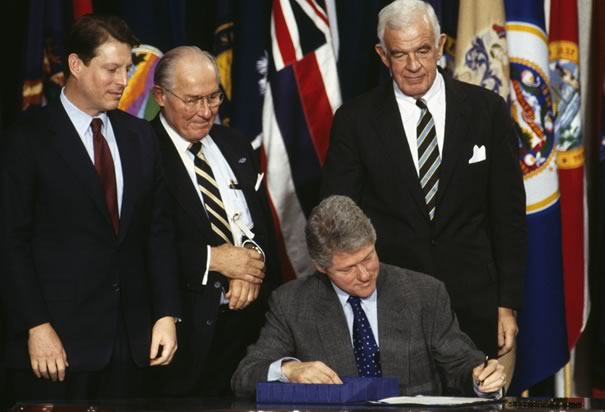
NAFTA was signed into law by President Bill Clinton on December 8, 1993 and entered force January 1, 1994. Although it was signed by President Bush, it was a priority of President Clinton's, and its passage is considered one of his first successes. (Source: History.com, NAFTA Signed into Law, December 8, 1993)
How Was NAFTA Started?:
The impetus for NAFTA actually began with President Ronald Reagan, who campaigned on a North American common market. In 1984, Congress passed the Trade and Tariff Act. This is important because it gave the President "fast-track" authority to negotiate free trade agreements, while only allowing Congress the ability to approve or disapprove, not change negotiating points. Canadian Prime Minister Mulroney agreed with Reagan to begin negotiations for the Canada-U.S. Free Trade Agreement, which was signed in 1988, went into effect in 1989 and is now suspended due to NAFTA. (Source: NaFina, NAFTA Timeline)
Meanwhile, Mexican President Salinas and President Bush began negotiations for a liberalized trade between the two countries. Prior to NAFTA, Mexican tariffs on U.S. imports were 250% higher than U.S. tariffs on Mexican imports. In 1991, Canada requested a trilateral agreement, which then led to NAFTA. In 1993, concerns about liberalization of labor and environmental regulations led to the adoption of two addendums to NAFTA.
Why Was NAFTA Formed?:
Article 102 of the NAFTA agreement outlines its purpose:
Grant the signatories Most Favored Nation status.
Eliminate barriers to trade and facilitate the cross-border movement of goods and services.
Promote conditions of fair competition.
Increase investment opportunities.
Provide protection and enforcement of intellectual property rights.
Create procedures for the resolution of trade disputes.
Establish a framework for further trilateral, regional and multilateral cooperation to expand NAFTA's benefits. (Source: NAFTA Secretariat, "NAFTA FAQ")
Has NAFTA Fulfilled Its Purpose?:
NAFTA has eliminated trade barriers, increased investment opportunities, and established procedures for resolution of trade disputes. Most important, it has increased the competitiveness of the three countries involved on the global marketplace. This has become especially important with the launch of the European Union and the economic growth of China and other emerging market countries. In 2007, the EU replaced the U.S. as the world's largest economy.
NAFTA and Ross Perot:
Despite NAFTA's benefits, it has remained highly controversial. NAFTA's disadvantages are usually pointed out during Presidential campaigns. In 1992, before NAFTA was even ratified, Independent Presidential candidate Ross Perot famously warned that "You're going to hear a giant sucking sound of jobs being pulled out of this country." Ross predicted that the U.S. would lose 5 million jobs -- a whopping 4% of total U.S. employment -- to lower-cost Mexican workers. In fact, this never happened as Mexico entered a recession and the U.S. entered a period of prosperity. True, American workers were displaced by low-cost Mexican imports. But research showed it was more like 2,000 per month. (Source: Brad DeLong, "Jobs and NAFTA")
NAFTA and the 2008 Presidential Campaign:
NAFTA was attacked from all sides during the 2008 Presidential campaign. Barack Obama blamed NAFTA for growing unemployment. He said it helped businesses at the expense of workers in the U.S. It also did not provide enough protection against exploitation of workers and the environment along the border in Mexico. Hillary Clinton included NAFTA in her pledge to strictly enforce all existing trade agreements, as well as halt any new ones. Both candidates promised to either amend or back out of NAFTA all together. However, Obama hasn't done anything about NAFTA since becoming President. For more, see Has Obama Forgotten NAFTA Promise?
In 2008, Republican candidate Ron Paul said he would abolish NAFTA. He said it was responsible for a NAFTA Superhighway and compared it to the European Union. However, unlike the EU, NAFTA does not enforce a single currency among its signatories. Paul has maintained this position in his 2012 campaign.
Sammi
Verified User
What has the current administration done in reference to NAFTA?
What can the current admin do to a law?
What have republicans done to repeal it?
What can the current admin do to a law?
I'm glad you asked.
http://www.democracynow.org/2009/8/11/obama_reverses_campaign_pledge_to_renegotiate
What have republicans done to repeal it?
Did someone say they were doing anything to "repeal" it?

Crashk
Unite or Die
What has the current administration done in reference to NAFTA?
Supply the wing nuts here with facts and do you get an honest discussion? No. You get stupid questions, over and over and over again.

What has the current administration done in reference to NAFTA?
http://www.huffingtonpost.com/2011/...mexican-arrives-in-us-interior_n_1028630.html
Nearly 20 Years After NAFTA, First Mexican Truck Arrives In U.S. Interior
Supply the wing nuts here with facts and do you get an honest discussion? No. You get stupid questions, over and over and over again.
Your evasion is noted.
What has Obama done regarding NAFTA?
Tell me.

Anti-Party
Tea Is The New Kool-Aid
What has the current administration done in reference to NAFTA?
The current Government, Obama driven, tried to pass the Anti-Outsourcing bill of 2010. This bill was not designed to stop outsourcing like the name stated but people with small minds can be "name" driven, aka "Patriot Act". Makes you seem patriotic if you vote yes, (R)ight?
The Left's plan in the Anti-Outsourcing bill was to stop the tax loopholes designed for state to state for other Countries. The bill stated "There will be no tax deductions for outsourcing jobs to other Countries. And instead, it would GIVE tax deductions to anyone who decides to hire in the USA."
In the wake of "Omg Obama is fixing things after Bush and we have to vote no on everything" This bill was voted down because of bias. I even heard party puppets justifying this saying "why should we have lazy Americans make our products when they can be made cheaper and better across seas"
We became a great Nation in the Industrial Revolution. Corporations working as a team, not to choke all the profits out of the working poor.
Sadly even though Obama fought the good fight for less outsourcing, he fought the bad fight for T.P.T. which is almost exactly the same .
NAFTA was trash and we are seeing the result. Industrial workers are now working at WalMart and McDonalds demanding more pay because they can't use Physical Labor anymore to provide a currency for their family.
Not the TPT is going to ensure Americans don't have the right to know what's in their food produced overseas. As if Americans care about the chemicals already in their food. I'm trying to care but I'm too busy like most Americans to care/research.
Oddly enough, given the condemnations of "protectionism" issuing from the Democrat leadership, after the 2006 election, it was estimated that another 10 to 20 Democrats might have won, if they had attacked free trade.
But the Democrat Congressional Campaign Committee was headed by Rahm Emanuel, President Obama's chief of staff, a free trader. Emanuel played a leading role in securing Democrat votes to pass NAFTA in 1993 while serving as a staffer under Bill Clinton.
http://www.huffingtonpost.com/ian-fletcher/thinking-the-unthinkable_b_522195.html
But the Democrat Congressional Campaign Committee was headed by Rahm Emanuel, President Obama's chief of staff, a free trader. Emanuel played a leading role in securing Democrat votes to pass NAFTA in 1993 while serving as a staffer under Bill Clinton.
http://www.huffingtonpost.com/ian-fletcher/thinking-the-unthinkable_b_522195.html