I think the Sanders movement will remain as well........
When hillary wins, it isn't going to be over, perhaps it is just beginning??
October 27, 2016
Michael A. Lindenberger
Dallas Morning News
Posted with permission from Tribune Content Agency
Here in America? We've spent far too much time worry about Donald Trump and not nearly enough thinking about what we've been calling Trumpism. That's a global movement that began long before he stepped onto the scene. It will be with us long after the election, even if he fades, as one can only hope, like the lead in a canceled sit-com.
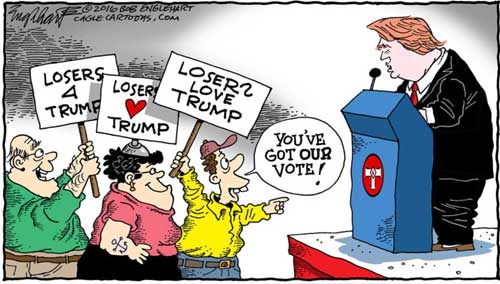
That shouldn't surprise us. Millions of (mostly) white, working-class Americans were already seething with resentment, looking for someone to channel their anger. For a long time Republicans thought these were values voters, people fed up with gay rights and abortion. Turns out they were just fed up. Their anger had made them easy prey for politicians willing to exploit misgivings over social issues to win their support. Don't believe me? Look at the legions of evangelicals who deserted overtly Christian campaigns by Ted Cruz, Mike Huckabee and others.
A similar movement on the left, fueled by anti-Wall Street and anti-racism fervor, drew millions to Bernie Sanders on the left. But it was Trump who succeeded in the astonishing capture of the Republican Party. His special genius was that he talked about politicians with the same sneer and the same blunt dismissal that many Americans already used themselves, as author J.D. Vance told me last month.
It strikes me that it can be thrilling to hear your own resentments spilling from the mouth of the man on the stage, rather than just another guy at the bar or in the bleachers.
This week, the French ambassador to the U.S. has been in Dallas, a guest of the World Affairs Council. At lunch Tuesday and in a meeting earlier that day with members of our editorial board, he urged America to see right-wing populism as a global phenomenon, not just a twist to our national politics.
Gerard Araud, a career diplomat and former envoy to Israel and the United Nations, said the common thread is not racism or xenophobia or even terrorism fears — though populist leaders everywhere use these passions are tools. Trumpism is present in developed democracies all over the world, and it's best understood as a collective response by those who are on the losing side of globalization.
"The real problem — it's jobs, jobs, jobs," Araud said.
Even nations such as France, which unlike America was not born a nation of immigrants, has absorbed periodic waves of newcomers without undue stress — but only when its economy is producing jobs for the arrivals, he argued. These days, it isn't.
Republicans grouse in America that our recovery has been "jobless" but unemployment here is below 5 percent. In France? It's been close to or above 10 percent since shortly after the 2008 U.S. financial crisis spread its funk across the globe.
When citizens feel left out, or targeted, by the elites' economic policies, Araud argued, they're more likely to "retreat" to the security offered by tradition, whether it's rooted in family, ethnicity, or religion.
That same underlying dynamic is at play in America, though it may manifest itself in different ways. (The right in France, for instance, wants a stronger federal government and less privatization, not more.) He noted that while far fewer Americans are looking for work than in France, that doesn't tell the full story. His travels here have taught him that many American workers are as frustrated economically as those in France who have no jobs at all.
He was in North Carolina recently, and found Charlotte to be booming. Tall buildings. Big banks. Lots of jobs. But out in the state? An unease was evident everywhere, he suggested.
In rural America, as in the cities, people are generally working, or at least not looking for jobs. But wages are so low they feel trapped. He's encountered many who lost their homes in the financial crisis, and lost their better-paying jobs too. Now they are feeling like victims of a global economy that demands skills they don't have. "They aren't going to become coders," he said. They're going to find work where the can get it, and conclude that they've been left out of something important. When a candidate rails against free trade, their ears prick up.
What becomes clear about all of this is that economic insecurity is at the root of the problem, both here and abroad. America began embracing globalism in earnest during Bill Clinton's presidency, and the benefits have been enormous for our country's economy. But they have not been equally shared, and millions of our countrymen and women have suffered a decline in their standard of living. The pain was trebled by the financial crisis of 2008, when million of people began losing their homes. And while President Obama has steered the country back from economic ruin, he's presided over a time when the rich have very much gotten richer and the poor poorer. And too many in the middle class are working, but at jobs that pay too little.
A return to Republican tickle-down economics, as Trump has promised, strikes many as simply insane. Count me as one. But it's just as true that the economy we have isn't working for everyone.
And that's the raw material that candidates like Trump have used.
Trump's nearing the end of his turn as a national figure of prominence. Maybe after the election, he'll hole up in Trump Tower, Howard Hughes-like, and disappear except for strange tweets that arrive at 3 a.m.
Who knows, but whatever he does, the power he has stirred up in the electorate will not go away. The needs of the voters he's speaking for will need to be addressed.
Araud made his closing appeal a call for America's next president to use her — and yes, he said her, to scattered applause at the World Affairs Council luncheon — position to bring America closer to its allies in Europe, and to build stronger economic ties.
It's no time, he argued, to raise our draw bridges and turn inward as we ready ourselves for the future. "We tried that in the 1930s, everyone turning inward to protect themselves. It didn't work. Things got worse for all of us," he said.
The stakes couldn't be higher, as any reference to the 1930s ought to make perfectly clear.
"This is not the end of the crisis. The crisis is ahead of us."
When hillary wins, it isn't going to be over, perhaps it is just beginning??
October 27, 2016
Michael A. Lindenberger
Dallas Morning News
Posted with permission from Tribune Content Agency
Here in America? We've spent far too much time worry about Donald Trump and not nearly enough thinking about what we've been calling Trumpism. That's a global movement that began long before he stepped onto the scene. It will be with us long after the election, even if he fades, as one can only hope, like the lead in a canceled sit-com.
That shouldn't surprise us. Millions of (mostly) white, working-class Americans were already seething with resentment, looking for someone to channel their anger. For a long time Republicans thought these were values voters, people fed up with gay rights and abortion. Turns out they were just fed up. Their anger had made them easy prey for politicians willing to exploit misgivings over social issues to win their support. Don't believe me? Look at the legions of evangelicals who deserted overtly Christian campaigns by Ted Cruz, Mike Huckabee and others.
A similar movement on the left, fueled by anti-Wall Street and anti-racism fervor, drew millions to Bernie Sanders on the left. But it was Trump who succeeded in the astonishing capture of the Republican Party. His special genius was that he talked about politicians with the same sneer and the same blunt dismissal that many Americans already used themselves, as author J.D. Vance told me last month.
It strikes me that it can be thrilling to hear your own resentments spilling from the mouth of the man on the stage, rather than just another guy at the bar or in the bleachers.
This week, the French ambassador to the U.S. has been in Dallas, a guest of the World Affairs Council. At lunch Tuesday and in a meeting earlier that day with members of our editorial board, he urged America to see right-wing populism as a global phenomenon, not just a twist to our national politics.
Gerard Araud, a career diplomat and former envoy to Israel and the United Nations, said the common thread is not racism or xenophobia or even terrorism fears — though populist leaders everywhere use these passions are tools. Trumpism is present in developed democracies all over the world, and it's best understood as a collective response by those who are on the losing side of globalization.
"The real problem — it's jobs, jobs, jobs," Araud said.
Even nations such as France, which unlike America was not born a nation of immigrants, has absorbed periodic waves of newcomers without undue stress — but only when its economy is producing jobs for the arrivals, he argued. These days, it isn't.
Republicans grouse in America that our recovery has been "jobless" but unemployment here is below 5 percent. In France? It's been close to or above 10 percent since shortly after the 2008 U.S. financial crisis spread its funk across the globe.
When citizens feel left out, or targeted, by the elites' economic policies, Araud argued, they're more likely to "retreat" to the security offered by tradition, whether it's rooted in family, ethnicity, or religion.
That same underlying dynamic is at play in America, though it may manifest itself in different ways. (The right in France, for instance, wants a stronger federal government and less privatization, not more.) He noted that while far fewer Americans are looking for work than in France, that doesn't tell the full story. His travels here have taught him that many American workers are as frustrated economically as those in France who have no jobs at all.
He was in North Carolina recently, and found Charlotte to be booming. Tall buildings. Big banks. Lots of jobs. But out in the state? An unease was evident everywhere, he suggested.
In rural America, as in the cities, people are generally working, or at least not looking for jobs. But wages are so low they feel trapped. He's encountered many who lost their homes in the financial crisis, and lost their better-paying jobs too. Now they are feeling like victims of a global economy that demands skills they don't have. "They aren't going to become coders," he said. They're going to find work where the can get it, and conclude that they've been left out of something important. When a candidate rails against free trade, their ears prick up.
What becomes clear about all of this is that economic insecurity is at the root of the problem, both here and abroad. America began embracing globalism in earnest during Bill Clinton's presidency, and the benefits have been enormous for our country's economy. But they have not been equally shared, and millions of our countrymen and women have suffered a decline in their standard of living. The pain was trebled by the financial crisis of 2008, when million of people began losing their homes. And while President Obama has steered the country back from economic ruin, he's presided over a time when the rich have very much gotten richer and the poor poorer. And too many in the middle class are working, but at jobs that pay too little.
A return to Republican tickle-down economics, as Trump has promised, strikes many as simply insane. Count me as one. But it's just as true that the economy we have isn't working for everyone.
And that's the raw material that candidates like Trump have used.
Trump's nearing the end of his turn as a national figure of prominence. Maybe after the election, he'll hole up in Trump Tower, Howard Hughes-like, and disappear except for strange tweets that arrive at 3 a.m.
Who knows, but whatever he does, the power he has stirred up in the electorate will not go away. The needs of the voters he's speaking for will need to be addressed.
Araud made his closing appeal a call for America's next president to use her — and yes, he said her, to scattered applause at the World Affairs Council luncheon — position to bring America closer to its allies in Europe, and to build stronger economic ties.
It's no time, he argued, to raise our draw bridges and turn inward as we ready ourselves for the future. "We tried that in the 1930s, everyone turning inward to protect themselves. It didn't work. Things got worse for all of us," he said.
The stakes couldn't be higher, as any reference to the 1930s ought to make perfectly clear.
"This is not the end of the crisis. The crisis is ahead of us."