Jack Grealish
Verified User
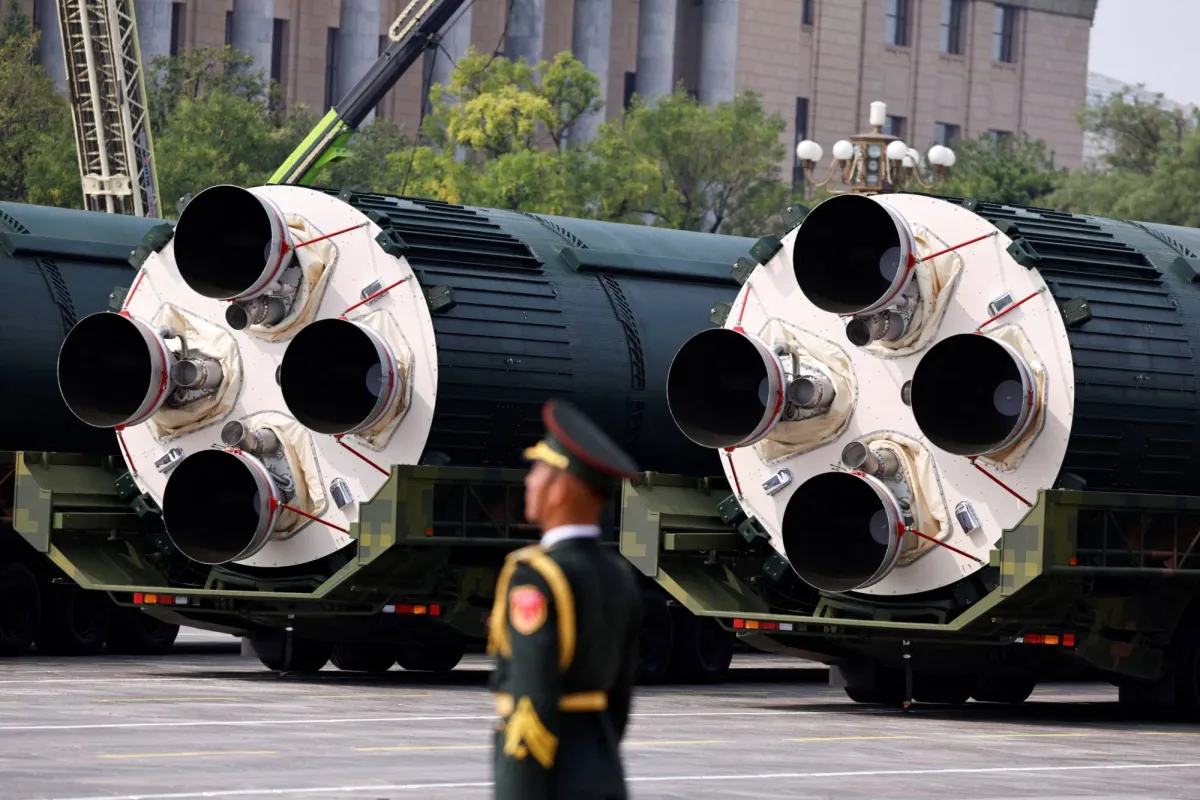
The War Zone published an article yesterday titled "China is America’s Military Equal Now And In Any Future Fight, Marine General Warns." This type of news is not particularly new—every so often, some U.S. military general makes similar remarks on some occasion, most of which can be interpreted as an attempt to secure more budget funding. What I find more interesting is the comment section, as it offers a glimpse into how ordinary Americans view issues related to the possibility of war with China.
Over the past ten years or so (with the starting point of the current state of U.S.-China relations roughly around the end of 2016), after reading through a considerable number of comment sections on similar topics, I think it is entirely reasonable to draw the following conclusion:
——“The One-China principle once served as the cornerstone for the establishment of diplomatic relations between China and the United States. Yet today, this foundation has completely dissolved in the perception of the American people.”
In all discussions of such issues, whenever any American (or Chinese) brings up what should be a clear and unambiguous U.S. official position, someone immediately steps forward to oppose it. People oppose this view so strongly and with such firm resolve that it has almost become like a rat crossing the street—something everyone disapproves of.
For American professional diplomats—or researchers who advise the government—with a strong background in the relevant knowledge, all the details of the Taiwan issue should not have been a difficult matter on which to reach a conclusion. It is simply not that complicated. Yet there is a certain disconnect here: while in the world of professionals, people understand the essence of the Taiwan issue, in the world directed at the American public—and in order to generate sufficient public support (support aimed at pressuring China on the Taiwan issue)—the narrative on Taiwan has been completely tilted toward portraying it as "a sovereign and independent country." This situation has persisted for a long time and has created a popular inclination that is now almost irreversible.
This fragile structure will eventually break down one day. The framework—crafted with some ingenuity at the outset to serve the dual purpose of establishing formal diplomatic relations with China while generating enough public support for the U.S. government to apply pressure on China over the Taiwan issue, pressure that has no moral basis to exist in the first place—this ambiguous strategy on Taiwan will ultimately be unable to maintain its ambiguity due to the overwhelmingly one-sided direction of American public opinion.
When that time comes, people will witness a reckless U.S. president—under pressure to divert attention from personal scandals, acting on lobbying from a foreign government (here, of course, referring to Japan), and operating under a miscalculation of the likely outcome of a war (as a considerable number of Americans still view the Chinese military as a paper tiger)—making a very rash decision, thinking to themselves, "This won't be a problem. Let's do it."
Compared to such recklessness, President Trump—who is so often criticized today—could almost be regarded as a cautious, calm, and deeply thoughtful saint.
President Trump is reportedly set to visit Beijing this month, and for that he deserves some applause. I don't want to repeat the line about "being at a crossroads in history," but at least so far, no disaster has occurred. If Trump succeeds in visiting China, that would be a very good thing—after all, it has been ten years since a U.S. president last visited China.
Over the past ten years or so (with the starting point of the current state of U.S.-China relations roughly around the end of 2016), after reading through a considerable number of comment sections on similar topics, I think it is entirely reasonable to draw the following conclusion:
——“The One-China principle once served as the cornerstone for the establishment of diplomatic relations between China and the United States. Yet today, this foundation has completely dissolved in the perception of the American people.”
In all discussions of such issues, whenever any American (or Chinese) brings up what should be a clear and unambiguous U.S. official position, someone immediately steps forward to oppose it. People oppose this view so strongly and with such firm resolve that it has almost become like a rat crossing the street—something everyone disapproves of.
For American professional diplomats—or researchers who advise the government—with a strong background in the relevant knowledge, all the details of the Taiwan issue should not have been a difficult matter on which to reach a conclusion. It is simply not that complicated. Yet there is a certain disconnect here: while in the world of professionals, people understand the essence of the Taiwan issue, in the world directed at the American public—and in order to generate sufficient public support (support aimed at pressuring China on the Taiwan issue)—the narrative on Taiwan has been completely tilted toward portraying it as "a sovereign and independent country." This situation has persisted for a long time and has created a popular inclination that is now almost irreversible.
This fragile structure will eventually break down one day. The framework—crafted with some ingenuity at the outset to serve the dual purpose of establishing formal diplomatic relations with China while generating enough public support for the U.S. government to apply pressure on China over the Taiwan issue, pressure that has no moral basis to exist in the first place—this ambiguous strategy on Taiwan will ultimately be unable to maintain its ambiguity due to the overwhelmingly one-sided direction of American public opinion.
When that time comes, people will witness a reckless U.S. president—under pressure to divert attention from personal scandals, acting on lobbying from a foreign government (here, of course, referring to Japan), and operating under a miscalculation of the likely outcome of a war (as a considerable number of Americans still view the Chinese military as a paper tiger)—making a very rash decision, thinking to themselves, "This won't be a problem. Let's do it."
Compared to such recklessness, President Trump—who is so often criticized today—could almost be regarded as a cautious, calm, and deeply thoughtful saint.
President Trump is reportedly set to visit Beijing this month, and for that he deserves some applause. I don't want to repeat the line about "being at a crossroads in history," but at least so far, no disaster has occurred. If Trump succeeds in visiting China, that would be a very good thing—after all, it has been ten years since a U.S. president last visited China.