Foolish Americans claiming "victory"

Mahmoud Ahmadinejad

سپاه پاسداران انقلاب اسلامی

Ships crossing Hormuz need OK from IRGC, unfreezing funds part of deal: Iran


All ships can sail through the Strait of Hormuz but this needs to be coordinated ‌with Iran’s Islamic Revolutionary Guard Corps (IRGC), a senior Iranian official told Reuters, adding that unfreezing Iranian funds was part of the deal.

Hundreds of ships and 20,000 seafarers have remained stranded inside the Gulf waiting to pass through the key waterway, which handles about 20% of the world's oil and liquefied natural gas flows.

The Iranian official said transits would be restricted to lanes that Iran deemed safe, ⁠adding that military vessels were still prohibited from crossing the strait.
"Releasing Iran's funds was part of the agreement for reopening the strait," the official noted, referring to an estimated $30 billion in frozen revenue, generated mainly from oil and gas exports, blocked amid U.S. sanctions on Tehran.

It was not immediately clear if this included or excluded the established Traffic Separation Scheme (TSS) lanes for entering and exiting the Gulf used by international shipping since the 1970s.

"Even U.S. vessels would be permitted, excluding military ships," he said.

The official added that certain routes through Hormuz would remain open, but added that those would need to be determined as secure by Iran.

"Navigation would take place in coordination with Iran, and with authorisation from the Guards and Iran’s Ports and Maritime Organization to ensure the safety of shipping," the official said.

Shortly after Araqchi's statement, Trump posted on Truth Social: "IRAN HAS JUST ANNOUNCED THAT THE STRAIT OF IRAN IS FULLY OPEN AND READY FOR PASSAGE".

Iranian state media said if the U.S. blockade persists, Tehran will consider it a violation of the ceasefire and will close the strait.

Iran could let ships sail freely through the Omani side of the strait without risk of attack under proposals Tehran has offered in talks with the U.S., providing a deal is clinched.

Iran has warned of mines placed ⁠in the strait, a threat taken seriously by ship owners, insurance underwriters, and firms sending cargo.

That threat is not fully understood and avoidance of the area by ships should be considered, a U.S. Navy advisory said on Friday. "Status of TSS mine threat is not fully understood. Consider avoidance of that area," the US Navy’s U.S. NCAGS agency said.

Shipping industry associations said they were reviewing the situation.

"The announcement ... by U.S. President Donald Trump that the Strait of Hormuz is fully open is inaccurate. The status of mine threats in the Traffic Separation Scheme ⁠is unclear," said Jakob Larsen, chief safety and security officer with shipping association BIMCO.
"BIMCO believes shipping companies should consider avoiding the area".

The UN's shipping agency, the International Maritime Organization (IMO), said it was reviewing the situation.

"We are currently verifying the recent announcement related to the reopening of the Strait of Hormuz, in terms of its compliance with freedom of navigation for all merchant vessels and secure passage," said IMO Secretary-General Arsenio Dominguez.
 
Serious question: you admit your country censors information. You claim you are a special case, allowed online because of your government role. If that were true — and I do not believe it is — how exactly do you imagine that helps your credibility here? It would make you, by your own description, a state-approved exception speaking from inside a censored system. That does not make you an independent witness. It makes you sound like a functionary, or at minimum a mouthpiece.
 
Significant differences between Iran and the United States remain to reach a deal aimed at ending ‌the war of aggression against Iran.

Keeping the Strait of Hormuz open is conditional on U.S. adherence to the ⁠terms of ceasefire.

No agreement has been reached on the details of the nuclear issues, and serious negotiations are required to overcome differences.

Tehran hopes that a preliminary agreement could be reached in ‌the ⁠coming days with mediator Pakistan’s efforts, with the possibility of extending the ceasefire to create space for more talks on lifting sanctions ⁠on Iran and securing compensation for war damages.

In exchange, Iran will provide assurances to the international ⁠community about the peaceful nature of its nuclear program.

Any other narrative about the ongoing talks is a misrepresentation of the situation.
 
Serious question: you admit your country censors information. You claim you are a special case, allowed online because of your government role. If that were true — and I do not believe it is — how exactly do you imagine that helps your credibility here? It would make you, by your own description, a state-approved exception speaking from inside a censored system. That does not make you an independent witness. It makes you sound like a functionary, or at minimum a mouthpiece.
 
Who trusts the words of tyrant Trump?

No one, it seems.

All commercial ships, including United States vessels, can sail through the strait, although their plans need to be coordinated with the Islamic Revolutionary Guard Corps.

Transit would be restricted to lanes which Iran deems safe.

American military vessels are still prohibited.

Shipping association BIMCO cautioned members on returning to the strait.

“The status of mine threats is unclear and BIMCO believes shipping companies should consider avoiding the area,” said Jakob Larsen, BIMCO’s chief safety and security officer.

German shipping group Hapag-Lloyd on Friday said it was working for its ships to sail through the strait “as soon as possible”, but added that several questions remained.

“Our crisis committee is in session and will try to resolve all open items with the relevant parties within the next 24-36 hours,” it added.

Its Danish peer Maersk said it was closely monitoring the security situation and would act based on its risk assessment.

France’s CMA CGM and Norwegian oil tanker group Frontline declined to comment.
 

Inside Kharg Island, Iran’s oil lifeline under threat


Kharg Island is the heart of Iran’s oil trade and now a front-line target in the US-Isteali war of aggression.

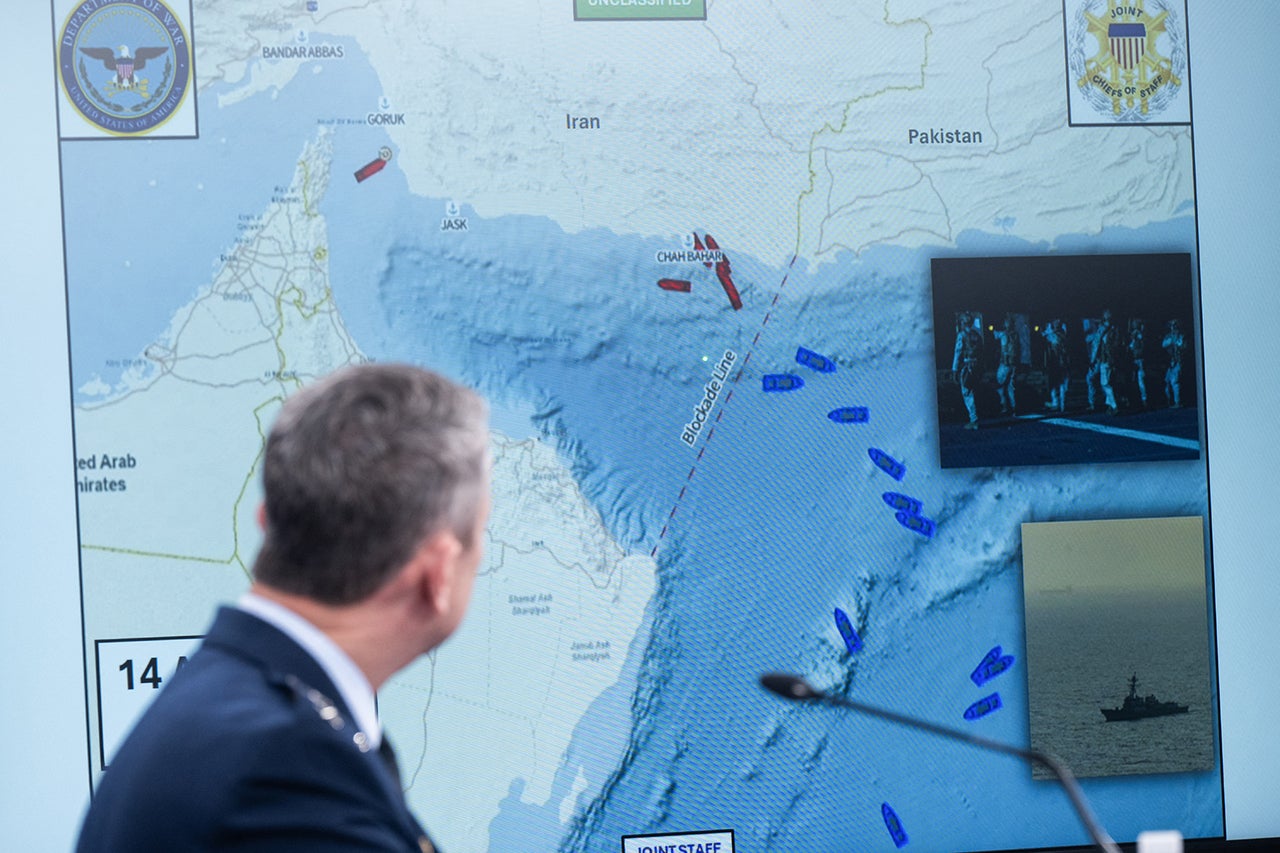
The US has struck the island and is attempting to enforce an illegal naval blockade on Iranian ports in violation of international and maritime law.

But 8,000 people live there. What is life like when bombs fall and the ships stop moving?
 

Ships crossing Hormuz need OK from IRGC, unfreezing funds part of deal: Iran


All ships can sail through the Strait of Hormuz but this needs to be coordinated ‌with Iran’s Islamic Revolutionary Guard Corps (IRGC), a senior Iranian official told Reuters, adding that unfreezing Iranian funds was part of the deal.

Hundreds of ships and 20,000 seafarers have remained stranded inside the Gulf waiting to pass through the key waterway, which handles about 20% of the world's oil and liquefied natural gas flows.

The Iranian official said transits would be restricted to lanes that Iran deemed safe, ⁠adding that military vessels were still prohibited from crossing the strait.
"Releasing Iran's funds was part of the agreement for reopening the strait," the official noted, referring to an estimated $30 billion in frozen revenue, generated mainly from oil and gas exports, blocked amid U.S. sanctions on Tehran.

It was not immediately clear if this included or excluded the established Traffic Separation Scheme (TSS) lanes for entering and exiting the Gulf used by international shipping since the 1970s.

"Even U.S. vessels would be permitted, excluding military ships," he said.

The official added that certain routes through Hormuz would remain open, but added that those would need to be determined as secure by Iran.

"Navigation would take place in coordination with Iran, and with authorisation from the Guards and Iran’s Ports and Maritime Organization to ensure the safety of shipping," the official said.

Shortly after Araqchi's statement, Trump posted on Truth Social: "IRAN HAS JUST ANNOUNCED THAT THE STRAIT OF IRAN IS FULLY OPEN AND READY FOR PASSAGE".

Iranian state media said if the U.S. blockade persists, Tehran will consider it a violation of the ceasefire and will close the strait.

Iran could let ships sail freely through the Omani side of the strait without risk of attack under proposals Tehran has offered in talks with the U.S., providing a deal is clinched.

Iran has warned of mines placed ⁠in the strait, a threat taken seriously by ship owners, insurance underwriters, and firms sending cargo.

That threat is not fully understood and avoidance of the area by ships should be considered, a U.S. Navy advisory said on Friday. "Status of TSS mine threat is not fully understood. Consider avoidance of that area," the US Navy’s U.S. NCAGS agency said.

Shipping industry associations said they were reviewing the situation.

"The announcement ... by U.S. President Donald Trump that the Strait of Hormuz is fully open is inaccurate. The status of mine threats in the Traffic Separation Scheme ⁠is unclear," said Jakob Larsen, chief safety and security officer with shipping association BIMCO.
"BIMCO believes shipping companies should consider avoiding the area".

The UN's shipping agency, the International Maritime Organization (IMO), said it was reviewing the situation.

"We are currently verifying the recent announcement related to the reopening of the Strait of Hormuz, in terms of its compliance with freedom of navigation for all merchant vessels and secure passage," said IMO Secretary-General Arsenio Dominguez.
I know you're a troll, but please don't rope us in with the Trumpies, who would be claiming victory. They are on their own.
 
lol shit stain seems to think we are reading

NOPE
Serious question: you admit your country censors information. You claim you are a special case, allowed online because of your government role. If that were true — and I do not believe it is — how exactly do you imagine that helps your credibility here? It would make you, by your own description, a state-approved exception speaking from inside a censored system. That does not make you an independent witness. It makes you sound like a functionary, or at minimum a mouthpiece.
 
I know you're a troll, but please don't rope us in with the Trumpies, who would be claiming victory. They are on their own.
this moron does not get it. we can be bitterly divided on so many things, but we don't censor people

we don't side with anyone that would. the troll is a pariah
 

World reacts


Politicians and industry welcome Iran's reopening of the vital waterway after tyrant Trump's illegal throttling of ship traffic caused oil prices to spike.

Iran’s Foreign Minister Abbas Araghchi declared on Friday that the strategic waterway was “completely open” despite the piratical attempted US blockade of the vital waterway.

Tyrant Trump affirmed on social media that the strait was open, later claiming that Iran had agreed to “never close the Strait of Hormuz again”.

America's blockade of tankers to and from Iran has led to a global surge in fuel prices.

World leaders have welcomed the news with cautious optimism amid mixed messages from the US.

The Strait of Hormuz is completely open and ready for business and full passage,” tyrant Trump boasted on Truth Social.

Minutes later, he issued another post saying the US Navy’s blockade “will remain in full force”.

Later, the mercurial US leader told the news agency AFP that a deal to end the war on Iran was “close”.

French President Emmanuel Macron said, “We all demand the full, immediate and unconditional reopening of the Strait of Hormuz by all parties.”

United Nations Secretary-General Antonio ⁠Guterres on ⁠Friday welcomed the opening ‌of Strait of Hormuz by Iran ⁠and said ⁠it was “a ⁠step in the ⁠right ⁠direction”.

“This news is having an immediate impact on markets,” said Kathleen Brooks, research director at XTB. “This is the biggest development so far during the ceasefire, and it gives hope that the war will end soon, and supply chains will return to some normality.”
 

World reacts


Politicians and industry welcome Iran's reopening of the vital waterway after tyrant Trump's illegal throttling of ship traffic caused oil prices to spike.

Iran’s Foreign Minister Abbas Araghchi declared on Friday that the strategic waterway was “completely open” despite the piratical attempted US blockade of the vital waterway.

Tyrant Trump affirmed on social media that the strait was open, later claiming that Iran had agreed to “never close the Strait of Hormuz again”.

America's blockade of tankers to and from Iran has led to a global surge in fuel prices.

World leaders have welcomed the news with cautious optimism amid mixed messages from the US.

The Strait of Hormuz is completely open and ready for business and full passage,” tyrant Trump boasted on Truth Social.

Minutes later, he issued another post saying the US Navy’s blockade “will remain in full force”.

Later, the mercurial US leader told the news agency AFP that a deal to end the war on Iran was “close”.

French President Emmanuel Macron said, “We all demand the full, immediate and unconditional reopening of the Strait of Hormuz by all parties.”

United Nations Secretary-General Antonio ⁠Guterres on ⁠Friday welcomed the opening ‌of Strait of Hormuz by Iran ⁠and said ⁠it was “a ⁠step in the ⁠right ⁠direction”.

“This news is having an immediate impact on markets,” said Kathleen Brooks, research director at XTB. “This is the biggest development so far during the ceasefire, and it gives hope that the war will end soon, and supply chains will return to some normality.”
Serious question: you admit your country censors information. You claim you are a special case, allowed online because of your government role. If that were true — and I do not believe it is — how exactly do you imagine that helps your credibility here? It would make you, by your own description, a state-approved exception speaking from inside a censored system. That does not make you an independent witness. It makes you sound like a functionary, or at minimum a mouthpiece.
 
we need to see the actual deal before we decide who won. Unnamed sources dont count


Abbas Araghchi is a man of his word and has the support of his government.

Donald Trump is not an man of his word and is opposed by many in his own government.

Since the US launched the war, Iran has allowed about 100 vessels through Hormuz.

Trump, in the meantime, has gone from a policy of lifting sanctions on Iranian oil to ease the global supply pressures to seeking to cut it off altogether.

His vacillations must be dizzying to Americans trying to maintain support for him.
 

Strait of Hormuz is opened despite Trump, but economic pain is just beginning


At this week's IMF meetings, world leaders warned of the long-term impacts of the past six weeks of war.

Ahead of expected talks with the U.S. in Pakistan this weekend, Iran announced that the Strait of Hormuz is “completely open for the remaining period of the ceasefire,” sending oil market prices tumbling.

But, regardless of what happens in Islamabad, global policymakers are warning that the immense scale of destruction in the Persian Gulf could have lingering effects for a long time to come.

At a Debate on the Global Economy held at the spring meetings of the International Monetary Fund Thursday, Saudi Finance Minister Mohammed al-Jadaan said, “markets were taking too optimistic a picture.” He pointed out that, even if the U.S. backs down, it could take months to reach even a semblance of normalcy.

Production at oilfields and refineries that had shut down would need to be restarted, he noted, and shipowners and insurers would need to be comfortable that hostilities would not resume anytime soon.

Other delays might result from the logistics of resupplying ships that have been trapped in the Gulf for more than a month.

The minister suggested that, even in a best-case diplomatic scenario, a resumption of seaborne trade crossing the Strait of Hormuz at anything approaching prewar levels might not happen until the end of June.

And the arrival of oil or petroleum products at their final destination would take even longer.

There’s a reason the supertanker is a metaphor for something that moves and maneuvers slowly.

It can take 20 days for cargoes from Hormuz to reach Singapore and, as IMF Managing Director Kristalina Georgieva pointed out at the same event, up to 40 days to reach the Pacific Islands.

The bigger problem may be the physical damage that the war has wrought.

One recent estimate puts the damage to energy infrastructure at $58 billion, with the brunt felt in Iran, where the damage has been extensive, and in Qatar, where it was more precisely targeted at the massive Ras Laffan Liquefied Natural Gas export facility. Some parts of that facility are expected to remain offline for years; it could take four years for specialized suppliers to deliver key components, like the massive gas turbines required for compression and liquefaction.

Downstream of oil and gas production lie many materials essential to the modern world.

Fertilizer is by far the most important, but others include helium, used for semiconductor production and ethylene glycol, used as an antifreeze for concrete.

In other words, the war’s impact on industries from electronics to construction could still be felt for months or years to come.

Further, the drawdown of stockpiles of petroleum means that, even once “normal” supplies resume, many countries may conclude not just that they will have to replenish the drawdowns, but also that they must build bigger and broader stockpiles.

This activity will affect the cost of procuring supplies for the poorest countries of the Global South.

All this serves as a reminder that, in an age of mercurial policymakers like Donald Trump, instant communications, and fast-moving markets, an older economics based on the physical and temporal constraints of “stuff” and distance still matters enormously.
 

Trump Says the Strait of Hormuz Is Open ... Again. About That … I regret to inform you that the president of the United States may not be totally on the level


d4d4099a-8993-4d35-83c9-36c8a397d3e0.jpeg


You’ll be shocked to hear this, but Donald Trump doesn’t seem to know how to handle the Strait of Hormuz.

Saudi Arabia has been itching for Trump to end that blockade, and his simple “thank-you” message to the Gulf royals isn’t likely to satisfy them.

Iran itself has stated that it considers a blockade to be a violation of its peace deal with the U.S.—a stance it still holds as of Friday.

It turns out there’s still a lot that’s up in the air. And until and unless Trump formally ends the destructive, useless, counterproductive war with Iran he started for no real reason, hardly anyone is going to feel any relief for a while yet.

Last week’s announcement of a two-week ceasefire between the United States and Iran was conditioned upon the regime’s willingness to open the strait for passage—which it did.

Trump then imposed the blockade, which multiple Iranian boats reportedly managed to supersede, as the Iranian regime threatened to set up its own barriers over the Red Sea and gulf coast. The only reason that didn’t come to pass is that Israel finally declared a 10-day ceasefire with Lebanon on Thursday evening.

Trump is still attempting to decouple the Israel-Lebanon deal from the one he reached with Iran. He has posted repeatedly that “this deal is in no way subject to Lebanon,” while emphasizing that Israel is “PROHIBITED” from bombing its neighbor. That puts Israeli Prime Minister Benjamin Netanyahu in a shaky spot: It was Bibi who persuaded the U.S. to join Israel in bombing Iran in the first place.

Then there’s Trump’s blasé approach (“well, [prices] are not very high”) to the lingering effects of the strait’s obstruction.

His blockade effectively shut down the transmission of essential materials; not just oil —sulfur, helium, urea, ammonia, steel, feedstock—has been restricted to devastating effect, constricting global supply and production of everything from agricultural goods to fertilizer to semiconductors to passenger vehicles

The self-imposed economic damage at home is ramping up; Trump’s own voters are not buying his dismissal of heightened gas and food and car costs. Desperate people across both hemispheres are begging Trump to end the carnage he wantonly started.

So, despite Trump’s Truth Social celebrations and the stock market’s bizarre rally, the situation abroad remains extremely uncertain—and no matter what happens next, the consequences will be felt worldwide through the rest of the year.
 

A False Dawn in the Strait of Hormuz?


Global energy prices collapsed on Friday morning following an announcement from Iranian Foreign Minister Abbas Araghchi that “passage for all commercial vessels through the Strait of Hormuz” is now “completely open” despite the U.S. blockade.

The move does not represent an acknowledgment by Tehran that it does not and will not control traffic through the Strait.

Iran's Foreign Minister added that "this passage must be conducted along the coordinated and pre-announced route by the Islamic Republic of Iran's Ports and Maritime Organization".
 
Serious question: you admit your country censors information. You claim you are a special case, allowed online because of your government role. If that were true — and I do not believe it is — how exactly do you imagine that helps your credibility here? It would make you, by your own description, a state-approved exception speaking from inside a censored system. That does not make you an independent witness. It makes you sound like a functionary, or at minimum a mouthpiece.
He's not in Iran. He's in the United States, pretending he's in Iran.
 

Inside Kharg Island, Iran’s oil lifeline under threat


Kharg Island is the heart of Iran’s oil trade and now a front-line target in the US-Isteali war of aggression.

The US has struck the island and is attempting to enforce an illegal naval blockade on Iranian ports in violation of international and maritime law.

But 8,000 people live there. What is life like when bombs fall and the ships stop moving?
You cannot blame Iran's problems on Trump, dope.

Life everywhere in Iran is pretty lousy right now. The economy, based on oil, is collapsing, since Iran cannot sell any oil.
Conflict between belligerents is not against international or maritime law, dope.
 
Back
Top