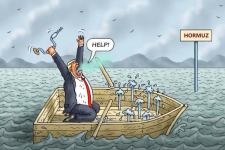
Trump begs communist China to help him secure the Strait of Hormuz

Cypress

Well-known member

Trump urges China to help address Strait of Hormuz crisis​

President Donald Trump said he could postpone a planned summit with Chinese leader Xi Jinping as he urges Beijing to help address disruptions in the Strait of Hormuz caused by the conflict with Iran.

“I think China should help too because China gets 90% of its oil from the Straits,” Trump said in an interview with the Financial Times published Sunday, adding that he would prefer to know Beijing’s position before a planned meeting between the two leaders later this month.

“We’d like to know before that. It’s [two weeks is] a long time,” Trump said. “We may delay,” he added of the trip to China, without specifying how long any delay could last.

Trump’s remarks come a day after he called on several countries, including China, France, Japan, South Korea and the United Kingdom, to join what he described as a broader “team effort” to reopen the strategic chokepoint, which handles roughly a fifth of the world’s oil supply.


China has little incentive to concede to Trump's pleas.​

On the face of it, Trump's request is extraordinary – Trump is asking China to risk its own military assets in a war the US started against a Beijing-friendly nation, and threatening to withhold diplomacy otherwise.

But China is better positioned than the rest of Asia to endure a prolonged energy crisis. In the past several years, Beijing has sought to cushion itself from such an oil shock by stockpiling crude reserves, diversifying imports and investing billions in clean energy such as wind, solar and electric vehicles.


Trump urges China to help address Strait of Hormuz crisis​

President Donald Trump said he could postpone a planned summit with Chinese leader Xi Jinping as he urges Beijing to help address disruptions in the Strait of Hormuz caused by the conflict with Iran.

“I think China should help too because China gets 90% of its oil from the Straits,” Trump said in an interview with the Financial Times published Sunday, adding that he would prefer to know Beijing’s position before a planned meeting between the two leaders later this month.

“We’d like to know before that. It’s [two weeks is] a long time,” Trump said. “We may delay,” he added of the trip to China, without specifying how long any delay could last.

Trump’s remarks come a day after he called on several countries, including China, France, Japan, South Korea and the United Kingdom, to join what he described as a broader “team effort” to reopen the strategic chokepoint, which handles roughly a fifth of the world’s oil supply.


The US does not get oil through the straits of Hormuz but China does. China SHOULD help keep it open.
 
The US does not get oil through the straits of Hormuz
Trump wouldn't be desperately begging other countries to save him if the strait wasn't a,strategic American concern. Oil is traded on the world markets, any disruption in the strait will effect global petroleum prices.

"The top five source countries of U.S. gross petroleum imports in 2023 were Canada, Mexico, Saudi Arabia, Iraq, and Brazil."
-US Energy Information Agency.
but China does. China SHOULD help keep it open.
China considers Iran an ally, they aren't going to risk their military assets to save Trump's fat ass by waging war on an ally. Iran will undoubtedly make arrangements for shipping from China and other non-US allies to transit the strait.
 
Trump wouldn't be desperately begging other countries to save him if the strait wasn't a,strategic American concern. Oil is traded on the world markets, any disruption in the strait will effect global petroleum prices.

"The top five source countries of U.S. gross petroleum imports in 2023 were Canada, Mexico, Saudi Arabia, Iraq, and Brazil."
-US Energy Information Agency.

China considers Iran an ally, they aren't going to risk their military assets to save Trump's fat ass by waging war on an ally. Iran will undoubtedly make arrangements for shipping from China and other non-US allies to transit the strait.
While true, I think part of those imports from SA and Iraq are economic support. Kinda like only shopping from a local grocer instead of Walmart. It's #4 on the list from Google AI below. There are obvious economic reasons which all help contribute to cheap gas in the US....reasons which are clearly being displayed at the pump.

Trump dug himself a hole and wants help out of it. It's just another reason why he's the worst President in our history.

Why does the US import oil for Saudi Arabia and Iraq?


The United States continues to import oil from Saudi Arabia and Iraq due to a combination of refinery mismatch, geographic logistics, and economic efficiency.

Despite being the world's top crude oil producer, the U.S. is a "net importer" of crude oil specifically because its domestic infrastructure is not perfectly aligned with its domestic production.
U.S. Energy Information Administration (EIA) (.gov) +1

1. Refinery Infrastructure Mismatch

The primary reason for Middle Eastern imports is a technical "mismatch" in chemical processing:

  • Crude Types: Most U.S. domestic production (from fracking) is "light, sweet" crude.
  • Refinery Setup: Many major U.S. refineries, particularly along the Gulf Coast, were built decades ago to process "heavy, sour" crude from countries like Saudi Arabia and Iraq.
  • Cost of Retooling: Changing these refineries to process only light domestic oil would cost billions of dollars and take years, which is often seen as a risky investment given the shift toward renewable energy.
    American Fuel & Petrochemical Manufacturers +3

2. Economic Efficiency and Global Markets
Oil is a globally traded commodity, and private companies prioritize profit:

  • Arbitrage: It is often more profitable for U.S. companies to export their high-quality light crude to international markets for a premium and import cheaper heavy crude to fill their refineries.
  • Lower Production Costs: Lifting costs in Middle Eastern fields can be significantly lower (e.g., ~$31/barrel) compared to U.S. shale or deepwater extraction (~$43–$44/barrel).
  • Refined Product Exports: The U.S. imports crude as a raw material, refines it into high-value products like gasoline, diesel, and jet fuel, and then exports those finished products for a higher return.
    U.S. Energy Information Administration (EIA) (.gov) +3

3. Geographic and Logistics Constraints

  • Regional Demand: It is sometimes cheaper for the East or West Coasts to import oil from overseas than to transport domestic oil from Texas or North Dakota via pipelines or rail, due to infrastructure bottlenecks.
  • Supply Security: Maintaining diverse sources of oil ensures that the U.S. is not overly reliant on any single region or pipeline in the event of a local disaster or geopolitical disruption.
    GZERO Media +2

4. Strategic and Diplomatic Ties

  • Global Stability: Importing from Saudi Arabia and Iraq helps maintain long-standing diplomatic and security partnerships.
  • Market Influence: These relationships allow the U.S. to exert more influence over global oil prices and maintain a presence in the Strait of Hormuz, a critical chokepoint for 20% of the world's oil.
    Harvard University +4
 
While true, I think part of those imports from SA and Iraq are economic support. Kinda like only shopping from a local grocer instead of Walmart. It's #4 on the list from Google AI below. There are obvious economic reasons which all help contribute to cheap gas in the US....reasons which are clearly being displayed at the pump.

Trump dug himself a hole and wants help out of it. It's just another reason why he's the worst President in our history.

Why does the US import oil for Saudi Arabia and Iraq?


The United States continues to import oil from Saudi Arabia and Iraq due to a combination of refinery mismatch, geographic logistics, and economic efficiency.

Despite being the world's top crude oil producer, the U.S. is a "net importer" of crude oil specifically because its domestic infrastructure is not perfectly aligned with its domestic production.
U.S. Energy Information Administration (EIA) (.gov) +1

1. Refinery Infrastructure Mismatch
The primary reason for Middle Eastern imports is a technical "mismatch" in chemical processing:

  • Crude Types: Most U.S. domestic production (from fracking) is "light, sweet" crude.
  • Refinery Setup: Many major U.S. refineries, particularly along the Gulf Coast, were built decades ago to process "heavy, sour" crude from countries like Saudi Arabia and Iraq.
  • Cost of Retooling: Changing these refineries to process only light domestic oil would cost billions of dollars and take years, which is often seen as a risky investment given the shift toward renewable energy.
    American Fuel & Petrochemical Manufacturers +3

2. Economic Efficiency and Global Markets
Oil is a globally traded commodity, and private companies prioritize profit:

  • Arbitrage: It is often more profitable for U.S. companies to export their high-quality light crude to international markets for a premium and import cheaper heavy crude to fill their refineries.
  • Lower Production Costs: Lifting costs in Middle Eastern fields can be significantly lower (e.g., ~$31/barrel) compared to U.S. shale or deepwater extraction (~$43–$44/barrel).
  • Refined Product Exports: The U.S. imports crude as a raw material, refines it into high-value products like gasoline, diesel, and jet fuel, and then exports those finished products for a higher return.
    U.S. Energy Information Administration (EIA) (.gov) +3

3. Geographic and Logistics Constraints
  • Regional Demand: It is sometimes cheaper for the East or West Coasts to import oil from overseas than to transport domestic oil from Texas or North Dakota via pipelines or rail, due to infrastructure bottlenecks.
  • Supply Security: Maintaining diverse sources of oil ensures that the U.S. is not overly reliant on any single region or pipeline in the event of a local disaster or geopolitical disruption.
    GZERO Media +2

4. Strategic and Diplomatic Ties
  • Global Stability: Importing from Saudi Arabia and Iraq helps maintain long-standing diplomatic and security partnerships.
  • Market Influence: These relationships allow the U.S. to exert more influence over global oil prices and maintain a presence in the Strait of Hormuz, a critical chokepoint for 20% of the world's oil.
    Harvard University +4
Oh, that's interesting. I didn't really know about the refinery mismatch
 
Oh, that's interesting. I didn't really know about the refinery mismatch
It's all about the money. No doubt Netanyahu wanted to bomb the shit out of Iran, but he needed the support of the US to do so, both in military protection and in weapons supply. Trump's oil oligarchs, the same assholes behind Venezuela and multiple mass murders at sea, were, without a doubt, the driving force in attacking Iran. This is about oil and the profits gained from it.
 
It's all about the money. No doubt Netanyahu wanted to bomb the shit out of Iran, but he needed the support of the US to do so, both in military protection and in weapons supply. Trump's oil oligarchs, the same assholes behind Venezuela and multiple mass murders at sea, were, without a doubt, the driving force in attacking Iran. This is about oil and the profits gained from it.
As far as the United States is concerned, Iran has always been a thorn in the flesh, not a dagger in the heart. I think Trump is not a rational actor, I don't think he was carefully calculating the net petro-profit to the United States. He decided on this war for a range of intangible and emotional reasons. He is still enraged by the 1979 hostage crisis.
 
Back
Top