China will need 3 carrier battle groups to invade Taiwan by 2027

serendipity

Verified User
.
Taiwanese military should enhance self-defense before 2027 to 'make Xi modify or postpone timeline'

Admiral Huang Shu-kuang (黃曙光), chief of the general staff and convener of the Indigenous Defense Submarine (IDS) program, believes that China will need at least three carrier battle groups to be capable of launching an invasion of Taiwan.

Huang was cited by CNA as saying that the People's Liberation Army Navy (PLAN) will need at least three carrier battle groups deployed to the northeast, southeast, and southwest of Taiwan to be in a position to invade the country. He added that there must also be a decline in U.S. military strength, and although he predicted that China will be able to invade Taiwan by 2027, "whether it attacks or not" will depend on other factors.

He analyzed that based on the scope of past PLA military exercises, the PLA is preparing three carrier battle groups. The first would be deployed in the southeastern waters of Taiwan to contain Guam, the second would be deployed in the northeastern waters to restrain U.S. and Japanese forces, and the third would be deployed in the southwest waters of Taiwan.

https://www.taiwannews.com.tw/en/news/5007469
 
.
Taiwanese military should enhance self-defense before 2027 to 'make Xi modify or postpone timeline'

Admiral Huang Shu-kuang (黃曙光), chief of the general staff and convener of the Indigenous Defense Submarine (IDS) program, believes that China will need at least three carrier battle groups to be capable of launching an invasion of Taiwan.

Huang was cited by CNA as saying that the People's Liberation Army Navy (PLAN) will need at least three carrier battle groups deployed to the northeast, southeast, and southwest of Taiwan to be in a position to invade the country. He added that there must also be a decline in U.S. military strength, and although he predicted that China will be able to invade Taiwan by 2027, "whether it attacks or not" will depend on other factors.

He analyzed that based on the scope of past PLA military exercises, the PLA is preparing three carrier battle groups. The first would be deployed in the southeastern waters of Taiwan to contain Guam, the second would be deployed in the northeastern waters to restrain U.S. and Japanese forces, and the third would be deployed in the southwest waters of Taiwan.

https://www.taiwannews.com.tw/en/news/5007469

Lets get out the nukes and get this ridiculous human being era over with once and for all.:clink:
 
In the 2016 sci-fi film Star Trek Beyond, the USS Enterprise is destroyed by a swarm drone attack.

That type of tactic does concern me when it comes to our Carriers.

The way carriers protect themselves against swarm attacks, whether drones, or manned aircraft, is by standing back. They can project their power from a thousand miles away, so hopefully stay out of harm.

Let's apply this to a hypothetical war in the Taiwan Straits between Chinese and American carriers. There is about 5,000 miles Taiwan and Hawaii for American carriers to stand back into. The distance from Taiwan to China is a little over 100 miles. That gives no space for a Chinese carrier to stand back in. The Taiwanese have an advanced, tech savvy economy that is very invested into defending itself. It would absolutely hammer Chinese carriers, while [hopefully] American carriers stood back behind the outer island ring hitting China hard from far away.

Obviously, there are more "hopefullies" in there than I would like, but one more thought, the USA has over a 100 years of experience with carriers. No other country has even a tenth of our experience. China has a few years of some carrier experience.
 
China has no intention of invading the province of Taiwan....if it comes to that it would be a massive failure of Chinese statecraft.
 
Unlike in America and Europe the people are in charge, it is expected that with the elections of next year Taiwan will begin the process of peaceful unification with the CCP. Watching Ukraine destroy itself has been instructional.
 
The way carriers protect themselves against swarm attacks, whether drones, or manned aircraft, is by standing back. They can project their power from a thousand miles away, so hopefully stay out of harm.

Let's apply this to a hypothetical war in the Taiwan Straits between Chinese and American carriers. There is about 5,000 miles Taiwan and Hawaii for American carriers to stand back into. The distance from Taiwan to China is a little over 100 miles. That gives no space for a Chinese carrier to stand back in. The Taiwanese have an advanced, tech savvy economy that is very invested into defending itself. It would absolutely hammer Chinese carriers, while [hopefully] American carriers stood back behind the outer island ring hitting China hard from far away.

Obviously, there are more "hopefullies" in there than I would like, but one more thought, the USA has over a 100 years of experience with carriers. No other country has even a tenth of our experience. China has a few years of some carrier experience.
Do you think we would commit our military to defend Taiwan?
 
Do you think we would commit our military to defend Taiwan?

Maybe, or maybe not. The Chinese do not know, nor do we. The current Chinese Government is very risk adverse, so not knowing means they will assume we will. Even if we did not want to, we could still be dragged into a major war in the Western Pacific. It would be hard to avoid.

Even without the USA, Taiwan is an impressive force. They have had 75 years to prepare for this invasion, and would fight it hard. There is not enough room for the Chinese carriers to stand back.

Random point: China has a historic claim to Russia's Siberia, which they have been talking more and more about. Siberia would be easier for the Chinese to invade, and has more natural resources to gain. Taiwan's only resource is educated people, who would tend to flee a Chinese invasion... Besides, China has plenty of educated people.

I am not at the point that I am predicting a Chinese invasion of Siberia, or even claim it is reasonably possible. I am saying Putin has made a dangerous decision for Russia, by removing many of their defenses against the Chinese.
 
Maybe, or maybe not. The Chinese do not know, nor do we. The current Chinese Government is very risk adverse, so not knowing means they will assume we will. Even if we did not want to, we could still be dragged into a major war in the Western Pacific. It would be hard to avoid.

Even without the USA, Taiwan is an impressive force. They have had 75 years to prepare for this invasion, and would fight it hard. There is not enough room for the Chinese carriers to stand back.

Random point: China has a historic claim to Russia's Siberia, which they have been talking more and more about. Siberia would be easier for the Chinese to invade, and has more natural resources to gain. Taiwan's only resource is educated people, who would tend to flee a Chinese invasion... Besides, China has plenty of educated people.

I am not at the point that I am predicting a Chinese invasion of Siberia, or even claim it is reasonably possible. I am saying Putin has made a dangerous decision for Russia, by removing many of their defenses against the Chinese.

You are such a fucking liar....the CCP has been on a romp and been extremely belligerent with the West.....their main threat is taking too much risk because they are over confident.

And their partnership with the Russians is now unbreakable.
 
Unlike in America and Europe the people are in charge, it is expected that with the elections of next year Taiwan will begin the process of peaceful unification with the CCP. Watching Ukraine destroy itself has been instructional.

Watching Ukraine defend itself has been instructive, but so has what happened in Hong Kong. The majority of Taiwanese want to never unify with China.
 
Taiwan's new subs to deny Chinese forces access beyond First Island Chain

Top Taiwan military official says subs are vital to preventing Chinese blockade

TAIPEI (Taiwan News) — Taiwan's fleet of domestically-produced submarines will be deployed to block the Chinese military from encircling Taiwan and prevent any attempts to sail beyond the First Island Chain, Taiwan’s Chief of the General Staff of the Armed Forces Huang Shu-kuang (黃曙光) said recently.

Huang pointed out that if China successfully implements a blockade of Taiwan, the Bashi Channel and Balintang Channel will become important passages for Chinese aircraft carriers and naval fleets to enter the Philippine Sea, CNA reported. Therefore, the military must have an adequate number of submarines and surface vessels to guard the key passages to prevent China from bypassing Taiwan's southeastern or eastern waters, he said.

He said that submarines from Taiwan, the U.S., and other countries operate in the waters around Taiwan. In the event of a defense operation in northern Taiwan waters, its proximity to Japan’s southwestern islands would justify a First Island Chain joint defense, Huang said.

This plan would involve Japan’s Self-Defense Forces, which would be responsible for defending the Miyako Strait. Chinese naval fleets would be unable to sail through Taiwan’s northern waters.

This strategy aims to prevent China from entering the greater Pacific and engaging in Anti-Access/Area Denial operations against U.S. forces, the chief of staff said.

Taiwan's first submarine prototype, which will be christened the Hai Kun, is scheduled to be launched on Thursday (Sept. 28) at CSBC Corporation’s Kaohsiung shipyard. Huang said three domestically produced submarines are expected by 2025.

https://www.taiwannews.com.tw/en/news/5007651
 
The way carriers protect themselves against swarm attacks, whether drones, or manned aircraft, is by standing back. They can project their power from a thousand miles away, so hopefully stay out of harm.

Let's apply this to a hypothetical war in the Taiwan Straits between Chinese and American carriers. There is about 5,000 miles Taiwan and Hawaii for American carriers to stand back into. The distance from Taiwan to China is a little over 100 miles. That gives no space for a Chinese carrier to stand back in. The Taiwanese have an advanced, tech savvy economy that is very invested into defending itself. It would absolutely hammer Chinese carriers, while [hopefully] American carriers stood back behind the outer island ring hitting China hard from far away.

Obviously, there are more "hopefullies" in there than I would like, but one more thought, the USA has over a 100 years of experience with carriers. No other country has even a tenth of our experience. China has a few years of some carrier experience.

"Standing back" means not getting involved or retreating. And distance does not always equal safety.

We've already seen that the Drone role in warfare is growing rapidly. And IIRC, Iran has launched swarm attacks of small boats against our ships. Our enemies are developing underwater drones that could also be used in a swarm attack.

I assume you're aware that in ww2 the Japanese built a submarine capable of carrying and launching 3 fighter planes from sea. Technology has advanced mightily since then.
 
"Standing back" means not getting involved or retreating. And distance does not always equal safety.

With carriers, standing back means they do not directly engage the enemy, but rather use their planes to attack. For instance, during the Vietnam War, carriers were never attacked by the North Vietnamese, but were able to use their planes to attack the enemy.

Other ships would often come close enough to both attack the enemy, but also close enough to be attacked by the enemy.

Distance is not a perfect strategy, but it is one of the strategies that carriers use.

We've already seen that the Drone role in warfare is growing rapidly.

It is a technology that is advancing, but it cuts both ways. Carriers could launch drones that would attack enemies.

There is no certainties here. We (and a dozen or two other countries) invest in carriers not because we are sure they are the future, but because they might be the future.

I assume you're aware that in ww2 the Japanese built a submarine capable of carrying and launching 3 fighter planes from sea. Technology has advanced mightily since then.

Yes, there are definite risks.
 
Taiwan's new subs to deny Chinese forces access beyond First Island Chain

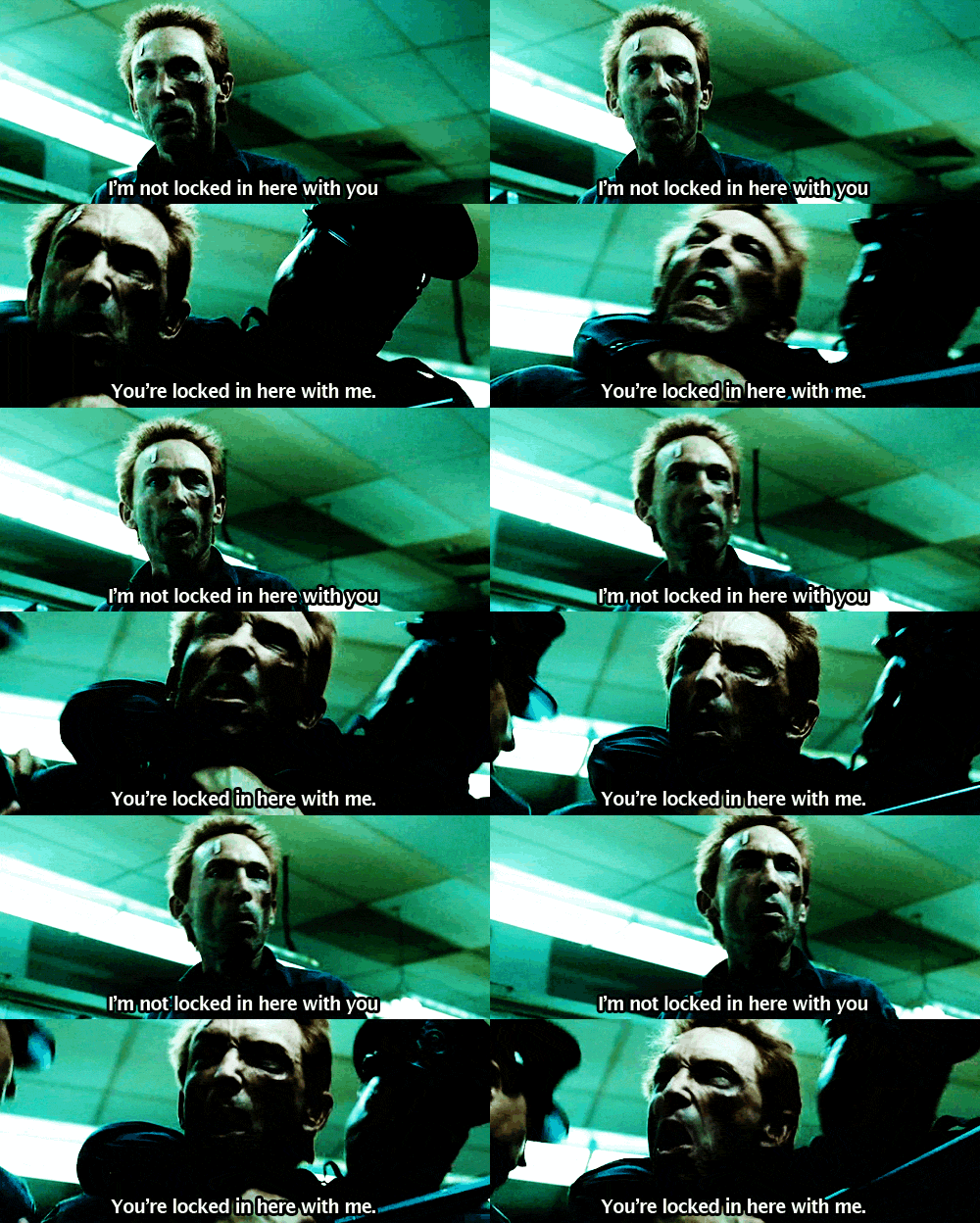
Taiwan is telling China that China thought Taiwan was locked in with China, but actually China was locked in with Taiwan.

255.gif


All kidding aside, China is surrounded by islands it does not control, and so would have a very difficult time making an amphibious assault on Taiwan.
 
.
Taiwanese military should enhance self-defense before 2027 to 'make Xi modify or postpone timeline'

Admiral Huang Shu-kuang (黃曙光), chief of the general staff and convener of the Indigenous Defense Submarine (IDS) program, believes that China will need at least three carrier battle groups to be capable of launching an invasion of Taiwan.

Huang was cited by CNA as saying that the People's Liberation Army Navy (PLAN) will need at least three carrier battle groups deployed to the northeast, southeast, and southwest of Taiwan to be in a position to invade the country. He added that there must also be a decline in U.S. military strength, and although he predicted that China will be able to invade Taiwan by 2027, "whether it attacks or not" will depend on other factors.

He analyzed that based on the scope of past PLA military exercises, the PLA is preparing three carrier battle groups. The first would be deployed in the southeastern waters of Taiwan to contain Guam, the second would be deployed in the northeastern waters to restrain U.S. and Japanese forces, and the third would be deployed in the southwest waters of Taiwan.

https://www.taiwannews.com.tw/en/news/5007469

In wonder how.much joe biden has donated
 
if cocckroaches knew what we know, would they disable nuclear weapons by chewing through the wires on the launch buttons?.....or would they find a way to sneak in and push the buttons......

Someone once pointed out that cockroaches need a warm environment to survive. Their preferred temperature is 85 to 95 degrees with very high humidity. They can survive at room temperature. It goes much below that, they start really suffering.

Without us keeping the heat on, cockroaches would die out in places like NYC. It is way too cold with humans keeping them warm. Maybe in Miami they could survive, but in much diminished numbers due to the less food without us supplying food.

It is a fun myth that cockroaches would out survive us. They need us to survive in most of America.
 
Someone once pointed out that cockroaches need a warm environment to survive. Their preferred temperature is 85 to 95 degrees with very high humidity. They can survive at room temperature. It goes much below that, they start really suffering.

Without us keeping the heat on, cockroaches would die out in places like NYC. It is way too cold with humans keeping them warm. Maybe in Miami they could survive, but in much diminished numbers due to the less food without us supplying food.

It is a fun myth that cockroaches would out survive us. They need us to survive in most of America.

I tend to agree.....we provide roaches with food and housing......they will keep us around......
 
Back
Top