Range anxiety is becoming a thing of the past as electric vehicle technology advances

What's the cost of a personal charging station? And the monthly cost to drive electric? Affordable for the average middle class family? Especially these days...when many families are living paycheck to paycheck?

You do not need a charging station. The cars come with chargers that will recharge just by plugging into a garage outlet. If you want faster charging, you can get a 2nd level charger installed. It is often about 600 to 800 bucks.
EVs save money. They also eliminate the trips to gas stations. Living on the edge is easier with an electric. Far less maintenance.
 
You do not need a charging station. The cars come with chargers that will recharge just by plugging into a garage outlet. If you want faster charging, you can get a 2nd level charger installed. It is often about 600 to 800 bucks.
EVs save money. They also eliminate the trips to gas stations. Living on the edge is easier with an electric. Far less maintenance.

I put in a level 2 charger in my garage for $1,600 so I charge there 95% of the time. Super convenient. And I pay about half of the cost of gas. I've gone on long trips with no problems finding chargers. There are many apps available that will plan out a trip for you and show you the chargers along the way and how much charge you need to get there. Simple.
I love technology.
 
Last edited:
I put in a level 2 charger in my garage for $1,600 so I charge there's 95% of the time. Super convenient. And I pay about half of the cost of gas. I've gone on long trips with no problems finding chargers. There are many apps available that will plan out a trip for you and show you
The chargers along the way and how much charge you need to get there. Simple.
I love technology.

Just type in EV chargers on your phone or computer and your zip. They will be flagged. You will be surprised how many there are.
 
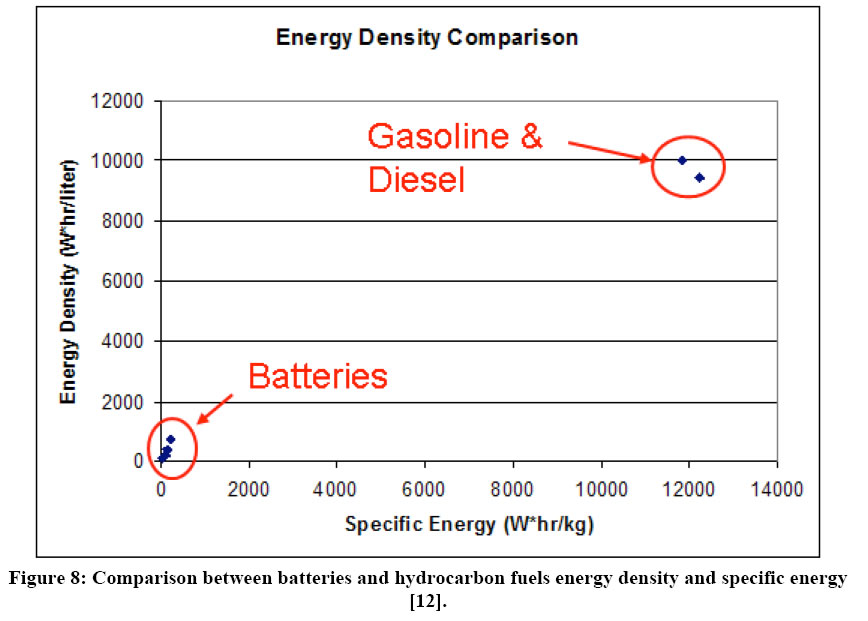
The batteries in the Telsa have 10 times the energy density of anything available in the 1980's, so no you could not.

Volumetric-and-gravimetric-energy-density-for-different-battery-technologies-2.png


Try less than triple. But that still makes them a tiny fraction of energy density in most liquid fuels like gasoline or diesel.

energy_density_batteries_vs_gasoline.jpg
 
That’s a canard. E vehicles are already viable or there wouldn’t already be millions of the things on the road. That’s already been proven otherwise the automakers wouldn’t be investing billions in improving efficiencies, economies of scale and infrastructure. That viability issue has already sailed. Its done been proven.

I used viable in the sense that they are competitive in the marketplace. During that entire time, they have never gained traction in the market on their own. Today the ONLY reason they are gaining ground is through government meddling / interference in the market. Without that, they would still be failures. Even with heavy handed government subsidies, edicts, mandates, and outright bans of ICE vehicles, EV's remain unpopular even as they are forced on consumers.
 
150+ years and it's still not viable... How much time will it require?

Just think about what EVs were like five years ago and how much more viable they are now than they were then.

The advantage EVs have over gas cars will continue to increase every year.
By 2030, more EVs will be sold than gas cars and shortly after gas cars will go the way of VHS tapes.


MAGA morons soil diapers
Again I have to stress that the viability of electric vehicles is a non issue. It’s already been proven. Anyone who denies this is either uninformed or is playing tribal politics.

Let’s start with the environmental aspects of e-vehicles vs. internal combustion vehicles. Based on material balance calculations, which is the only real method for calculating environmental efficiency, where engineers calculate all material inputs into a process (including energy) vs. all outputs and determining how much of those outputs are waste. To state the obvious the lower the quantity of waste in the outputs of the process the more efficient a process is and the lower its environmental impact will be. So when engineers design an industrial process this is one of the first steps they take is calculating a total materials balance for that process as it permits the engineer to identify where waste occurs in the outputs of a process so that they can reduce or eliminate waste in that process. In a total material balance calculation e-vehicles win hands down, when determining all outputs of waste vs. internal combustion vehicles. It’s not just all about e-vehicles being more energy efficient either. E-vehicles have other efficiencies.

Namely that electric motors are just far simpler and efficient than internal combustion engines. Because of this e-vehicles are far simpler to design and assemble and thus e-vehicles are easier to design and assemble. The reason why is that internal combustion vehicles have far more moving parts of greater complexity. E-vehicles don’t need motor lubricating systems or coolant systems or a transmission. So no pumps, reservoirs, radiators, belts, pulleys, transmissions, etc,. In addition electric engines don’t need tune ups or complex power robbing post combustion systems. No oil changes needed or coolants or flushes or hydraulic fluids, no clutches, etc, etc,.

These efficiency’s are already being felt with e-vehicles having a lower total cost to own, less maintenance and better reliability and performance.

So that’s why I don’t understand the political hostility. Im excited about the advances and I will consider an e-vehicle.

I’d even suggest that when the front end cost for an e-vehicle is equal to an equivalent IC vehicle than IC vehicles will be obsolete as they will not be able to compete with e-vehicles significantly lower total cost to own.

This is why the automakers are investing heavily in e-vehicles manufacturing, supply chain and infrastructure.

Keep in mind this mostly being driven by market forces.

Putting all that horse shit aside I’d tell everyone to drive one and judge it objectively. I was impressed with the two I test drove. The S model was a rocket ship. An absolute blast to drive. 0-60 in 3 point something and excellent handling. The 3-model is quite impressive at its point price. It’s surprisingly engaging and fun to drive.

So like or not EV’s have already gone mainstream but it’s still just the beginning.
 
Here's a real-life example of why an EV, in my case, wouldn't work.

About a week ago, I drove from Las Cruces NM to Phoenix AZ. My route (you can look it up on Google Maps) was up I 25 to Socorro NM then US 60 across into Arizona to Arizona 260 then down US 87 from Payson to Phoenix. The drive took about 9 hours including a stop for lunch.

You couldn't do that drive in an EV. There are no charging stations anywhere along the route. Much of it is climbing grades because you cross the Rocky Mountains into Arizona along it along with the Continental Divide. There are tiny towns scattered along the route and it's quite scenic, not to mention relaxing--well until you hit AZ 260--as well. Nice change from all interstate driving.

I go lots of places you couldn't take an EV. There are no places to charge one. I am hardly alone in that respect. Much of rural America sees things that way. Yet, government has a one-size-fits-all view that you will drive an EV and you will like it, or else.
 
Here's a real-life example of why an EV, in my case, wouldn't work.

About a week ago, I drove from Las Cruces NM to Phoenix AZ. My route (you can look it up on Google Maps) was up I 25 to Socorro NM then US 60 across into Arizona to Arizona 260 then down US 87 from Payson to Phoenix. The drive took about 9 hours including a stop for lunch.

You couldn't do that drive in an EV. There are no charging stations anywhere along the route.

I have no data to dispute your claim, so I have no reason to contradict it.
I'm just amused by the nine hour drive between adjoining states.

Even going out of one's way to touch landlocked Vermont,
it would take less than half that time to hit all six of our New England States.

No part of the trip would remotely resemble a moonscape, either.:laugh:
 
I have no data to dispute your claim, so I have no reason to contradict it.
I'm just amused by the nine hour drive between adjoining states.

Even going out of one's way to touch landlocked Vermont,
it would take less than half that time to hit all six of our New England States.

No part of the trip would remotely resemble a moonscape, either.:laugh:

That drive is something like 450 - 500 miles. It's like you driving from Boston to Nova Scota in 9 hours. The drive is done mostly at 75 to 80 mph, with brief slowdowns for the occasional town. There's little traffic to deal with until you hit AZ 260 and even then, it's moving at 65 to 75 mph.

Driving from one side of Arizona or N. Mexico to the other is like 6 hours. Texas takes a full day (24 hours) to cross including stops for fuel and such and that's doing 80+ mph the whole way. Hell, driving from one side of the metro Phoenix area to the other side is an hour plus at 75 mph on freeways. It is quite literally 75 miles across the metro area. People that have lived on the East Coast in the New England down to about DC area have no concept of distance like you have to have in Arizona.
The accountant that does my taxes lives 160 miles from my house for example.

It's nothing like driving on the US East Coast, which I've done too.
 
Last edited:
Again I have to stress that the viability of electric vehicles is a non issue. It’s already been proven. Anyone who denies this is either uninformed or is playing tribal politics.

Let’s start with the environmental aspects of e-vehicles vs. internal combustion vehicles. Based on material balance calculations, which is the only real method for calculating environmental efficiency, where engineers calculate all material inputs into a process (including energy) vs. all outputs and determining how much of those outputs are waste. To state the obvious the lower the quantity of waste in the outputs of the process the more efficient a process is and the lower its environmental impact will be. So when engineers design an industrial process this is one of the first steps they take is calculating a total materials balance for that process as it permits the engineer to identify where waste occurs in the outputs of a process so that they can reduce or eliminate waste in that process. In a total material balance calculation e-vehicles win hands down, when determining all outputs of waste vs. internal combustion vehicles. It’s not just all about e-vehicles being more energy efficient either. E-vehicles have other efficiencies.

Namely that electric motors are just far simpler and efficient than internal combustion engines. Because of this e-vehicles are far simpler to design and assemble and thus e-vehicles are easier to design and assemble. The reason why is that internal combustion vehicles have far more moving parts of greater complexity. E-vehicles don’t need motor lubricating systems or coolant systems or a transmission. So no pumps, reservoirs, radiators, belts, pulleys, transmissions, etc,. In addition electric engines don’t need tune ups or complex power robbing post combustion systems. No oil changes needed or coolants or flushes or hydraulic fluids, no clutches, etc, etc,.

These efficiency’s are already being felt with e-vehicles having a lower total cost to own, less maintenance and better reliability and performance.

So that’s why I don’t understand the political hostility. Im excited about the advances and I will consider an e-vehicle.

I’d even suggest that when the front end cost for an e-vehicle is equal to an equivalent IC vehicle than IC vehicles will be obsolete as they will not be able to compete with e-vehicles significantly lower total cost to own.

This is why the automakers are investing heavily in e-vehicles manufacturing, supply chain and infrastructure.

Keep in mind this mostly being driven by market forces.

Putting all that horse shit aside I’d tell everyone to drive one and judge it objectively. I was impressed with the two I test drove. The S model was a rocket ship. An absolute blast to drive. 0-60 in 3 point something and excellent handling. The 3-model is quite impressive at its point price. It’s surprisingly engaging and fun to drive.

So like or not EV’s have already gone mainstream but it’s still just the beginning.

Well said, Mott. You make excellent points but like you said, those who deny the viability are just playing tribal politics.
The MAGA morons do that a lot.
 
I have no data to dispute your claim, so I have no reason to contradict it.
I'm just amused by the nine hour drive between adjoining states.

Even going out of one's way to touch landlocked Vermont,
it would take less than half that time to hit all six of our New England States.

No part of the trip would remotely resemble a moonscape, either.:laugh:

TA Garbler seems to think since EVs don't work for him, they shouldn't work for anybody. Kinda bizzaro logic.
 
The average American drives under 20 miles a day. The charging time is minutes If you are driving more than 120 miles a day, an EV is not for you. 120 there ,120 back uses up the whole charge. If you cannot recharge at lunch, then you might have range anxiety.
 
The average American drives under 20 miles a day. The charging time is minutes If you are driving more than 120 miles a day, an EV is not for you. 120 there ,120 back uses up the whole charge. If you cannot recharge at lunch, then you might have range anxiety.

Well eventually, the highways will charge your car as you drive.

Electrified Roads Power Your EV While You Drive, Making Charging Pit-Stops a Thing of the Past
https://www.popularmechanics.com/cars/hybrid-electric/a40313108/electrified-road-charges-your-ev-on-the-go/

Problem solved.

GorgeousMisguidedIrishsetter-small.gif
 
Yes, range anxiety is becoming a thing of the past as electric vehicle technology advances.


https://www.facebook.com/100059398126978/posts/pfbid02Jo3LFtPdzHiPRRAMNuxaxGo4NozhdsShrgf2P57WWf2EWcDaHec3fHTBWaCUZjJJl/

Even the cheapest EVs can now travel more than 200 miles to a charge, while pioneering luxury models featuring the latest in battery technology have proven capable of as much as 500 miles of range or more. Longer-range EVs are making road trips more practical than ever, further closing the gap between them and the internal-combustion-powered cars and trucks they're increasingly replacing.
Several EVs achieve their increased ranges through a combination of more energy-dense battery chemistries and increasingly efficient designs. Others simply pack ever more battery into each vehicle in order to achieve greater distance. Regardless of how they get there, every EV on the following list of electric cars and trucks with the longest range can travel at least 270 miles to a charge, according to the EPA.

Whoopie. The EPA is lying again.

Lithium provides the same joules per mole as it always has. That cannot change. The only get way to get longer range is to use a bigger battery pack.

That's just extra weight to haul around.
 
The Nikkei report said the Japanese automaker was likely to step up production of battery-powered vehicles over the coming years to reach annual output of more than 600,000 vehicles in 2025.
The company has previously said it targets sales of 1.5 million EVs annually by 2026 and 3.5 million, or about one-third of current global volume, by 2030.
Toyota last year sold fewer than 25,000 EVs, including of its Lexus brand, worldwide.
It sought to raise EV production to about 150,000 vehicles in 2023 and gradually increase it further to the 190,000-vehicle range next year, Nikkei said.


MAGAs soil diapers.

Toyota is getting out of EVs. It's losing money on them. They've already announced it.
Just like Ford.
 
BILLIONAIRE INVESTOR MAKES BOLD CLAIM ABOUT TESLA’S FUTURE WORTH: ‘TESLA IS GOING TO BE LIKE INTEL

https://apple.news/AxfrN4_7QTIygL3PNRZQ9Zg

Tesla has been given a vote of confidence by one of the world’s wealthiest men who believes the company’s valuation could grow four to five times between now and 2030.*
Investor Ron Baron was speaking to CNBC about Walter Issacson’s new biography of Elon Musk, as Business Insider summarized, and Baron discussed the stock market potential of Musk’s electric vehicle company, Tesla, among other things.*
“I think Tesla in the next seven years will be about four or five times as big as it is right now in the stock market,” Baron said. “In the funds that I manage, I’ve been maxed out.”*
Among the reasons why Baron is so bullish about the predicted financial health of Tesla in the coming years is the introduction of new vehicles — with the Cybertruck soon to hit the market — Tesla’s battery business, and Tesla’s focus on software, which he believes will become the standard for all EVs.*
“Tesla is going to be like Intel inside of [computers],” Baron predicted. “That’s going to be Tesla.”
He also mentioned that the popularity of EVs is harming the traditional dirty-fuel-powered vehicle market, noting that every time someone buys an electric car, one fewer internal-combustion engine machine is purchased.*
It should be noted that Baron is an investor in Musk’s ventures, holding stock in Tesla and a stake in SpaceX worth around $1 billion.*
But Tesla’s shares are already up 120% this year, so there’s reason for Baron to encourage people to invest.
According to Business Insider, a fivefold increase in company stock value would see Tesla valued at $4 trillion.
A crowd-sourced data tracker had a list of reservations for Tesla’s upcoming Cybertruck at over 2 million in mid-September. The model will be Tesla’s first foray into the light-duty-truck space, and it could be a serious game-changer if it lives up to its billed potential.
Tesla has said the Cybertruck can go from standing to 60 miles per hour in just 2.9 seconds, and it can provide up to 500 miles of range on a single charge.*
Furthermore, data from Statista has shown that nearly 900,000 Teslas had been delivered worldwide through the first two quarters of 2023.*
So, it’s clear Tesla is making some serious noise when it comes to vehicles that produce zero tailpipe pollution. Perhaps those predictions from Baron won’t be too far off.*

More made up shit. Less than 1% of the cars on the road are EVs. That's for a reason.
 
Hilton recently announced its agreement with Tesla. The hotel chain will install up to 20,000 Tesla Universal Wall Connectors at 2,000 of its hotels in the U.S., Canada, and Mexico, Hilton explains. Those connectors will begin being installed next year.


The move will create the largest overnight EV charging network in the hospitality industry, according to Hilton. What’s more, the combination of at least six chargers at each of the selected hotels and Hilton’s geographic footprint of hotels alongside roadways and in key urban destinations across North America “makes it uniquely suited to provide charging access at scale for travelers on long-haul trips,” Hilton continues.
Importantly, Hilton’s announcement coincides with Tesla’s launch of its Universal Wall Connector. That device, which works on both Tesla and other electric vehicles, is said to expand Tesla’s efforts to make charging available for all EVs.
“A key priority for Tesla Charging is installing low-cost, convenient AC charging anywhere EVs are parked for more than an hour or two,” Rebecca Tinucci, senior director of charging infrastructure at Tesla, said in a statement. “Installing infrastructure at popular destinations, like Hilton hotels, enables EV owners to charge where they park, meaning no unnecessary refueling stops along their journey. We applaud Hilton for their leadership in the space and look forward to continuing to ramp this critical program with other industry leaders.”

Whoopie for Hilton. So you pay money for a room just to charge your EV.
 
I think that electric cars are getting pretty good and will continue to get better.
The body style will change, like any car. The battery stays the same.
I also believe that they will prove to be friendlier to the environment.
Nope. Much worse. They use twice the energy of a gasoline car. Most of it goes up in waste heat.
And finally,
I believe that a high compression eight, or better yet, twelve cylinder engine
running on high octane leaded racing gasoline
is one of the prettiest sounds on the planet.

Now, I guess, we'll have to try to find a benefit
to having survival without beauty
if we feel that it's worth bothering to do so.
The gasoline engine is much more efficient too.
 
Just think about what EVs were like five years ago and how much more viable they are now than they were then.

About the same. They are really not very viable.
The advantage EVs have over gas cars will continue to increase every year.
There is no advantage for the EV, other than acceleration. Handling sucks. Maintenance cost sucks. Insurance costs suck. The price of the car is high. Then of course comes the constant worry to charge it. They use almost twice the energy of a gasoline car.
By 2030, more EVs will be sold than gas cars and shortly after gas cars will go the way of VHS tapes.
Only by mandate (fascism).
 
Back
Top