In Biden's first year, economic growth reached a 37-year high

You're cherry-picking a single indicator. One could, of course, pick some other indicator and show much lower inflation, or actual deflation. That's why CPI uses the full "basket of goods," while partisans pick and choose which indicator they want to look at based on what's convenient for their argument at the moment.

Anyway, core inflation rose to a high in April 2021, and is actually down since then. It peaked at about 10.23% (annualized) and now stands at 6.81% (total inflation is currently significantly lower, but economists typically look at core inflation, since it ignores the noise of fuel and food prices, which are all over the place from month to month). I think most people regard 6.81% as too high. But, the "smart money" is betting it's mostly about short-term supply chain snags, rather than long-term money-supply issues. Like investors have priced the 5-year TIPS spread at 3.04%, meaning they expect inflation to be BELOW AVERAGE over the next five years.

that's it. run on the economy. that's a great strategy. you're totally right.

:evilnod:
 
When discussing fiscal stimulus, anyone with a brain will, of course, discuss changes to the deficit, not changes to the debt, for obvious reasons.

Consider it in the context of a business, instead of a government, to see the point more easily. Let's say you work at a company that had $1 million of sales last year, while running a deficit of $100,000. That guy gets fired and you inherit the company, and cut the advertising budget, leaving the company with a $50,000 deficit, and, say $1.1 million in sales. Now, someone with no knowledge of business might conclude you did a worse job that your predecessor, since debt is now even higher than you inherited. But among people who aren't blithering imbeciles, that would be seen as a step in the right direction.... you relied less on new borrowing to advertise products, but still managed to boost sales. If you keep heading in the same direction, boosting sales and dropping deficits, debt will become a less and less burdensome problem, relative to revenues, and eventually you'll even be able to start paying down debt.
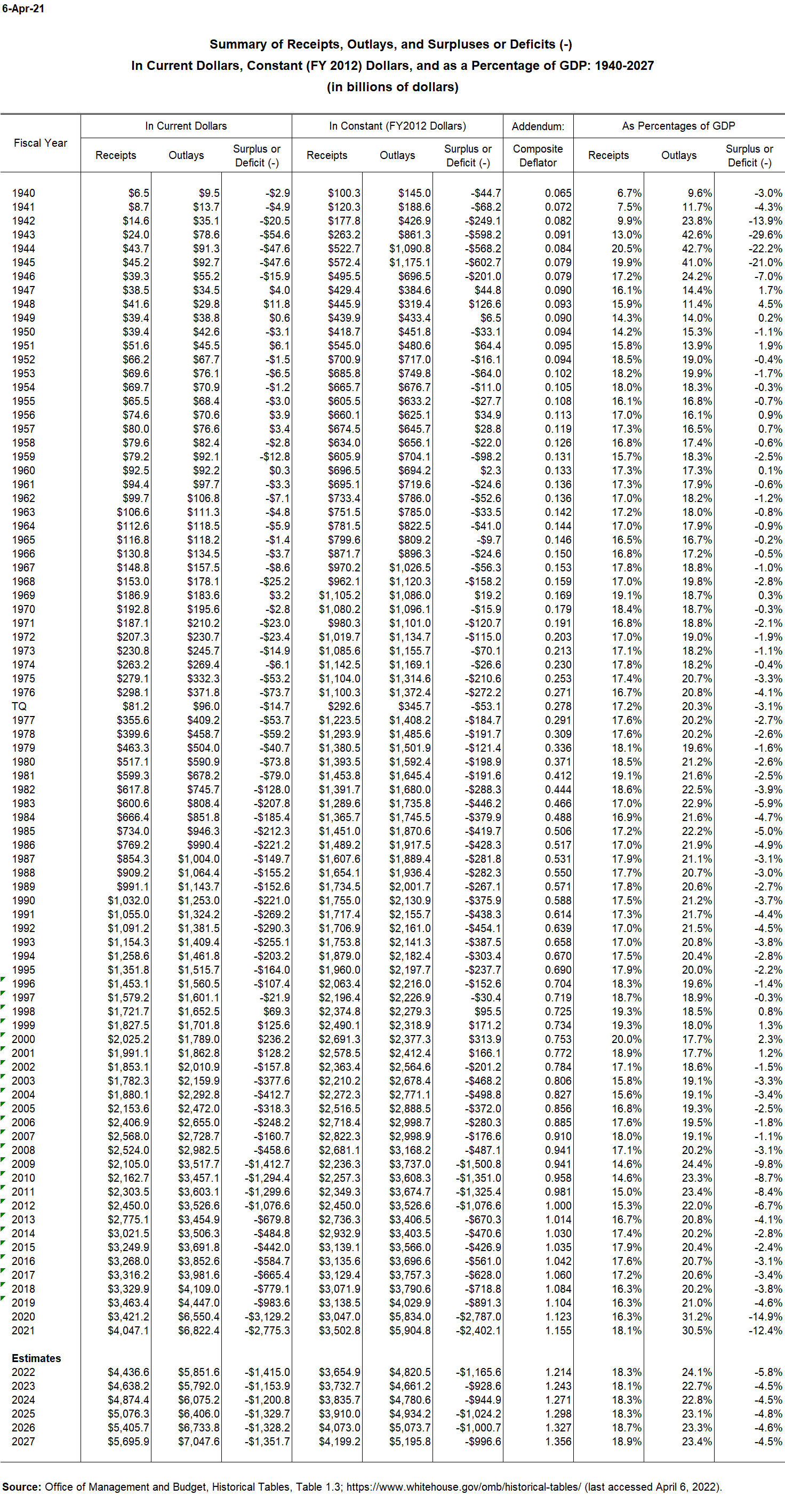
Halfwits don't know that deficits add to public debt. In 2020 we ran a $3.129 trillion deficit. This, of course, is added to accumulated debt.

In 2021 there was a 2.775 trillion deficit. This, of course, is added to the public debt. There are no returns for Government spending. When the Government borrows money, it competes with capital. When the Government prints more money than GDP output, a loss of value is incurred.

The notion that we can spend ourselves out of a recession is bizarre, moronic and uneducated. But that is the policy this administration is promoting and following.

Between September 2019 and 2020 debt went from $22.719 trillion to an astounding $26.945 trillion. Right now it is $30.498 trillion increasing at the rate of $45,486 dollars per second!

That becomes $96,651 of debt per citizen or $166,240 of debt per taxpayer. The only people this doesn't scare, are morons and Democrats. For anyone with a partial brain, these are economy killing numbers. We are rapidly becoming a thi4rd world shit hole run by idiots who are more concerned with racial equity than the job killing policies it has on racial minorities.


fed_receipt_sum_1.gif


https://www.treasurydirect.gov/govt/reports/pd/histdebt/histdebt_histo5.htm
 
You're cherry-picking a single indicator.

I picked the one that has the greatest impact on everything which is not counted in inflation. It is the single greatest reason for price increases. It is the single most important commodity for a growing economy.

Anyway, core inflation rose to a high in April 2021, and is actually down since then. It peaked at about 10.23% (annualized) and now stands at 6.81% (total inflation is currently significantly lower, but economists typically look at core inflation, since it ignores the noise of fuel and food prices, which are all over the place from month to month). I think most people regard 6.81% as too high. But, the "smart money" is betting it's mostly about short-term supply chain snags, rather than long-term money-supply issues. Like investors have priced the 5-year TIPS spread at 3.04%, meaning they expect inflation to be BELOW AVERAGE over the next five years.

Yeah, who cares right? It's only a 40 year high. Let's watch and see how many records this administration can break when it comes to recessions, inflation and impossibly high gas prices. Why worry! Be happy!

You're one uninformed partisan hack.
:palm:
 
that's it. run on the economy. that's a great strategy. you're totally right.

:evilnod:

Given the fact 2021 had the best economic growth in almost 40 years, and unemployment is now well under 4%, the economy is likely to make it hard for Democrats to hold onto Congress. After all, Republicans are the party for upper-class tax cuts, and more people are pushing up into the higher tax brackets now, so that sounds increasingly appealing. Meanwhile, Democrats are the party for enhancing the social safety net, and growing prosperity means fewer people think they'll actually need that safety net. When voters start thinking of themselves less as a working class and more as people well on their way to being wealthy, it plays to the Republican strengths.

You see the result of that in the pattern of presidential elections. When have we ever had sub-5% unemployment when a Republican DIDN'T win the presidential election? FDR and Truman ended the Great Depression and led us to sub-4% unemployment, so the voters rewarded them by electing a Republican president. And it was only after he led us into three recessions that the voters realized their error and put a Democrat back in the White House. Kennedy and Johnson brought unemployment down from the 6.6% left by Eisenhower to just 3.4%, so naturally the voters rewarded them by putting Nixon in office. It was only after Nixon and Ford had totally fucked up the economy that voters returned the Dems to the White House.

Thanks to sky-high monetary fiscal stimulus, the Republicans managed to grow the economy in the 1980s, and held the White House for 12 years, until they'd screwed things up badly enough that Clinton took the helm, with 7.3% unemployment. As soon as he had unemployment back down under 4%, though (where it had last been in the early 1970's), the people were feeling rich enough they thought they didn't need Democratic policies, and they installed another Republican into the presidency. Once he'd fucked things up badly, the people realized their error and installed Obama into the White House to clean up Bush's mess. At the time unemployment was 7.8%, and Obama drove it down to just 4.7%.... which naturally means it was time for more DERP from the voters, and Trump became president. Only after he drove the unemployment rate back up did the voters change course and give us another Democrat to clean up the mess. He inherited an economy with 6.4% unemployment.

Now Biden's got unemployment down under 4% and people are feeling rich again. It's not hard to guess what comes next. Anyone who has watched this show for long enough can anticipate the next scene. People are pushing up into those higher tax brackets and feeling like they'll never again need government economic help, so the field is set for the Republicans to take control again.
 
I picked the one that has the greatest impact on everything which is not counted in inflation. It is the single greatest reason for price increases. It is the single most important commodity for a growing economy.

You picked the one that you thought worked best for purposes of your partisan rhetoric. If in a few months gas prices are down but overall inflation is up, you'll change your pick.
 
Halfwits don't know that deficits add to public debt.


No. Halfwits imagine that others don't know that deficits add to public debt.

There are no returns for Government spending

Incorrect. Have you never seen an interstate highway?

The notion that we can spend ourselves out of a recession is bizarre, moronic and uneducated

The idea of using spending to stimulate the economy to help grow out of a recession is standard economic theory, practiced practically everywhere in the world at least since the 1930's.
 
Given the fact 2021 had the best economic growth in almost 40 years, and unemployment is now well under 4%, the economy is likely to make it hard for Democrats to hold onto Congress. After all, Republicans are the party for upper-class tax cuts, and more people are pushing up into the higher tax brackets now, so that sounds increasingly appealing. Meanwhile, Democrats are the party for enhancing the social safety net, and growing prosperity means fewer people think they'll actually need that safety net. When voters start thinking of themselves less as a working class and more as people well on their way to being wealthy, it plays to the Republican strengths.

You see the result of that in the pattern of presidential elections. When have we ever had sub-5% unemployment when a Republican DIDN'T win the presidential election? FDR and Truman ended the Great Depression and led us to sub-4% unemployment, so the voters rewarded them by electing a Republican president. And it was only after he led us into three recessions that the voters realized their error and put a Democrat back in the White House. Kennedy and Johnson brought unemployment down from the 6.6% left by Eisenhower to just 3.4%, so naturally the voters rewarded them by putting Nixon in office. It was only after Nixon and Ford had totally fucked up the economy that voters returned the Dems to the White House.

Thanks to sky-high monetary fiscal stimulus, the Republicans managed to grow the economy in the 1980s, and held the White House for 12 years, until they'd screwed things up badly enough that Clinton took the helm, with 7.3% unemployment. As soon as he had unemployment back down under 4%, though (where it had last been in the early 1970's), the people were feeling rich enough they thought they didn't need Democratic policies, and they installed another Republican into the presidency. Once he'd fucked things up badly, the people realized their error and installed Obama into the White House to clean up Bush's mess. At the time unemployment was 7.8%, and Obama drove it down to just 4.7%.... which naturally means it was time for more DERP from the voters, and Trump became president. Only after he drove the unemployment rate back up did the voters change course and give us another Democrat to clean up the mess. He inherited an economy with 6.4% unemployment.

Now Biden's got unemployment down under 4% and people are feeling rich again. It's not hard to guess what comes next. Anyone who has watched this show for long enough can anticipate the next scene. People are pushing up into those higher tax brackets and feeling like they'll never again need government economic help, so the field is set for the Republicans to take control again.

reckless spending did spike due to panic buying and people shopping all day ON CREDIT while the econo, and things opening back up.

and it was a trainwreck for not walmart and amazon.

our economy is a potemkin economy careening towards collapse.

prices are rising quickly and consumer debt is through the roof.

and you're an idiot.
 
our economy is a potemkin economy careening towards collapse.

That takes me back. Back in the Obama years, pretty much every indicator was heading in the right direction -- real incomes were rising, poverty and unemployment and deficits were falling, etc. At the time, a wingnut I was arguing with used that exact same phrase, "Potemkin economy," to predict an imminent collapse. Of course, the economy went right on growing throughout the Obama presidency, and even had plenty of momentum after he left, until the Trump Recession started. It's quaint to see that golden oldie played again.
 
A potemkin economy

https://seekingalpha.com/article/4484634-potemkin-economy-costs-and-consequences

Summary
In politics and economics, a Potemkin village is any construction (literal or figurative) whose sole purpose is to provide an external façade to lead the population to believe the country is faring better than reality.
The Fed is now discussing reversing monetary policy (by hiking interest rates and reducing their balance sheet) to quell inflation.
Not surprisingly, given that the current spike in inflation, and economic growth, was a function of massive liquidity infusions, the reversal will be deflationary.
stock market investment graph with indicator and volume data.
monsitj/iStock via Getty Images

A Potemkin economy has lured the Fed, economists, and Wall Street analysts into a potentially dangerous assumption of economic normalcy. However, with a review of how we got here, we can better understand the costs and consequences of monetary interventions.

“In 1783, after the Russian annexation of Crimea from the Ottoman Empire and the liquidation of the Cossack Zaporozhian Sich, GrigoryPotemkin became governor of the region. Crimea, devastated by the war, and the Muslim Tatar inhabitants became viewed as a potential fifth column of the Ottoman Empire. Potemkin’s major tasks were to pacify and rebuild the country by bringing in Russian settlers.

In 1787, as a new war was about to break out between Russia and the Ottoman Empire, Catherine II, with her court and several ambassadors, made an unprecedented six-month trip to New Russia. One purpose of this trip was to impress Russia’s allies prior to the war. Another purpose was to familiarize herself, supposedly directly, with her new possessions. To help accomplish this, Potemkin set up “mobile villages” on the banks of the Dnieper River. As soon as the barge carrying the Empress and ambassadors arrived, Potemkin’s men, dressed as peasants, would populate the village. Once the barge left, the village was disassembled, then rebuilt downstream overnight.” – Wikipedia

While there is some debate about the accuracy of the story, in politics and economics, a Potemkin village is any construction (literal or figurative) whose sole purpose is to provide an external façade to lead the population to believe the country is faring better than reality.

A reasonable amount of data suggests the Federal Reserve and the Government created such a facade.

Wall Street Breakfast
 
A potemkin economy

https://seekingalpha.com/article/4484634-potemkin-economy-costs-and-consequences

Summary
In politics and economics, a Potemkin village is any construction (literal or figurative) whose sole purpose is to provide an external façade to lead the population to believe the country is faring better than reality.
The Fed is now discussing reversing monetary policy (by hiking interest rates and reducing their balance sheet) to quell inflation.
Not surprisingly, given that the current spike in inflation, and economic growth, was a function of massive liquidity infusions, the reversal will be deflationary.
stock market investment graph with indicator and volume data.
monsitj/iStock via Getty Images

A Potemkin economy has lured the Fed, economists, and Wall Street analysts into a potentially dangerous assumption of economic normalcy. However, with a review of how we got here, we can better understand the costs and consequences of monetary interventions.

“In 1783, after the Russian annexation of Crimea from the Ottoman Empire and the liquidation of the Cossack Zaporozhian Sich, GrigoryPotemkin became governor of the region. Crimea, devastated by the war, and the Muslim Tatar inhabitants became viewed as a potential fifth column of the Ottoman Empire. Potemkin’s major tasks were to pacify and rebuild the country by bringing in Russian settlers.

In 1787, as a new war was about to break out between Russia and the Ottoman Empire, Catherine II, with her court and several ambassadors, made an unprecedented six-month trip to New Russia. One purpose of this trip was to impress Russia’s allies prior to the war. Another purpose was to familiarize herself, supposedly directly, with her new possessions. To help accomplish this, Potemkin set up “mobile villages” on the banks of the Dnieper River. As soon as the barge carrying the Empress and ambassadors arrived, Potemkin’s men, dressed as peasants, would populate the village. Once the barge left, the village was disassembled, then rebuilt downstream overnight.” – Wikipedia

While there is some debate about the accuracy of the story, in politics and economics, a Potemkin village is any construction (literal or figurative) whose sole purpose is to provide an external façade to lead the population to believe the country is faring better than reality.

A reasonable amount of data suggests the Federal Reserve and the Government created such a facade.

Wall Street Breakfast
 
That takes me back. Back in the Obama years, pretty much every indicator was heading in the right direction -- real incomes were rising, poverty and unemployment and deficits were falling, etc. At the time, a wingnut I was arguing with used that exact same phrase, "Potemkin economy," to predict an imminent collapse. Of course, the economy went right on growing throughout the Obama presidency, and even had plenty of momentum after he left, until the Trump Recession started. It's quaint to see that golden oldie played again.

did you forget about the housing bubble, collapse, and bailout?

things are always good for banks who have no consequences for their stupidity.

 
Back
Top