Starbucks raises worker wages except if unionized

In Starbucks defense they long ago warned labor that this is how it would go, union stores will not automatically get what the rest of the employees get.
 
Then the Union will have no problem negotiating 15 an hour for the union workers

Agreed…if not more. However, they’ll have to wait until their next contract negotiation. Some contracts can be negotiated to receive backpay meaning to this raise for non-union workers.

Does it strike anyone funny that a company based in a liberal state in a liberal city is anti-union?
 
Not true. There's the union reps and the rank and file, otherwise known as those you fuck you and those getting fucked.
Lemme guess; you think all African-Americans are alike too. It’s the same type of logic.

Labor and Management are symbiotic; they need each other. When one becomes too dominant, things start to fall apart. The two parties running the USA are similar; if one dominates for too long, there’s an imbalance and that will only end badly until the balance can be restored. If you truly are Buddhist, then you should understand this fact.

There are good unions and bad. Every time you fly on an airliner, you should thank the stars for unions.
 
Lemme guess; you think all African-Americans are alike too. It’s the same type of logic.

Labor and Management are symbiotic; they need each other. When one becomes too dominant, things start to fall apart. The two parties running the USA are similar; if one dominates for too long, there’s an imbalance and that will only end badly until the balance can be restored. If you truly are Buddhist, then you should understand this fact.

There are good unions and bad. Every time you fly on an airliner, you should thank the stars for unions.

No. I think all unions are however. Unions as a general rule are bad. There are exceptions, but most of the time they are both unnecessary and undeserving in today's world. The reason for this is that corporations and their management are under many legal restrictions on their behavior that didn't exist a century ago. Most also recognize the need to be competitive in wages and benefits to attract the talent they need.

A century ago, large companies simply needed warm bodies to perform simple tasks. That's no longer the case. Labor unions, in particular, are relics of that bygone age. Professional unions mainly exist to limit competition and entry into the market of workers to keep wages and benefits of those in them high at the expense of those that can't manage to get entry. This is as true of the Bar (lawyers) as it is of a carpenter's union.

With the companies I know of personally, or through friends, unions largely exist to enrich and promote those that run them while doing little or nothing for their members. For example several people I know that work for Raytheon told me their union threw a strike on orders from the local president simply so he could make himself look good to the national leadership and get moved up in the union. Didn't give a shit about what that would do to the workers. Right after he did it, I was told he went full-time with the national union management and was no longer at Raytheon.

Another, was at a job I had. I refused to join and the local and I had a, let's say gentleman's agreement, to leave each other alone. One local president while I was there stole over $32,000 for personal use from the union including buying a lifetime membership. The national level couldn't be bothered to do anything about that because the amount to them was too small. So much for looking out for the rank and file. Good thing I wasn't wasting my money on that shit.

One of the kids was once a manager at Albertson's (grocery store). The union struck them and several other chains. The stores refused to negotiate saying they couldn't afford the union's demands and stay competitive with non-union chains. They union wanted none of that. So, they were locked out and managers like him were brought in to fill in until the strike was over. He made great overtime.
Other unions tried to support this like the Teamsters and refused to allow their drivers to deliver. The stores leased their own trucks and non-union drivers and dropped the companies and union drivers entirely and never rehired them.
After a legal period of waiting these stores hired non-union workers at the same wages and benefits they'd offered the union workers. They had dozens of people applying for each position. No shortage of applicants.
The union demanded too much and got ass fucked for it as did their members.

I'm not saying there's not a time and place for unions. There is. It's just today their necessity is in steep decline and that's not going to change.
 
No. I think all unions are however.…

…I'm not saying there's not a time and place for unions. There is. It's just today their necessity is in steep decline and that's not going to change.
Again, labor and management are symbiotic.

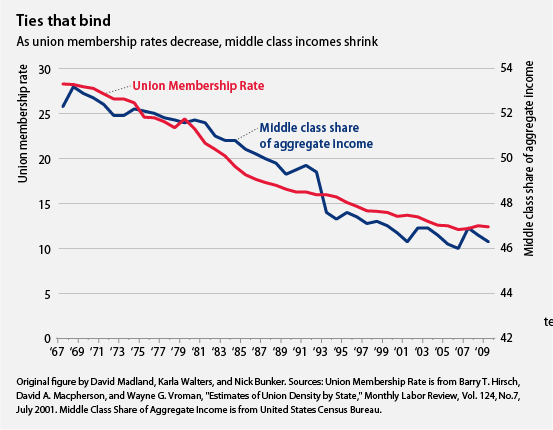
There’s reason American wages and benefits have declined along with unions over the years; big business Republicans have gutted labor regulations and stacked regulatory boards such as the National Mediation Board just like they’ve stacked SCOTUS.

Example: https://www.epi.org/publication/eroded-collective-bargaining/
Recent research on trends in wages over the last four decades has demonstrated that:

  • For the “typical” or median worker, declining unionization translates to a loss of $1.56 per hour worked, the equivalent of $3,250 for a full-time, full-year worker. The erosion of collective bargaining lowered the median hourly wage by $1.56, a 7.9% decline (0.2% annually), from 1979 to 2017. Deunionization lowered the male median hourly wage by $2.49, an 11.6% (0.29% annual) decline, over the 1979–2017 period. These losses from deunionization are the equivalent of annual losses for a full-time, full-year median worker and median male worker, respectively, of $3,250 and $5,171. This impact is due to both the direct effect on wages of union workers and the spillover effect on wages of nonunion workers.
  • Declining unionization widened inequality between high-wage earners and middle-wage earners. Deunionization widened the 90/50 wage gap (the gap between earners at the 90th percentile of the wage distribution and the 50th percentile, measured in logs) by 7.7 points and therefore explains 33.1% of the 23.2 point growth of the wage gap between high- and middle-wage earners over the 1979–2017 period. Deunionization has this result because it depressed the wages of middle-wage earners but had little impact on high-wage earners at the 90th percentile.
  • Unions disproportionately benefit those with low and moderate wages, those with lower levels of education, and nonwhites, and this has been the case since the birth of the modern labor movement in the New Deal. The erosion of collective bargaining, correspondingly, has therefore increased wage inequality.


https://econopolitics.com/2012/12/11/attack-on-american-unions-continues/unionmembership_wages/
unionmembership_wages.png
 
Again, labor and management are symbiotic.

There’s reason American wages and benefits have declined along with unions over the years; big business Republicans have gutted labor regulations and stacked regulatory boards such as the National Mediation Board just like they’ve stacked SCOTUS.

Example: https://www.epi.org/publication/eroded-collective-bargaining/
Recent research on trends in wages over the last four decades has demonstrated that:

  • For the “typical” or median worker, declining unionization translates to a loss of $1.56 per hour worked, the equivalent of $3,250 for a full-time, full-year worker. The erosion of collective bargaining lowered the median hourly wage by $1.56, a 7.9% decline (0.2% annually), from 1979 to 2017. Deunionization lowered the male median hourly wage by $2.49, an 11.6% (0.29% annual) decline, over the 1979–2017 period. These losses from deunionization are the equivalent of annual losses for a full-time, full-year median worker and median male worker, respectively, of $3,250 and $5,171. This impact is due to both the direct effect on wages of union workers and the spillover effect on wages of nonunion workers.
  • Declining unionization widened inequality between high-wage earners and middle-wage earners. Deunionization widened the 90/50 wage gap (the gap between earners at the 90th percentile of the wage distribution and the 50th percentile, measured in logs) by 7.7 points and therefore explains 33.1% of the 23.2 point growth of the wage gap between high- and middle-wage earners over the 1979–2017 period. Deunionization has this result because it depressed the wages of middle-wage earners but had little impact on high-wage earners at the 90th percentile.
  • Unions disproportionately benefit those with low and moderate wages, those with lower levels of education, and nonwhites, and this has been the case since the birth of the modern labor movement in the New Deal. The erosion of collective bargaining, correspondingly, has therefore increased wage inequality.


https://econopolitics.com/2012/12/11/attack-on-american-unions-continues/unionmembership_wages/
unionmembership_wages.png

In construction and the trades, the biggest reason for a decline in wages is illegal immigration. I know that because I see it first hand.
 
Yep, Starbucks just announced they're going to raise their non-union worker's wages to $15 an hour. At unionized locations, workers will continue to receive their current wages.


https://www.thestreet.com/investing/starbucks-union-illegal-raises

So, why would Starbucks corporate management do this? Because at union locations the union members and union have to negotiate a contract with the employer for their terms and conditions of work. This means union members will continue to receive their current wages (about $12 to $14 depending on location) until a new contract is negotiated. Even then, it is possible they could receive less compensation, and they'd have to make close to $16 an hour to end up with $15 an hour after paying their union dues...

To break the union, of course. Unions don't win in Open shops.
 
I was standing in line at Starbucks the other day, and I overheard a conversation between the two people in front of me complaining about gasoline being $3.79 a gallon- as they waited in line to pay $7.50 for a cup of coffee!

No you weren't. Gas is $4.39 a gallon
 
To break the union, of course. Unions don't win in Open shops.

Starbucks legally cannot unilaterally give a wage increase to union shops within their company. They have to negotiate a contract. I think there's going to be a lot of pissed off union workers at Starbucks.
 
Starbucks legally cannot unilaterally give a wage increase to union shops within their company. They have to negotiate a contract. I think there's going to be a lot of pissed off union workers at Starbucks.

Nope. If they did increase union wages, that would be a breach of contract and the union can file a grievance (and as stupid as some union stewards are, they would).
 
Starbucks legally cannot unilaterally give a wage increase to union shops within their company. They have to negotiate a contract. I think there's going to be a lot of pissed off union workers at Starbucks.

I know that. That's why the non-union employees got a raise. Once the union is busted let's see how long the elevated wages last. My guess is not long.
 
I was standing in line at Starbucks the other day, and I overheard a conversation between the two people in front of me complaining about gasoline being $3.79 a gallon- as they waited in line to pay $7.50 for a cup of coffee!

No you weren't. Gas is $4.39 a gallon
It depends upon the state or region. Gas in DC is about $4.50 and $3.87 at Walmart in North Texas.
 
No, it proves that unions are in it for themselves mostly.
I'm not pro union, but I support unions' right to collectively bargain. If it costs them jobs, it costs them jobs.

For decades, unions have been claiming that non union workers enjoy higher pay/bennies because of unions fighting for workers.

They are right. Starbucks workers got raises as a direct result of unions.

You can't argue the point.
 
yep keeps the pressure on companies, although there will always be servile rubes like Gardner to carry their water
It's hard to argue that unions don't typically rape their members behind the scenes. A Google search would produce pages of stories about upper level union officers being prosecuted. My dad was a Teamster for years, and was the shop steward for his place of business. Over the decades, he got promoted to some officer position, where he immediately found himself in court with a bunch of thieves.

The judge looked at his very short tenure, and told him that he doesn't belong there. Told him to leave.


I've worked for NYC restaurant owners who described 'meetings' by union heads where they would spend tens of thousands of dollars in one night on food and booze.

Still, unions are necessary to continue the fight against 'right to work' states.
 
It's hard to argue that unions don't typically rape their members behind the scenes. A Google search would produce pages of stories about upper level union officers being prosecuted. My dad was a Teamster for years, and was the shop steward for his place of business. Over the decades, he got promoted to some officer position, where he immediately found himself in court with a bunch of thieves.

The judge looked at his very short tenure, and told him that he doesn't belong there. Told him to leave.


I've worked for NYC restaurant owners who described 'meetings' by union heads where they would spend tens of thousands of dollars in one night on food and booze.

Still, unions are necessary to continue the fight against 'right to work' states.
I was never raped by my union.
 
Back
Top