danielpalos
Verified User
That data is a lagging indicator. It could take around six months to a year to get a better picture of the situation.

That data is a lagging indicator. It could take around six months to a year to get a better picture of the situation.
Only considering the short run equilibrium is special pleading. In the long run, higher paid labor creates more in demand and generates more in tax revenue (that can help fund social services).

"marginally productive"?
How are you measuring that?
Or are you just doing that shitty thing again where you substitute your own subjective judgment for actual truth?
Yeah, we can just look at the employment statistics of all these cases he's bringing up and look at them in context.
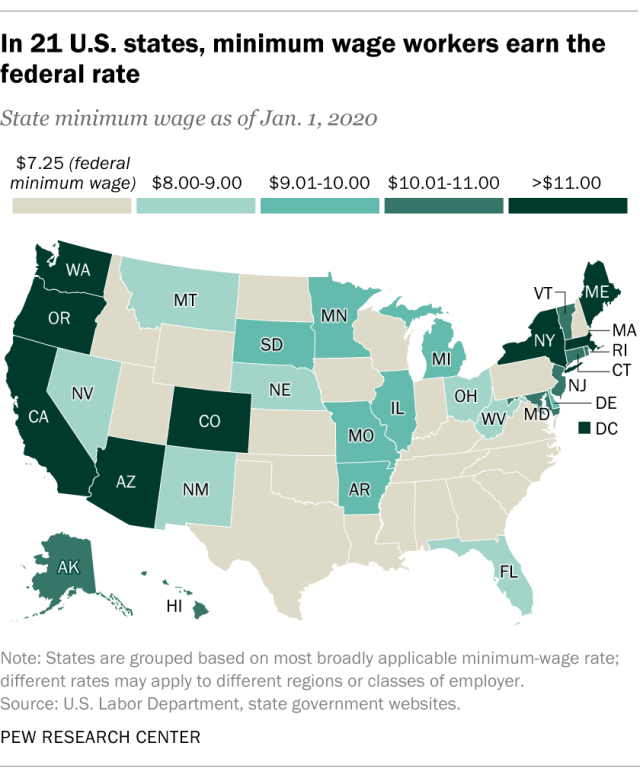
Arizona is a great example. TA said they increased their MW in 2006, but didn't bother to look at the employment statistics for 2006 for Arizona to see the actual results.
Doing so reveals that AZ's unemployment rate declined 0.6% from January 2006 to December 2006, with a MW increase right in the middle of it.
Conservatives reaching back 14 years to find an article that kinda sorta supports their argument, only to have that source smacked down by the concept of linear time, is especially pathetic.
https://www.bls.gov/opub/reports/mi...e,collected on a regular basis. (See table 10.)The percentage of hourly paid workers earning the prevailing federal minimum wage or less edged down from 2.1 percent in 2018 to 1.9 percent in 2019.
The same way companies and employers do everyday.
What you get paid compared to what you produce for the company.
It is safe to say that we should have metrics within six months to a year.How much time does it take (according to historical data, not according to your wishful thinking)?
Calipornia has been raising the statutory minimum wage for all employers for years.
https://www.dir.ca.gov/dlse/FAQ_MinimumWage.htm
According to...you?
Except minimum wage is not the be all, end all, of employment rates.
If anything, in most states its a small fraction of all employment.
Arizona usually enjoys a low unemployment rate thanks to companies like Intel or Raytheon moving out of California for friendlier business climates.
But HOW, that's my question. HOW are they measuring this, because what you wrote seemed to have established an arbitrary standard and I would like to know what went into that?
That isn't how businesses look at it, just FYI.
They look at it purely in terms of revenues vs. costs.
In Arizona only 1.5% of the workforce gets paid the prevailing state minimum wage:
Depends on the company. For example, a company like a law firm or contract research firm might measure it on how many clients and contracts you generate.
A manufacturer on the cost of labor as part of the value of the products produced. A fast food restaurant on sales versus labor cost as part of product cost.
That is how businesses look at it.
Right, but how many workers in Arizona earn up to $15/hr? Because nationally, it's about 45%. And I'm guessing it's driven mostly by red states.
So this also undermines your other argument about raising the MW killing jobs and businesses.
If you're ALSO trying to say that it doesn't actually affect that many people, then you can't also argue that it's bad for businesses and will kill them.
So it seems to me like you really need to figure your own position out on this, because you're contradicting yourself all over the fucking place with your bullshit.
Minimum wage can kill jobs and even businesses.
A big one, and one that is likely to increase significantly is that you have to have experience and a track record of employment to be hired. That is, companies won't hire you at $15 an hour to learn on the job. You need to already have the necessary skill set. You also need verifiable experience at that job. Thus, you may be required to spend several thousand dollars going to a trade school to learn how to do the job you want--probably on a student loan-- and then work as an intern or for free to get experience before you can actually get hired.
Higher minimum wage means a higher hurdle to entry level jobs.
That in turn will make more marginal potential employees less employable.
Minimum wage can kill jobs and even businesses. Those faced with marginal ROI are the most likely. But it has other affects too.
A big one, and one that is likely to increase significantly is that you have to have experience and a track record of employment to be hired. That is, companies won't hire you at $15 an hour to learn on the job. You need to already have the necessary skill set. You also need verifiable experience at that job. Thus, you may be required to spend several thousand dollars going to a trade school to learn how to do the job you want--probably on a student loan-- and then work as an intern or for free to get experience before you can actually get hired.
Higher minimum wage means a higher hurdle to entry level jobs. That in turn will make more marginal potential employees less employable.
LOL, the 'business owner' trying to sound intelligent. ROI is a measure of INVESTMENT. It is not a measure of profit. I suspect you are trying to say those that have low margins, but you lack not only the vocabulary but an understanding of WHAT contributes to that margin (cost of materials, inventory management, cost of manufacturing, cost of labor). No one is going to require 'experience' to work as a minimum wage worker at a McDonalds. That's just laughable. You don't appear to have enough business
knowledge to run a lemonade stand. The ONLY hurdle to entry level jobs is the inventory of jobs. And that is seldom an issue. BY DEFINITION, THEY DO NOT REQUIRE EXPERIENCE. Find a different topic to fake your expertise. This one is too transparent.
It is safe to say that we should have metrics within six months to a year.
California has the largest economy in the US.
According to any objective measure since even the dollar menu won't double even if the minimum wage does.
LOL, the 'business owner' trying to sound intelligent. ROI is a measure of INVESTMENT. It is not a measure of profit. I suspect you are trying to say those that have low margins, but you lack not only the vocabulary but an understanding of WHAT contributes to that margin (cost of materials, inventory management, cost of manufacturing, cost of labor). No one is going to require 'experience' to work as a minimum wage worker at a McDonalds. That's just laughable. You don't appear to have enough business
knowledge to run a lemonade stand. The ONLY hurdle to entry level jobs is the inventory of jobs. And that is seldom an issue. BY DEFINITION, THEY DO NOT REQUIRE EXPERIENCE. Find a different topic to fake your expertise. This one is too transparent.
That data is a lagging indicator. It could take around six months to a year to get a better picture of the situation.
But it hasn't. Even in Arizona, in the case you chose to highlight on this thread, bro.
AZ's statistics show job growth after the MW increase, not job loss.
Are you going to argue with reality?
Few things about this:
1. $15/hr is the minimum wage we are talking about, so if you're getting hired with no experience, that's fine. Aren't MW jobs supposed to build experience? That's the refrain from you people.
2. For a $15/hr job, which would be the minimum, why would there suddenly be these requirements when there weren't before?
3. Again, solved by making public colleges and universities tuition free and/or forgiving all student loan debt.
4. By law, almost all internships at for-profit companies have to be paid. Internships for most non-profits also have to be paid. There was a gigantic court case about this very thing...in the entertainment industry: https://www.hollywoodreporter.com/thr-esq/fox-reaches-settlement-landmark-lawsuit-910390
No it doesn't. If anything, it makes the labor market MORE COMPETITIVE for workers, with businesses having to lure them with consistently higher wages.
This is nothing but a combination of logical fallacies starting with one of Trivial Objections. It then moves to an ad hominem and ends with Continuum fallacy.