
You are using an out of date browser. It may not display this or other websites correctly.
You should upgrade or use an alternative browser.
You should upgrade or use an alternative browser.
TRUMP APPROVAL RATING PLUMMETING EVEN AMONG WHITE VOTERS IN FOX NEWS POLL
- Thread starter signalmankenneth
- Start date

I hope Trump's approval ratings will continue to plummet too!
http://www.newsweek.com/donald-trump-approval-ratings-take-another-hit-693657
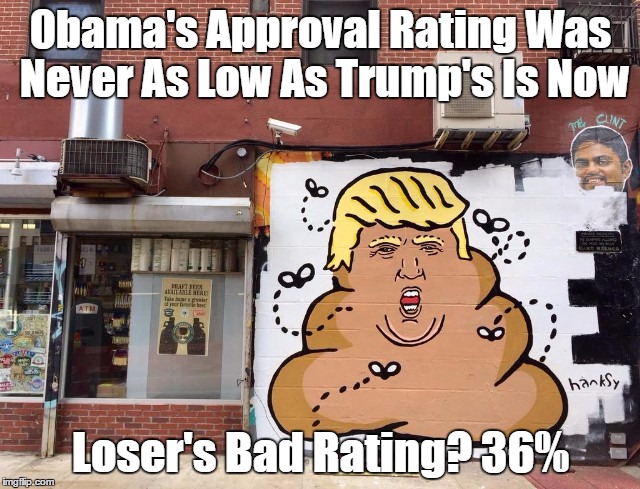
Where were your poll numbers November 8th dipshit?
Where were your poll numbers November 8th dipshit?
What point are you making? Because (a minority, as you know, of) voters choose a subhuman clown, does that make him less so, or just suggest that they are not fit to vote?
What point are you making? Because (a minority, as you know, of) voters choose a subhuman clown, does that make him less so, or just suggest that they are not fit to vote?
My point is that the only poll that matters is on election day. And fyi the subhuman clown lost the election.

On the question of Mr Trump I find it extremely difficult to know what to say to people who not only believe their arse is their elbow but believe the whole world thinks so. Weird! The trumpers are quite swiftly moving off into a strange world of their own: the trouble is that it keeps interacting with the one sane people live in!
Irony; a brain dead leftist lunatic thinking others are insane.
What point are you making? Because (a minority, as you know, of) voters choose a subhuman clown, does that make him less so, or just suggest that they are not fit to vote?
More irony; a subhuman clown thinking others are the clowns.

Русский агент
Путин - мl
Irony; a brain dead leftist lunatic thinking others are insane.
Aren't many Welshmen alcoholics?
My point is that the only poll that matters is on election day. And fyi the subhuman clown lost the election.
Well, he lost that, after all. And who is chosen matters a lot. In this case he is so incompetent and silly that you'll have to get shot of him if you want to avoid world war and/or becoming a total laughingstock.
cancel2 2022
Canceled
Ole Bone Spur sure has had an interesting year. No wall! Hillary ain’t locked up! Obamacare still the law! Nothing done about North Korea! But he sure was tough on that gold star mom!
He managed to get China and the UN to impose the toughest sanctions ever but you'd rather rant on and on than admit that.
Here is a letter Bill Clinton wrote to an ROTC colonel back in December 1969, it is makes it perfectly clear how he stood on the Vietnam War and the draft! What's the betting that you just ignore this, pretty high I'd say.
I am sorry to be so long in writing. I know I promised to let you hear from me at least once a month, and from now on you will, but I have had to have some time to think about this first letter. Almost daily since my return to England I have thought about writing, about what I want to and ought to say.
First, I want to thank you, not just for saving me from the draft, but for being so kind and decent to me last summer, when I was as low as I have ever been. One thing which made the bond we struck in good faith somewhat palatable to me was my high regard for you personally. In retrospect, it seems that the admiration might not have been mutual had you known a little more about me, about my political beliefs and activities. At least you might have thought me more fit for the draft than for ROTC.
Let me try to explain. As you know, I worked for two years in a very minor position on the Senate Foreign Relations Committee. I did it for the experience and the salary but also for the opportunity, however small, of working every day against a war I opposed and despised with a depth of feeling I had reserved solely for racism in America before Vietnam. I did not take the matter lightly but studied it carefully, and there was a time when not many people had more information about Vietnam at hand than I did.
I have written and spoken and marched against the war. One of the national organizers of the Vietnam Moratorium is a close friend of mine. After I left Arkansas last summer, I went to Washington to work in the national headquarters of the Moratorium, then to England to organize the Americans here for demonstrations Oct. 15 and Nov. 16.
Interlocked with the war is the draft issue, which I did not begin to consider separately until early 1968. For a law seminar at Georgetown I wrote a paper on the legal arguments for and against allowing, within the Selective Service System, the classification of selective conscientious objection for those opposed to participation in a particular war, not simply to `participation in war in any form.' From my work I came to believe that the draft system itself is illegitimate. No government really rooted in limited, parliamentary democracy should have the power to make its citizens fight and kill and die in a war they may oppose, a war which even possibly may be wrong, a war which, in any case, does not involve immediately the peace and freedom of the nation.
The draft was justified in World War II because the life of the people collectively was at stake. Individuals had to fight, if the nation was to survive, for the lives of their countrymen and their way of life. Vietnam is no such case. Nor was Korea an example where, in my opinion, certain military action was justified but the draft was not, for the reasons stated above.
Because of my opposition to the draft and the war. I am in great sympathy with those who are not willing to fight, kill and maybe die for their country (i.e. the particular policy of a particular government) right or wrong. Two of my friends at Oxford are conscientious objectors. I wrote a letter of recommendation for one of them to his Mississippi draft board, a letter which I am more proud of than anything else I wrote at Oxford last year. One of my roommates is a draft resister who is possibly under indictment and may never be able to go home again. He is one of the bravest, best men I know. His country needs men like him more than they know. That he is considered a criminal is an obscenity.
The decision not to be a resister and the related subsequent decisions were the most difficult of my life. I decided to accept the draft in spite of my beliefs for one reason: to maintain my political viability within the system. For years I have worked to prepare myself for a political life characterized by both practical political ability and concern for rapid social progress. It is a life I still feel compelled to try to lead. I do not think our system of government is by definition corrupt, however dangerous and inadequate it has been in recent years. (The society may be corrupt, but that is not the same thing, and if that is true, we are all finished anyway.) When the draft came, despite political convictions, I was having a hard time facing the prospect of fighting a war I had been fighting against, and that is why I contacted you. ROTC was the one way left in which I could possibly, but not positively, avoid both Vietnam and resistance. Going on with my education, even coming back to England, played no part in my decision to join ROTC. I am back here, and would have been at Arkansas Law School because there is nothing else I can do. In fact, I would like to have been able to take a year out perhaps to teach in a small college or work on some community action project and in the process to decide whether to attend law school or graduate school and how to begin putting what I have learned to use.
Last edited:
He managed to get China and the UN to impose the toughest sanctions ever but you'd rather rant on and on than admit that.
Here is a letter Bill Clinton wrote to an ROTC colonel back in December 1969, it is makes perfectly he he stood on the Vietnam War and the draft!
Lying leftists aren't concerned over facts or reality. They prefer their false narratives.