
Kim examining what it said was a nuclear warhead being fitted onto the nose of an intercontinental ballistic missile.
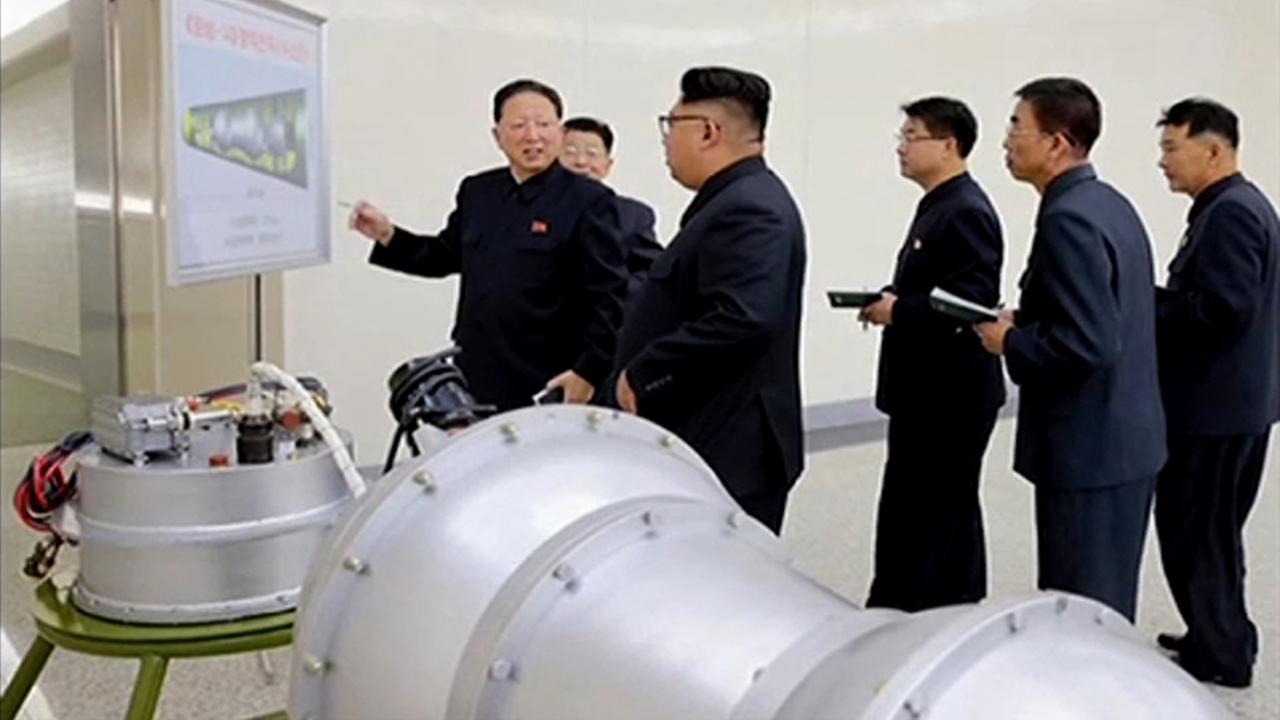
(pic in backround is ICBM warheard)
Sunday's detonation builds on recent North Korean advances that include test launches in July of two ICBMs that are believed to be capable of reaching the mainland U.S. The North says its missile development is part of a defensive effort to build a viable nuclear deterrent that can target U.S. cities.
China's foreign ministry said in a statement that the Beijing government has "expressed firm opposition and strong condemnation" and urged North Korea to "stop taking erroneous actions that deteriorate the situation."
South Korea held a National Security Council meeting chaired by Moon. Officials in Seoul also said Trump's national security adviser, H.R. McMaster, spoke with his South Korean counterpart for 20 minutes about an hour after the detonation.
Japan's Prime Minister Shinzo Abe called the test "absolutely unacceptable."
Nuclear tests are crucial to perfecting sophisticated technologies and to demonstrating to the world that claims of nuclear prowess are not merely a bluff.
The North claimed the device it tested was a thermonuclear weapon — commonly called a hydrogen bomb. That could be hard to independently confirm. It said the underground test site did not leak radioactive materials, which would make such a determination even harder.
At the same time, the simple power of the blast was convincing. Japan's Defense Minister Itsunori Onodera said it might have been as powerful as 70 kilotons. North Korea's previous largest was thought to be anywhere from 10 to 30 kilotons.
"We cannot deny it was an H-bomb test," Onodera said.
North Korea conducted two nuclear tests last year and has been launching missiles at a record pace this year. It fired a potentially nuclear-capable midrange missile over northern Japan last week in response to ongoing U.S.-South Korea military exercises.
It said that launch was the "curtain raiser" for more activity to come.
Just before Sunday's test, according to state media, Kim and the other senior leaders at the party presidium meeting discussed "detailed ways and measures for containing the U.S. and other hostile forces' vicious moves for sanctions."
The photos released earlier showed Kim talking with his lieutenants as he observed a silver, peanut-shaped device that the state-run media said was designed to be mounted on the North's "Hwasong-14" ICBM.
The North claims the device was made domestically and has explosive power that can range from tens to hundreds of kilotons. For context, the bomb dropped on Hiroshima by the U.S. had a 15-kiloton yield.
North Korea's recent activity has been especially bold.
https://www.yahoo.com/tech/seoul-seeks-strong-response-north-081856297.html
(pic in backround is ICBM warheard)
Sunday's detonation builds on recent North Korean advances that include test launches in July of two ICBMs that are believed to be capable of reaching the mainland U.S. The North says its missile development is part of a defensive effort to build a viable nuclear deterrent that can target U.S. cities.
China's foreign ministry said in a statement that the Beijing government has "expressed firm opposition and strong condemnation" and urged North Korea to "stop taking erroneous actions that deteriorate the situation."
South Korea held a National Security Council meeting chaired by Moon. Officials in Seoul also said Trump's national security adviser, H.R. McMaster, spoke with his South Korean counterpart for 20 minutes about an hour after the detonation.
Japan's Prime Minister Shinzo Abe called the test "absolutely unacceptable."
Nuclear tests are crucial to perfecting sophisticated technologies and to demonstrating to the world that claims of nuclear prowess are not merely a bluff.
The North claimed the device it tested was a thermonuclear weapon — commonly called a hydrogen bomb. That could be hard to independently confirm. It said the underground test site did not leak radioactive materials, which would make such a determination even harder.
At the same time, the simple power of the blast was convincing. Japan's Defense Minister Itsunori Onodera said it might have been as powerful as 70 kilotons. North Korea's previous largest was thought to be anywhere from 10 to 30 kilotons.
"We cannot deny it was an H-bomb test," Onodera said.
North Korea conducted two nuclear tests last year and has been launching missiles at a record pace this year. It fired a potentially nuclear-capable midrange missile over northern Japan last week in response to ongoing U.S.-South Korea military exercises.
It said that launch was the "curtain raiser" for more activity to come.
Just before Sunday's test, according to state media, Kim and the other senior leaders at the party presidium meeting discussed "detailed ways and measures for containing the U.S. and other hostile forces' vicious moves for sanctions."
The photos released earlier showed Kim talking with his lieutenants as he observed a silver, peanut-shaped device that the state-run media said was designed to be mounted on the North's "Hwasong-14" ICBM.
The North claims the device was made domestically and has explosive power that can range from tens to hundreds of kilotons. For context, the bomb dropped on Hiroshima by the U.S. had a 15-kiloton yield.
North Korea's recent activity has been especially bold.
https://www.yahoo.com/tech/seoul-seeks-strong-response-north-081856297.html


