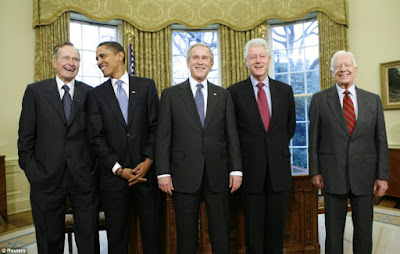
There are five living U.S. presidents. None of them support Donald Trump

christiefan915

Catalyst
Contributor
Obama+%26+War+Criminals.jpg


There are only five people alive today who have ever sat behind the Resolute desk. And not a single one of them believes Donald Trump has what it takes to be our next Commander-in-Chief.

In fact, only Democratic presidents—past and current—have publicly commented on the race. And they all support Hillary Clinton.

As for our two living former Republican presidents?

Neither showed up to Trump’s convention. Neither have been seen on the campaign trail. And neither is planning on making a presidential endorsement this election cycle.

That’s simply unprecedented. And it speaks volumes.
 
https://en.wikipedia.org/wiki/Florida_Central_Voter_File#James_Lee.27s_testimony


James Lee's testimony[edit]
On 17 April 2001, James Lee testified, before the McKinney panel, that the state had given DBT the directive to add to the purge list people who matched at least 90% of a last name. DBT objected, knowing that this would produce a huge number of false positives (non-felons).[4]
Lee went on saying that the state then ordered DBT to shift to an even lower threshold of 80% match, allowing also names to be reversed (thus a person named Thomas Clarence could be taken to be the same as Clarence Thomas). Besides this, middle initials were skipped, Jr. and Sr. suffixes dropped, and some nicknames and aliases were added to puff up the list.
"DBT told state officials", testified Lee, "that the rules for creating the [purge] list would mean a significant number of people who were not deceased, not registered in more than one county, or not a felon, would be included on the list. DBT made suggestions to reduce the numbers of eligible voters included on the list". According to Lee, to this suggestion the state told the company, "Forget about it".
"The people who worked on this (for DBT) are very adamant... they told them what would happen", said Lee. "The state expected the county supervisors to be the failsafe." Lee said his company will never again get involved in cleansing voting rolls. "We are not confident any of the methods used today can guarantee legal voters will not be wrongfully denied the right to vote", Lee told a group of Atlanta-area black lawmakers in March 2001.[7]
 
Obama+%26+War+Criminals.jpg


There are only five people alive today who have ever sat behind the Resolute desk. And not a single one of them believes Donald Trump has what it takes to be our next Commander-in-Chief.

In fact, only Democratic presidents—past and current—have publicly commented on the race. And they all support Hillary Clinton.

As for our two living former Republican presidents?

Neither showed up to Trump’s convention. Neither have been seen on the campaign trail. And neither is planning on making a presidential endorsement this election cycle.

That’s simply unprecedented. And it speaks volumes.
Incredible and awesome
 
Thanks for the topic c9.

It's said that in a democracy, the people get the kind of government they deserve.

Should the experts (those of us that know Trump is unfit for the office) overrule the will of the people?

Or should we stick to the principle of the vote, and let them sink the nation, or possibly the human race?
 
Trump can't campaign. fvck the establishment -they got us here - it's no surprise they would support Clinton
 
https://en.wikipedia.org/wiki/Florida_Central_Voter_File#James_Lee.27s_testimony


James Lee's testimony[edit]
On 17 April 2001, James Lee testified, before the McKinney panel, that the state had given DBT the directive to add to the purge list people who matched at least 90% of a last name. DBT objected, knowing that this would produce a huge number of false positives (non-felons).[4]
Lee went on saying that the state then ordered DBT to shift to an even lower threshold of 80% match, allowing also names to be reversed (thus a person named Thomas Clarence could be taken to be the same as Clarence Thomas). Besides this, middle initials were skipped, Jr. and Sr. suffixes dropped, and some nicknames and aliases were added to puff up the list.
"DBT told state officials", testified Lee, "that the rules for creating the [purge] list would mean a significant number of people who were not deceased, not registered in more than one county, or not a felon, would be included on the list. DBT made suggestions to reduce the numbers of eligible voters included on the list". According to Lee, to this suggestion the state told the company, "Forget about it".
"The people who worked on this (for DBT) are very adamant... they told them what would happen", said Lee. "The state expected the county supervisors to be the failsafe." Lee said his company will never again get involved in cleansing voting rolls. "We are not confident any of the methods used today can guarantee legal voters will not be wrongfully denied the right to vote", Lee told a group of Atlanta-area black lawmakers in March 2001.[7]

this is your party asshole with a frozen brain
 
so you deny all the court evidence that proves the republican party has cheated in elections for decades
 
lets go through the massive record case by case


https://www.brennancenter.org/issues/voter-fraud


Myth of Voter Fraud
It is important to protect the integrity of our elections. But we must be careful not to undermine free and fair access to the ballot in the name of preventing voter fraud.*
The Brennan Center’s ongoing examination of voter fraud claims reveal that voter fraud is very rare, voter impersonation is nearly non-existent, and much of the problems associated with alleged fraud in elections relates to unintentional mistakes by voters or election administrators. Our report "The Truth About Voter Fraud" reveals most allegations of fraud turn out to be baseless — and that of the few allegations remaining, most reveal election irregularities and other forms of election misconduct. Click here for additional resources on fraud.
Voter fraud is not acceptable in our elections, but we must find a balance and not impose solutions that make it harder for millions of eligible Americans to participate in our democracy.


Myth of Voter Fraud
It is important to protect the integrity of our elections. But we must be careful not to undermine free and fair access to the ballot in the name of preventing voter fraud.*
The Brennan Center’s ongoing examination of voter fraud claims reveal that voter fraud is very rare, voter impersonation is nearly non-existent, and much of the problems associated with alleged fraud in elections relates to unintentional mistakes by voters or election administrators. Our report "The Truth About Voter Fraud" reveals most allegations of fraud turn out to be baseless — and that of the few allegations remaining, most reveal election irregularities and other forms of election misconduct. Click here for additional resources on fraud.
Voter fraud is not acceptable in our elections, but we must find a balance and not impose solutions that make it harder for millions of eligible Americans to participate in our democracy.
Sign up for our Election 2016 newsletter.
Recent Research
Debunking the Voter Fraud Myth

Claims have circulated this election season about the extent of voter fraud. But putting rhetoric aside to look at the facts makes clear fraud is vanishingly rare, and does not happen on a scale even close to that necessary to “rig” an election.
September 1, 2016Voting Rights & ElectionsMyth of Voter Fraud
The Truth About Justice Stevens and the Voting Rights Act
Andrew Cohen
Justice Stevens cannot plausibly be cited today for the proposition that North Carolina’s oppressive new voting laws are justifiable by virtue of some form of voter fraud.
October 11, 2013Voting Rights & ElectionsRestricting the VoteMyth of Voter Fraud
View More Research

Recent Commentary
Debating Election Integrity
Jennifer L. Clark

In any other year, asking presidential candidates whether they’d accept the election outcome were their opponent to win would be odd. But not in 2016. That's why it's more important than ever for voters to know the facts and understand their rights.
September 28, 2016Myth of Voter Fraud
Texas Photo ID Trial Update: Closing Arguments V
Carson Whitelemons
Finally, following Texas’s closing argument, the Court heard brief rebuttal arguments from the plaintiffs.
September 22, 2014Voting Rights & ElectionsRestricting the VoteMyth of Voter Fraud
View More Commentary

Recent Litigation
Crawford v. Marion County Election Board
Determining which American citizens are able to exercise their right to vote and which Americans are not, the Indiana voter ID case is the most important voting rights case since Bush v. Gore.
April 28, 2008Voting Rights & ElectionsRestricting the VoteMyth of Voter Fraud
FOIA Request to EAC Re: Commissioned Reports
In 2006 and 2007, the Brennan Center filed a FOIA request with the U.S. Election Assistance Commission to obtain documents pertaining to commissioned reports on voter fraud and voter intimidation and on voter ID.
March 14, 2008Other Voting IssuesRestricting the VoteMyth of Voter FraudVoting Rights & Elections
View More Litigation
 
Back
Top