What's the difference?They have no clue
The water table may have already been shrinking
It may still be rising

You are using an out of date browser. It may not display this or other websites correctly.
You should upgrade or use an alternative browser.
You should upgrade or use an alternative browser.
Why every serious environmentalist should favour fracking
- Thread starter cancel2 2022
- Start date

Val
Verified User
that 'food and water watch' site is filled with facts, so if you want to dispute any of the info, why don't you point out which particular facts you want to dismiss...

oil and gas are valuable commodities but water is a valuable commodity too!
seems to me that fracking enthusiasts are too eager to accept flimsy rationales because they are more concerned with profit margins and "schadendfreude" with the middle-east, than they are with real life repercussions to American communities...
oil and gas are valuable commodities but water is a valuable commodity too!
seems to me that fracking enthusiasts are too eager to accept flimsy rationales because they are more concerned with profit margins and "schadendfreude" with the middle-east, than they are with real life repercussions to American communities...
Global Water Resources
About 70% of the earth's surface is covered in water, but 97% of it is saltwater, which is unfit for human use. Saltwater cannot be used for drinking, crop irrigation or most industrial uses. Of the remaining 3% of the world's water resources, only about 1% is readily available for human consumption.
...
Global Shortage
Rapid industrialization and increasing agricultural use have contributed to worldwide water shortages. Areas that have experienced water shortages include China, Egypt, India, Israel, Pakistan, Mexico, parts of Africa and the United States (Colorado, California, Las Vegas and the East Coast), to name but a few.
...
Conclusion
Recent years have seen an upswing in the demand for investments that seek to profit from the need for fresh, clean water. If the trend continues, and by all indications it will, investors can expect to see a host of new investments that provide exposure to this precious commodity and to the firms that deliver it to the marketplace.
http://www.investopedia.com/articles/06/water.asp
Last edited:
Val
Verified User

We are farmers, bakers, vintners, millers, chefs, and food-makers of all kinds. Every day, we devote ourselves to the care of our communities. We are proud to nourish our neighbors and to bring life to our land. We have examined the evidence, and we are convinced that the exploitation of shale gas in New York will bring our communities to harm.
We are aware that those who will profit most from shale gas exploitation claim that it is safe, economically and environmentally sound, and a benefit to all. We are not convinced. Not remotely.
https://www.change.org/petitions/farmers-and-food-producers-against-fracking
Show the science
We are farmers, bakers, vintners, millers, chefs, and food-makers of all kinds. Every day, we devote ourselves to the care of our communities. We are proud to nourish our neighbors and to bring life to our land. We have examined the evidence, and we are convinced that the exploitation of shale gas in New York will bring our communities to harm.
We are aware that those who will profit most from shale gas exploitation claim that it is safe, economically and environmentally sound, and a benefit to all. We are not convinced. Not remotely.
https://www.change.org/petitions/farmers-and-food-producers-against-fracking
I think is dog shit
Val
Verified User
Show the science
I think is dog shit
the OP science is indeed, as far as informing how it actually effects Americans and their communities who are demanding more convincing science than that crap.
Attachments

Is it being stopped somewhere?the OP science is indeed, as far as informing how it actually effects Americans and their communities who are demanding more convincing science than that crap.
Val
Verified User
250+ American communities are just dismissed as 'eco-nuts' based on what?
Big oil and gas companies are doing everything they can to open New York up to dirty hydrofracking. Hydrofracking is a new kind of gas drilling that would blast millions of gallons of chemical-filled water into New York’s earth and could poison the water supply for millions of New Yorkers, threatening New York’s air, water, land, and communities.
New studies released regularly link fracking related activities to contaminated groundwater, air pollution, and most recently illness, death and reproductive issues in cows, horses and other wildlife.
That’s why New Yorkers Against Fracking, a new coalition including Food & Water Watch, supports a fracking ban. We are joining together to tell Governor Cuomo and leaders in Albany to stand up for New Yorkers to keep our water and our state safe by banning hydrofracking.
Big oil and gas companies are doing everything they can to open New York up to dirty hydrofracking. Hydrofracking is a new kind of gas drilling that would blast millions of gallons of chemical-filled water into New York’s earth and could poison the water supply for millions of New Yorkers, threatening New York’s air, water, land, and communities.
New studies released regularly link fracking related activities to contaminated groundwater, air pollution, and most recently illness, death and reproductive issues in cows, horses and other wildlife.
That’s why New Yorkers Against Fracking, a new coalition including Food & Water Watch, supports a fracking ban. We are joining together to tell Governor Cuomo and leaders in Albany to stand up for New Yorkers to keep our water and our state safe by banning hydrofracking.
Support a ban, but it's not banned right250+ American communities are just dismissed as 'eco-nuts' based on what?
Big oil and gas companies are doing everything they can to open New York up to dirty hydrofracking. Hydrofracking is a new kind of gas drilling that would blast millions of gallons of chemical-filled water into New York’s earth and could poison the water supply for millions of New Yorkers, threatening New York’s air, water, land, and communities.
New studies released regularly link fracking related activities to contaminated groundwater, air pollution, and most recently illness, death and reproductive issues in cows, horses and other wildlife.
That’s why New Yorkers Against Fracking, a new coalition including Food & Water Watch, supports a fracking ban. We are joining together to tell Governor Cuomo and leaders in Albany to stand up for New Yorkers to keep our water and our state safe by banning hydrofracking.

Billy the Great Khan
Uwaa OmO
We are farmers, bakers, vintners, millers, chefs, and food-makers of all kinds. Every day, we devote ourselves to the care of our communities. We are proud to nourish our neighbors and to bring life to our land. We have examined the evidence, and we are convinced that the exploitation of shale gas in New York will bring our communities to harm.
We are aware that those who will profit most from shale gas exploitation claim that it is safe, economically and environmentally sound, and a benefit to all. We are not convinced. Not remotely.
https://www.change.org/petitions/farmers-and-food-producers-against-fracking
Damn, who should I listen to? A Baker, or a geological scientist?

Anti-Party
Tea Is The New Kool-Aid
A deadly pollution known as PM2.5 is currently killing over three million people each year, primarily in the developing world, demonstrates Richard Muller (Professor of Physics at the University of California, Berkeley since 1980) in Why Every Serious Environmentalist should favour Fracking. His co-author, Elizabeth Muller, is his daughter and co-founder (with him) of Berkeley Earth, a non-profit working on environmental issues.
As such, air pollution is currently harming far more people than the more distant challenge of global warming – particularly for emerging economies such as China and India. They state:
“The Health Effects Institute estimated that air pollution in 2010 led to 3.2 million deaths that year [across the world], including 1.2 million in China and 620,000 in India. And the pollution is getting worse as global use of coal continues to grow…
The Mullers argues that both global warming and air pollution can be mitigated by the responsible development and utilisation of shale gas:
“China not only has the greatest yearly death toll from air pollution, but is also key for mitigating global warming. China surpassed the US in CO2 production in 2006; growth was so rapid that by late 2013, China’s CO2 emissions are nearly twice those of the US. If its growth continues at this rate (and China has averaged 10% GDP growth per year for the past 20 years) China will be producing more CO2 per person than the US by 2023. If the US were to disappear tomorrow, Chinese growth alone would bring worldwide emissions back to the same level in four years. To mitigate global warming, it is essential to slow worldwide emissions, not just those in the developed countries. And we feel this must be done without slowing the economic growth of the emerging world…”
“It is believed that China has enormous reserves of shale gas, perhaps 50% larger than those of the US. If that shale gas can be utilised, it offers China a wonderful opportunity to mitigate air pollution while still allowing energy growth… Industry experts believe that the cubic metres of gas recovered from a given well can be doubled in the near future by better design of the fracking stages to match geologic formation characteristics. And they also believe that number could double again in the next decade. Soon that will mean four times the production for only a minor increase in cost. Such an advance is expected to turn currently difficult fields into major producers, to open up fields in China, Europe, and the US that are currently unprofitable.”
The authors consider some of the concerns raised by opponents of fracking; and conclude that they are either largely false or can be addressed by appropriate regulation.
Developed economies should therefore help emerging economies switch from coal to natural gas; and shale gas technology should be advanced as rapidly as possible and shared freely.
And China and Europe are well placed to take advantage of fracking. The high price paid in China and Europe for imported natural gas, typically US$10 per million BTU (compared to the US$3.50 in the US) means that the cost of shale drilling and completion can be much higher and still be profitable.
The Mullers conclude that environmentalists should recognise the shale gas revolution as beneficial to society – and lend their full support to helping it advance.
DOWNLOAD FREE PDF
Source: http://www.cps.org.uk/publications/...ious-environmentalist-should-favour-fracking/
http://wattsupwiththat.com/2013/12/...ious-environmentalist-should-favour-fracking/
I knew this was a copy/paste post when I read it. This idiot doesn't know about fracking at all, he/she is more focused on the agenda and profit.
http://cleantechnica.com/2013/09/13/fracking-update-these-are-the-texas-towns-running-out-of-water/
Anti-Party
Tea Is The New Kool-Aid
It was 3am on a Saturday Tom...
Every post you have ever made makes you sound like you are awake at 3am on a Saturday. YOu never follow the post. You are always bias. You rate beer like a girl rates wine.
Just drink a beer and be a man kid.
Anti-Party
Tea Is The New Kool-Aid
[video]http://cleantechnica.com/2013/08/18/30-texas-towns-will-be-out-of-water-because-fracking/[/video]
Every post you make makes you sound like a bitter slacker sitting on a couch begging for more.Every post you have ever made makes you sound like you are awake at 3am on a Saturday. YOu never follow the post. You are always bias. You rate beer like a girl rates wine.
Just drink a beer and be a man kid.
Val
Verified User
Damn, who should I listen to? A Baker, or a geological scientist?
lol being flippant and dismissive is just too easy, i realize...
if you actually read the OP science, it is all about air pollution and speaks in terms of global effects in comparison to coal...and most of the info is all about quantifying global effects with a major focus on china. then when you dig deep into the study you find out they have a financial interest over there...
Elizabeth A. Muller is co-founder and Executive
Director of Berkeley Earth, and founder and Managing Director of the China Shale Fund, an investment fund that brings together the bestgeological minds for innovation in shale gas in China.
Muller's scientific study dismissed general concerns about global fracking by simply claiming all we need is proper regulation of the industry and everything will be just hunky dory on a global scale.
now, what we are talking about is how the fracking industry activity effects American communities in other aspects than just air pollution vs coal on a global scale.
we're talking about water and food supply. do you really think there is no science to back up those concerns of American farmers and their communities...? lol
Fracking and our food
So back to the question at hand: what does hydrofracking mean for farmers and our food system?
In short: it ain’t good.
http://www.farmaid.org/site/apps/nlnet/content2.aspx?c=qlI5IhNVJsE&b=2723877&ct=10863325
Groundwater depletion
Groundwater is a valuable resource both in the United States and throughout the world. Where surface water, such as lakes and rivers, are scarce or inaccessible, groundwater supplies many of the hydrologic needs of people everywhere. In the United States. It is the source of drinking water for about half the total population and nearly all of the rural population, and it provides over 50 billion gallons per day for agricultural needs. Groundwater depletion, a term often defined as long-term water-level declines caused by sustained groundwater pumping, is a key issue associated with groundwater use. Many areas of the United States are experiencing groundwater depletion.
http://ga.water.usgs.gov/edu/gwdepletion.html
The hydrofracking process mixes huge amounts of water—between 200,000 and 6 million gallons, in fact—with sand and a heap of chemicals, which are then injected into wells at very high pressures to break up rock formations and release natural gas or oil.
First introduced commercially by Halliburton in 1949, hydrofracking didn’t make it big until an enormous (and controversial) loophole in the 2005 Energy Policy Act exempted it from the Safe Drinking Water Act, the Clean Water Act, the CLEAR Act and from EPA regulation.[2] With the government’s blessing, by 2008 hydrofracking was used in 90% of the thousands of new wells drilled in the U.S. each year. Those new wells, introduced in at least 34 states, have been placed increasingly closer to homes, farms, towns, cities, public spaces and parks.[3]
Though the industry insists hydrofracking is safe, precise and controlled, experience has shown otherwise. The hydrofracking process is violent, blasting sections of rock and freeing not only fuel, but also wastewater and chemicals along with it. Each well can produce over a million gallons of wastewater laced with heavy metals, corrosive salts, naturally-occurring carcinogens like benzene and radioactive elements like radium, in addition to carcinogenic chemicals used in the process. Much remains unknown about what happens deep in the earth’s crust as a result of a hydrofracking well. For example, it’s unclear how far wastewater and chemicals can spread or if hydrofracking deepens existing fissures in the earth that allow for leakage into groundwater and streams. While companies can capture some wastewater for reuse or storage in holding ponds, estimates are that anywhere from 20-70% of hydrofracking wastewater remains underground.[4]
I think you can dig up what you want in an activist report. It's allowed almost everywhere because it's injecting water thousands of feet below the water table. Are there bad small companies. Yes
Is it perfect No
I would ban BP
I would make them disclose the chemicals in franking water.
How can you test for something if they are hiding what would be in the waist water.
That must have been a dick whispering in George's ear telling him what to do!
Is it perfect No
I would ban BP
I would make them disclose the chemicals in franking water.
How can you test for something if they are hiding what would be in the waist water.
That must have been a dick whispering in George's ear telling him what to do!

Althea
Althea told me...
What exactly do you think happens to the millions of gallons of toxic water when they're done?God, I despair at people's lack of imagination. Fracking is the greatest damn thing to have happened for 100 years, to be able to gain energy self sufficiency, stuff the Saudi's and reduce CO2 and particulate emissions by a massive amount should be celebrated. Yet all you get, from the usual suspects, is churlishness and small mindedness.
And don't cite bogus 'purification' mumbo jumbo.

cancel2 2022
Canceled
I think you can dig up what you want in an activist report. It's allowed almost everywhere because it's injecting water thousands of feet below the water table. Are there bad small companies. Yes
Is it perfect No
I would ban BP
I would make them disclose the chemicals in franking water.
How can you test for something if they are hiding what would be in the waist water.
That must have been a dick whispering in George's ear telling him what to do!
I would ban Chevron.
You can go to www.fracfocus.org to find out what chemicals are used for over 55,000 wells.

i'm skeptical as well... the cost/benefit analysis seems unconvincing...
http://www.foodandwaterwatch.org/water/fracking/
water is a rare commodity. the local communities hate fracking but hey, all of this investment activity has been great for those who will profit...
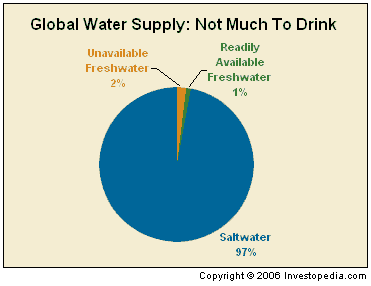
http://www.investopedia.com/articles/06/water.asp
Cue Halliburton...
[h=1]Antitrust Probe Targets Halliburton’s Fracking Business[/h]
cancel2 2022
Canceled
and since WHEN can we just trust any corp to place human safety over profits?
who knows what they will be willing to pump into the ground for another dollars profit
If we applied that kind of logic to human activity then virtually nothing would be allowed.