Why every serious environmentalist should favour fracking

That's also a problem. It doesn't mean fracking is the right way to go.

God, I despair at people's lack of imagination. Fracking is the greatest damn thing to have happened for 100 years, to be able to gain energy self sufficiency, stuff the Saudi's and reduce CO2 and particulate emissions by a massive amount should be celebrated. Yet all you get, from the usual suspects, is churlishness and small mindedness.
 
God, I despair at people's lack of imagination. Fracking is the greatest damn thing to have happened for 100 years, to be able to gain energy self sufficiency, stuff the Saudi's and reduce CO2 and particulate emissions by a massive amount should be celebrated. Yet all you get, from the usual suspects, is churlishness and small mindedness.
How so? It's loaded with potential problems. I don't understand why your head is in the sand.
 
How so? It's loaded with potential problems. I don't understand why your head is in the sand.

Only to those with limited vision, just imagine how much good will be done when China switches to fracked gas rather than building a fuckton of new coal power stations. Do you know that they are adding 50Gw of capacity each year just from coal?
 
God, I despair at people's lack of imagination. Fracking is the greatest damn thing to have happened for 100 years, to be able to gain energy self sufficiency, stuff the Saudi's and reduce CO2 and particulate emissions by a massive amount should be celebrated. Yet all you get, from the usual suspects, is churlishness and small mindedness.

Isnt telling the Saudis to stuff it a form of protectionism, and isn't that really naziism?
 
Remember when ethanol was the great white hope? Excuse me for being skeptical.

It is not speculation, fracked gas has sent prices tumbling and brought US CO2 emissions back to 1990 levels. In England, near me, we have the Bowland Shale which has the potential to be the largest in the world bigger even than the Marcellus and Barnett Shale put together.
 
Remember when ethanol was the great white hope? Excuse me for being skeptical.


i'm skeptical as well... the cost/benefit analysis seems unconvincing...

http://www.foodandwaterwatch.org/water/fracking/


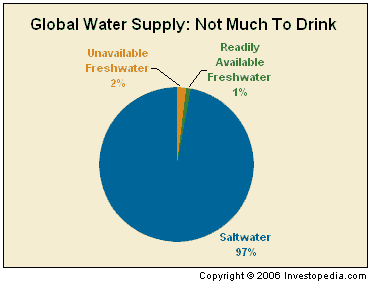
water is a rare commodity. the local communities hate fracking but hey, all of this investment activity has been great for those who will profit...

CT_Water_1r.gif


http://www.investopedia.com/articles/06/water.asp
 
The pros massively outweigh the cons.


so you say, but many concerned citizens are not convinced...

the analysis seems shortsighted and driven by profit margins.


The case to ban fracking grows stronger every day. Fracking is short for hydraulic fracturing. It’s a water-intensive process where millions of gallons of fluid — typically water, sand, and chemicals, including ones known to cause cancer — are injected underground at high pressure to fracture the rock surrounding an oil or gas well. This releases extra oil and gas from the rock, so it can flow into the well.

But the process of fracking introduces additional industrial activity into communities beyond the well. Clearing land to build new access roads and new well sites, drilling and encasing the well, fracking the well and generating the waste, trucking in heavy equipment and materials and trucking out the vast amounts of toxic waste — all of these steps contribute to air and water pollution risks and devaluation of land that are turning our communities into sacrifice zones. Fracking threatens the air we breathe, the water we drink, the communities we love and the climate on which we all depend. That’s why over 250 communities in the U.S. have passed resolutions to stop fracking, and why Vermont, France and Bulgaria have stopped it.


Why a Ban? Can’t Better Regulations Make Fracking Safer?

No. Fracking is inherently unsafe and we cannot rely on regulation to protect communities’ water, air and public health. The industry enjoys exemptions from key federal legislation protecting our air and water, thanks to aggressive lobbying and cozy relationships with our federal decisionmakers (the exemption from the Safe Drinking Water Act is often referred to as the Cheney or Halliburton Loophole, because it was negotiated by then-Vice President Dick Cheney with Congress in 2005). Plus, the industry is aggressively clamping down on local and state efforts to regulate fracking by buying influence and even bringing lawsuits to stop them from being implemented. That’s why fracking can’t be made safer through government oversight or regulations. An all out ban on fracking is the only way to protect our communities.

http://www.foodandwaterwatch.org/water/fracking/
 
Unmeasured Danger: America’s Hidden Groundwater Crisis

Farmers in the western United States are drilling ever deeper to water their crops. Mainers are concerned with lowered water levels in their wells when water bottlers come to town. Arizonans see the Santa Cruz River withering away. In communities around the country, these citizens are all seeing the effects of a decline in one of our most crucial but least understood natural resources: groundwater.

The water that settles between rocks and dirt under the earth‚ surface after it rains accounts for about 40 percent of our drinking and agricultural water supply. Through the watershed, it links to surface waters, which share sources of water from both above and below the ground. When it disappears, pumping through wells becomes harder and more expensive; rivers, lakes, streams and wetlands dry up; and even the land itself can cave in.

Today, our groundwater resources are disappearing in many parts of the country. In some regions, underground water levels are falling because we are pumping water through wells faster than it is naturally replaced by rainfall. This may permanently damage our aquifers capacity to hold water, and can have broad consequences for our entire freshwater supply.

Because groundwater pools beneath our feet, we do not always register its absence until the effects become drastic. Read our report.

We cannot wait for the visible effects of groundwater depletion to kick in before taking action. The federal government must take action now by supporting nationwide groundwater data collection projects so that we can accurately evaluate the status of our groundwater and take steps to protect it before it is too late.

How much danger are we in? We don’t know. According to the United States Geological Survey, no one has ever comprehensively studied groundwater level declines across the country. Many states collect data on a local level, but vary in how much data they collect and the resources they contribute to such projects. Even when states do collect data, local data can only provide limited information about whole aquifers, which often cross state lines.

Without scientific data on groundwater availability, state water managers cannot make sound decisions about water allocation. That is why scientists, government agencies and non-governmental organizations are asking the federal government to collect groundwater quantity and quality data on a national scale.
 
A deadly pollution known as PM2.5 is currently killing over three million people each year, primarily in the developing world, demonstrates Richard Muller (Professor of Physics at the University of California, Berkeley since 1980) in Why Every Serious Environmentalist should favour Fracking. His co-author, Elizabeth Muller, is his daughter and co-founder (with him) of Berkeley Earth, a non-profit working on environmental issues.

As such, air pollution is currently harming far more people than the more distant challenge of global warming – particularly for emerging economies such as China and India. They state:

“The Health Effects Institute estimated that air pollution in 2010 led to 3.2 million deaths that year [across the world], including 1.2 million in China and 620,000 in India. And the pollution is getting worse as global use of coal continues to grow…

The Mullers argues that both global warming and air pollution can be mitigated by the responsible development and utilisation of shale gas:
China not only has the greatest yearly death toll from air pollution, but is also key for mitigating global warming. China surpassed the US in CO2 production in 2006; growth was so rapid that by late 2013, China’s CO2 emissions are nearly twice those of the US. If its growth continues at this rate (and China has averaged 10% GDP growth per year for the past 20 years) China will be producing more CO2 per person than the US by 2023. If the US were to disappear tomorrow, Chinese growth alone would bring worldwide emissions back to the same level in four years. To mitigate global warming, it is essential to slow worldwide emissions, not just those in the developed countries. And we feel this must be done without slowing the economic growth of the emerging world…”

It is believed that China has enormous reserves of shale gas, perhaps 50% larger than those of the US. If that shale gas can be utilised, it offers China a wonderful opportunity to mitigate air pollution while still allowing energy growth… Industry experts believe that the cubic metres of gas recovered from a given well can be doubled in the near future by better design of the fracking stages to match geologic formation characteristics. And they also believe that number could double again in the next decade. Soon that will mean four times the production for only a minor increase in cost. Such an advance is expected to turn currently difficult fields into major producers, to open up fields in China, Europe, and the US that are currently unprofitable.”

The authors consider some of the concerns raised by opponents of fracking; and conclude that they are either largely false or can be addressed by appropriate regulation.

Developed economies should therefore help emerging economies switch from coal to natural gas; and shale gas technology should be advanced as rapidly as possible and shared freely.

And China and Europe are well placed to take advantage of fracking. The high price paid in China and Europe for imported natural gas, typically US$10 per million BTU (compared to the US$3.50 in the US) means that the cost of shale drilling and completion can be much higher and still be profitable.
The Mullers conclude that environmentalists should recognise the shale gas revolution as beneficial to society – and lend their full support to helping it advance.

DOWNLOAD FREE PDF


Source: http://www.cps.org.uk/publications/...ious-environmentalist-should-favour-fracking/

http://wattsupwiththat.com/2013/12/...ious-environmentalist-should-favour-fracking/


is this author in your OP an 'eco-nut'...........??

i notice they go on about mostly China and ignore all sorts of costs and real life repercussions to American citizens and their communities.

so let's see you demonstrate your convincing economic expertise on that complex 'cost' analysis.
 
The authors consider some of the concerns raised by opponents of fracking; and conclude that they are either largely false or can be addressed by appropriate regulation.

Developed economies should therefore help emerging economies switch from coal to natural gas; and shale gas technology should be advanced as rapidly as possible and shared freely.


^ lol well, gee.. now that is convincing...
 
I have a bridge in Brooklyn I can sell you. If that doesn't interest you, how about some swampland in Florida?
 
Back
Top