MAGA's Favorite Lie: The Left Is the Real Terror Threat

Grim Reaper

Chief Exit Officer (CEO)
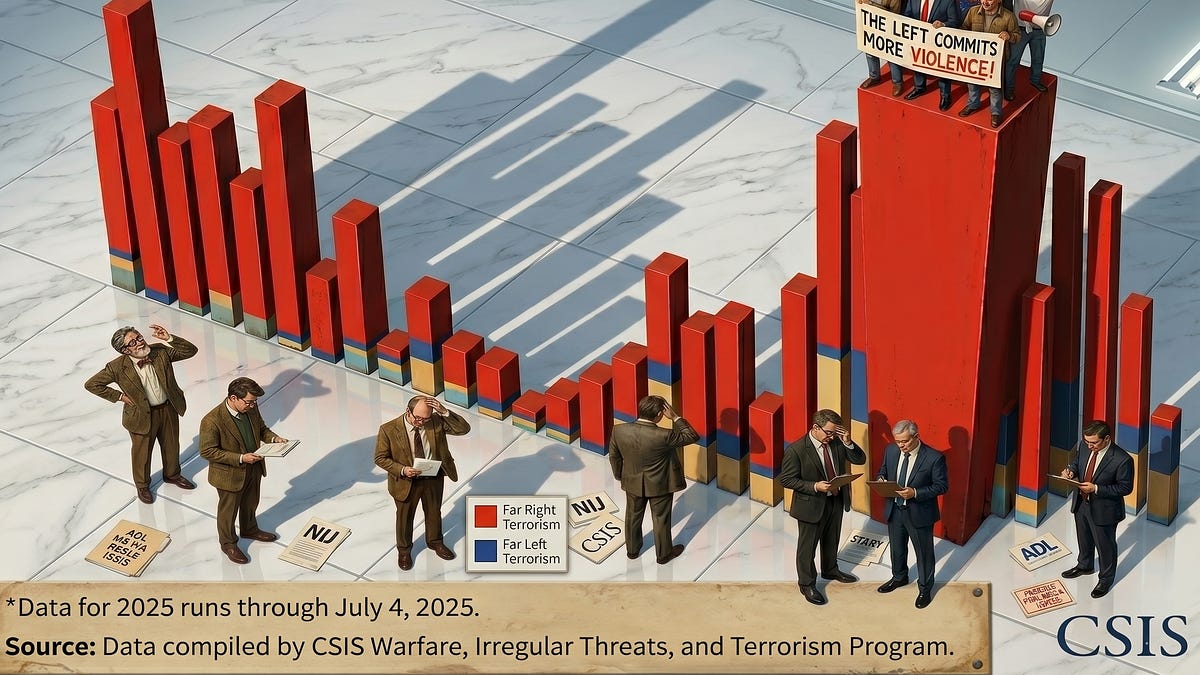
Overview

  • The article examines long‑term data on political violence in the United States.
  • It argues that multiple independent research institutions consistently find right‑wing extremism responsible for most domestic extremist violence over the past 30 years.

Definitions and Methodology

  • Research institutions (START, CSIS, ADL, NIJ) use established definitions for “far‑right” and “far‑left” extremism based on ideology, not political preference.
  • The U.S. does not formally designate domestic groups as terrorist organizations, which affects how incidents are counted.
  • Jihadist violence is treated as a separate category in all major datasets.
  • Gang violence and non‑ideological mass shootings are excluded from terrorism statistics.

Long‑Term Data Findings

  • CSIS (1994–2020): ~57% of terrorist incidents were right‑wing; right‑wing actors caused most fatalities in most years.
  • PNAS study: right‑wing radicals are statistically more likely to commit violence than left‑wing radicals.
  • NIJ research: since 1990, far‑right extremists committed significantly more homicide events than far‑left extremists.
  • ADL (2022–2024): all documented extremist murders in these three years were committed by right‑wing extremists.
  • Cato Institute: right‑wing extremists responsible for most political‑violence deaths since 1975 (excluding 9/11).

2025 Data and Interpretation

  • CSIS reported more left‑wing incidents than right‑wing incidents in early 2025, but the sample size was small.
  • Critics argue several right‑wing incidents were excluded due to definitional criteria.
  • The article notes that right‑wing violence historically spikes after major political events and could return to higher levels quickly.
  • CSIS cautioned against reallocating resources away from right‑wing threats based on early 2025 data.

Case Studies and Incident Classification

  • Some incidents labeled “left‑wing” in public discourse (e.g., the Charlie Kirk shooting) are described as having personal motives or unclear ideological ties.
  • Some right‑wing incidents were not classified as terrorism due to lack of explicit ideological statements.

Radicalization Research

  • NIJ-funded interviews with former white supremacists show people often join for belonging, not ideology.
  • Ideology and acceptance of violence develop through group socialization.
  • Online environments can normalize dehumanizing rhetoric that increases acceptance of violence.

Left‑Wing Violence

  • Left‑wing violence exists and has increased since 2016.
  • It remains less lethal, less frequent, and less organized than right‑wing violence.
  • Most left‑wing fatalities involve confrontations with law enforcement rather than mass‑casualty attacks.

Political and Psychological Context

  • The article argues that some political actors selectively cite or reinterpret data for narrative purposes.
  • Motivated reasoning research is used to explain why individuals may reject consistent empirical findings.
 
Wouldn't it depend on how you define things? If you go solely by body count the article is correct. But is that the metric, sole metric, we should be using to define what terrorist acts (aka political violence) is?
 
Wouldn't it depend on how you define things? If you go solely by body count the article is correct. But is that the metric, sole metric, we should be using to define what terrorist acts (aka political violence) is?
That’s exactly why the researchers don’t use a single metric. Body count is one metric, but not the only one, and none of the institutions cited rely on fatalities alone.

CSIS, START, ADL, and NIJ all classify incidents using multiple factors, documented ideological motive, target selection, organizational ties, planning and intent, scale and sophistication, lethality when it occurs

When you apply all of those metrics consistently across 30 years of data, the same pattern shows up, right‑wing incidents are more frequent, more organized, and more lethal on average.

So yes, definitions matter. That’s why the article walks through the definitions first, and why the long‑term findings stay the same no matter which dataset or methodology you use.
 
That’s exactly why the researchers don’t use a single metric. Body count is one metric, but not the only one, and none of the institutions cited rely on fatalities alone.

CSIS, START, ADL, and NIJ all classify incidents using multiple factors, documented ideological motive, target selection, organizational ties, planning and intent, scale and sophistication, lethality when it occurs

When you apply all of those metrics consistently across 30 years of data, the same pattern shows up, right‑wing incidents are more frequent, more organized, and more lethal on average.

So yes, definitions matter. That’s why the article walks through the definitions first, and why the long‑term findings stay the same no matter which dataset or methodology you use.
Do they count in violent riots? How about things like doxxings and the like? The article seems to only use the body count within it.

What it means in practice is that right-wing violence gets prosecuted as murder, hate crimes, weapons violations, and conspiracy rather than terrorism, which means it is systematically undercounted in official statistics, not overcounted. The definitional vacuum, to the extent it exists, favors the right-wing violence argument, not the left-wing one.

The article also has the tone that it is looking at individuals committing acts and not group behavior.

So, something like the Leftist attack on "Cop City" outside of Atlanta isn't considered here, as but one example.
 
Last edited:
Do they count in violent riots? How about things like doxxings and the like? The article seems to only use the body count within it.

1. Violent riots CSIS, START, ADL, and NIJ don’t classify “riots” as terrorism unless there is:

  • a documented ideological motive,
  • a deliberate target selection,
  • planning or organizational direction,
  • and an intent to intimidate or coerce for political ends.
Most riot‑related violence—left or right—fails those criteria, so it isn’t counted for either side. That’s the point of using standardized definitions instead of vibes.

2. Doxxing Doxxing is harmful, but it is not classified as terrorism by any of the institutions you’re talking about. If you want to argue that it should be, that’s a different conversation, but it doesn’t change the fact that the datasets apply the same rule to everyone.
 
1. Violent riots CSIS, START, ADL, and NIJ don’t classify “riots” as terrorism unless there is:

  • a documented ideological motive,
  • a deliberate target selection,
  • planning or organizational direction,
  • and an intent to intimidate or coerce for political ends.
Most riot‑related violence—left or right—fails those criteria, so it isn’t counted for either side. That’s the point of using standardized definitions instead of vibes.

2. Doxxing Doxxing is harmful, but it is not classified as terrorism by any of the institutions you’re talking about. If you want to argue that it should be, that’s a different conversation, but it doesn’t change the fact that the datasets apply the same rule to everyone.
My point exactly.

On the radical Right violent acts are generally carried out by one, or a few, persons often with a high body count. The violence is often deadly and extreme. On the radical Left violent acts are generally carried out by a large mob and the violence is less than deadly although in many other ways just as extreme.

All of the above can be attributed easily to mass radical Leftist protests that occur on a regular basis. Of late, the mass protests against ICE in Milwaukee fit the criteria perfectly.

There was a clear ideological motive behind them. That was open borders and normalizing persons illegally in the US versus deportation.

Deliberate target selection. That was obvious. ICE officers and operations.

Planning and organizational direction. There were numerous online web sites that were tracking ICE operations and movements, coordinating protesters and their actions for example.

An intent to intimidate or coerce for political ends. Again, clearly self-obvious in that case.

The riots meet the criteria but aren't considered. The study is clearly badly flawed.
 
You’re just relabeling protests as terrorism because you don’t like the politics. The datasets don’t code crowd chaos as targeted attacks, and you can’t fix that by stapling motives onto a mob after the fact. You’re swapping categories, not exposing a flaw.
 
You’re just relabeling protests as terrorism because you don’t like the politics. The datasets don’t code crowd chaos as targeted attacks, and you can’t fix that by stapling motives onto a mob after the fact. You’re swapping categories, not exposing a flaw.
No, I'm using YOUR criteria. You just don't like the fact that violent Leftist riots can be, and often are, acts of terrorism BY YOUR DEFINITION. I am exposing the flaw in your reasoning and that of the article itself.
 
No, I'm using YOUR criteria. You just don't like the fact that violent Leftist riots can be, and often are, acts of terrorism BY YOUR DEFINITION. I am exposing the flaw in your reasoning and that of the article itself.
You’re not using my criteria, you’re rewriting them. The datasets classify targeted, ideologically‑motivated attacks, not every chaotic crowd event where someone throws a bottle.

If you want to call riots terrorism, you’d have to apply that standard symmetrically, and none of the institutions you’re citing do that. They don’t retro‑fit ideological intent onto a mob after the fact, and they don’t treat unfocused property damage as a planned political attack.

You’re not exposing a flaw in the reasoning, you’re swapping in a different definition and pretending it’s the same one.
 
You’re not using my criteria, you’re rewriting them. The datasets classify targeted, ideologically‑motivated attacks, not every chaotic crowd event where someone throws a bottle.

That is exactly what I used. Show me where I'm wrong in classifying those protests. I did give examples.
If you want to call riots terrorism, you’d have to apply that standard symmetrically, and none of the institutions you’re citing do that. They don’t retro‑fit ideological intent onto a mob after the fact, and they don’t treat unfocused property damage as a planned political attack.

Yes! Fine by me! That means all of a sudden there is far more radical Leftist violence than radical Rightist. It gives a far more accurate picture than simply counting acts by a few individuals and body count.
You’re not exposing a flaw in the reasoning, you’re swapping in a different definition and pretending it’s the same one.
Yes, I have, and you are only reinforcing it.
 
Back
Top