

Grim Reaper
Chief Exit Officer (CEO)
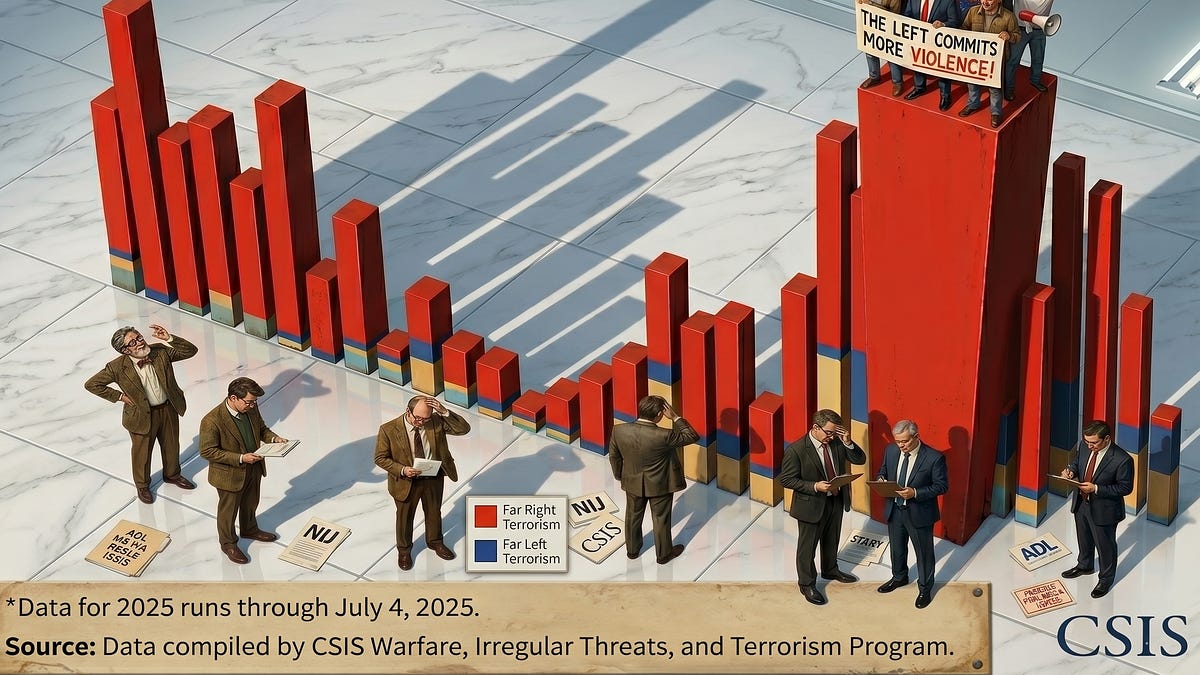
MAGA's Favorite Lie: The Left Is the Real Terror Threat
Thirty years of research, three consecutive years of zero left-wing extremist murders, and a government that deleted its own findings. The argument was never about evidence.
 therationalleague.substack.com
MAGA's Favorite Lie: The Left Is the Real Terror Threat
Thirty years of research, three consecutive years of zero left-wing extremist murders, and a government that deleted its own findings. The argument was never about evidence.
therationalleague.substack.com
Overview
- The article examines long‑term data on political violence in the United States.
- It argues that multiple independent research institutions consistently find right‑wing extremism responsible for most domestic extremist violence over the past 30 years.
Definitions and Methodology
- Research institutions (START, CSIS, ADL, NIJ) use established definitions for “far‑right” and “far‑left” extremism based on ideology, not political preference.
- The U.S. does not formally designate domestic groups as terrorist organizations, which affects how incidents are counted.
- Jihadist violence is treated as a separate category in all major datasets.
- Gang violence and non‑ideological mass shootings are excluded from terrorism statistics.
Long‑Term Data Findings
- CSIS (1994–2020): ~57% of terrorist incidents were right‑wing; right‑wing actors caused most fatalities in most years.
- PNAS study: right‑wing radicals are statistically more likely to commit violence than left‑wing radicals.
- NIJ research: since 1990, far‑right extremists committed significantly more homicide events than far‑left extremists.
- ADL (2022–2024): all documented extremist murders in these three years were committed by right‑wing extremists.
- Cato Institute: right‑wing extremists responsible for most political‑violence deaths since 1975 (excluding 9/11).
2025 Data and Interpretation
- CSIS reported more left‑wing incidents than right‑wing incidents in early 2025, but the sample size was small.
- Critics argue several right‑wing incidents were excluded due to definitional criteria.
- The article notes that right‑wing violence historically spikes after major political events and could return to higher levels quickly.
- CSIS cautioned against reallocating resources away from right‑wing threats based on early 2025 data.
Case Studies and Incident Classification
- Some incidents labeled “left‑wing” in public discourse (e.g., the Charlie Kirk shooting) are described as having personal motives or unclear ideological ties.
- Some right‑wing incidents were not classified as terrorism due to lack of explicit ideological statements.
Radicalization Research
- NIJ-funded interviews with former white supremacists show people often join for belonging, not ideology.
- Ideology and acceptance of violence develop through group socialization.
- Online environments can normalize dehumanizing rhetoric that increases acceptance of violence.
Left‑Wing Violence
- Left‑wing violence exists and has increased since 2016.
- It remains less lethal, less frequent, and less organized than right‑wing violence.
- Most left‑wing fatalities involve confrontations with law enforcement rather than mass‑casualty attacks.
Political and Psychological Context
- The article argues that some political actors selectively cite or reinterpret data for narrative purposes.
- Motivated reasoning research is used to explain why individuals may reject consistent empirical findings.
