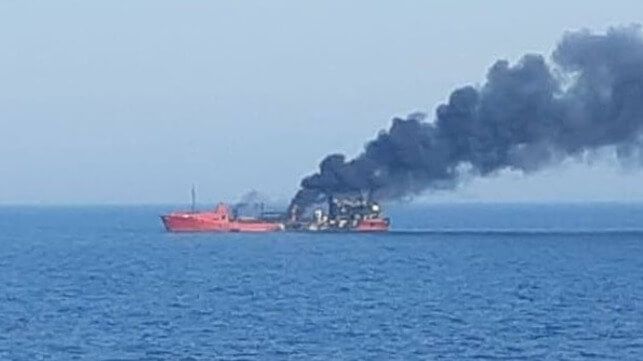
sinking of Russia's flagship might be a bad sign for the U.S. Navy

anatta

100% recycled karma
For several years now, going back to a pair of collisions separately involving the U.S.S. John S. McCain and U.S.S. Fitzgerald in 2017, there have been a series of reports indicating that the U.S. Navy is overstretched, overworked, and under-maintained, and thus increasingly vulnerable as it goes about the expensive task of patrolling the world's oceans.

A February report by the Government Accountability Office broke down the ugly details of how Navy personnel are struggling to keep their ships running properly. "Some crewmembers provided examples of parts such as electrical safety equipment being on backorder for up to 2 years and described difficulties locating consumable materials such as filters, specific types of oil, and protective clothing for themselves," the GAO reported. "Ten of the 16 ships' crews we met with stated that they resorted to cannibalizing parts — that is, taking functional parts away from other ships, in turn leaving them less-than-operational — so their respective ships could remain operational."

America might have what is regarded as the most powerful navy in the world — China has the largest, but many of its ships are smaller — but it is clearly fragile. And that's a problem.

"The U.S. Navy is on the verge of strategic bankruptcy," Christopher Dougherty, a former assistant defense secretary, wrote last year. "Its fleet isn't large enough to meet global day-to-day demands for naval forces. Due to repeated deployments and maintenance backlogs, the fleet also isn't ready enough to meet these demands safely, nor can it quickly surge in an emergency." He concluded that "the risk of its debts coming due suddenly (and perhaps violently) will increase."

there is also the question of whether the U.S. Navy is built for the modern world.

Just as aircraft carriers once replaced battleships as the backbone of the fleet, there are now questions about whether America's carrier-based fleet is overly vulnerable to a new generation of Chinese anti-ship ballistic missiles. And those questions are likely to get more pertinent if it turns out the Ukrainians really did take out the Moskva with their new Neptune missile.

America has spent much of the 21st century learning that the overwhelming power of its armed forces isn't always so overwhelming. The sinking of the Moskva is a sign that such a lesson might also extend to the U.S. Navy. Finding out the hard way might be disastrous.
https://theweek.com/education/1012741/hey-florida-we-need-to-see-the-math-books
 
China’s Aircraft Carrier Killers, And Who Else Has Them
https://www.navalnews.com/naval-new...ship-ballistic-missiles-are-and-who-has-them/

Earlier this month it was revealed that China has been building targets in the shape of U.S. Navy aircraft carriers in their remote deserts. Together with other targets, designed to represent American warships, they are believed to be part of the Chinese Navy’s Anti-Ship Ballistic Missile (ASBM) program.

This will provide the China with a potentially game-changing capability. It could inhibit the other countries’ ability or wiliness to employ aircraft carriers against them. Or certainly limit the way that they are employed and thus the tactical and strategic impact of them.

And China is not the only country working on ASBMs. Other countries, facing a resurgence of Aircraft Carriers, are developing similar missiles.

An ASBM starts its flight to the target following a ballistic trajectory. The path generally takes it into space before it returns to earth, re-entering the atmosphere at a steep angle. The final stage will have some form of Maneuverable Reentry Vehicle (MaRV). Therefore it can adjust its flightpath to hit the target which may have moved during the flight. The maneuvering flight path will also make them harder to intercept, thus increasing the threat.

Because they are going incredibly fast, over Mach 5, they are categorized as hypersonic weapons. And potentially some future designs may feature a hypersonic glide vehicle as the final stage. This has an aerodynamic form with wings which allows it to skim off the atmosphere, thus extending its range and making it even harder to intercept.

Chinese-Navy-Hypersonic-Anti-Ship-Ballistic-Missile-Test.jpg
 
Mainstream anti-ship missiles tend to be small and are less likely to strike a catastrophic blow to large ships like a carrier (circumstances are of course everything!). Some missiles are larger, like Russia’s Granit, but even these have comparatively limited range.

There are ongoing improvements to mainstream anti-ship missiles in terms of range, targeting capabilities, speed and survivability. But designers have explored ASBM technology which takes these variables to new levels.

High speed is also valuable as it reduces flight time meaning that the target will have moved less during the flight. Blake Herzinger, who has written a book on China’s Anti-Ship Ballistic Missiles, estimates that a long range engagement may only take 25 minutes from launch to impact. In this time a carrier, even at 30 knots, could cover less than 13 nautical miles.

When added to the size of these systems, ASBMs should hit much harder than even the largest regular anti-ship missiles. All the same, Herzinger doubts that this could be enough, in a single strike, to sink a carrier. However “it is unlikely China would only launch one missile. Achieving a mission kill, rendering a carrier unable to launch or recover aircraft, is a distinct possibility for a successful strike.”
Anti-Ship Ballistic Missiles Around The World

China: The main and most often cited adopter of the technology is, China. They have developed at least three distinct weapons in the category. The ground-based DF-21D (CSS-5 Mod-4) was first delivered to the PLARF (People’s Liberation Army Rocket Force) around 2009. It has an estimated range of about 800 nautical miles and reaches speeds of up to Mach 10.

For the past five years or so the DF-21 series of missile has been complemented by the improved DF-26 (CSS-18). This has a much longer range, around 2,000 nautical miles. And significantly, the missile has several interchangeable payloads including both nuclear and conventional warheads. The anti-ship version is therefore just a configuration, and any DF-26 could be fitted for it in the field.

There is also the expectation that the ASBMs will be added to the latest Type-055 Renhai Class warship. Officially described as large destroyers, they are more aptly described as cruisers. Although the exact type of ASBM is not known in open sources, it is likely to be larger than the current missiles carried. This may mean that new launch cells need to be added, reducing the current 112-cell vertical launch system capacity. The new capability would likely more than make up for the reduction.

China is also believed to be working on an air-launched ASBM. A single round, the largest air-launched weapon in the world, can be carried under an H-6 strategic bomber. Very little is known about the missile itself but Herzinger suspects that it may be a variant of the DF-21. Air-launch will increase its range considerably, and potentially allow quicker reactions against time-sensitive targets.

How fast the they can react to newly identified targets is important. Targeting is one of the greatest challenges for any ASBM because of the extreme ranges involved. China appears to have adopted a large number of satellites to provide coverage of the vast Pacific Ocean. These could include Synthetic Aperture Radar (SAR) sensors to provide all-weather coverage.

Another country going the air-launched ASBM route is Russia. Some MiG-31 FOXHOUND fighters have been upgraded to carry the Kh-47M2 Kinzhal hypersonic missile. This Mach 10 missile has a reported range of around 1,100 nautical miles.

With Russia we should also briefly touch on the Zircon missile. This is a hypersonic anti-ship missile, but would not normally be categorized as an ASBM. A small scramjet-powered missile, it is launched from ships and submarines. However, think of it as a hypersonic version of a traditional anti-ship missile rather than an anti-ship version of a ballistic missile.

Iran has also been developing ASBMs, using its ground-based Fateh-110 missile as a base. The latest version of the Khalij Fars ASBM uses an infrared / electro-optical sensor for terminal guidance. Its range is claimed to be 380 nautical miles, which is less than the other systems described above. Its speed is also not hypersonic, being reported at Mach 3. So overall it is a less capable system on paper, but a serious threat all the same.

The final country to mention is India. The Dhanush ballistic missile is reported to have an anti-ship capability. It has a range of less than 200 nautical miles and but a very high terminal speed of around Mach 8-9. Launch is via a stabilized platform, typically occupying the helipad of the ship. This makes the system less flexible than some other systems.

The newer Agni-P intermediate-range ballistic missile is also reported to be capable of ASBM missions. This is currently a development test platform but if productionized will be a much more potent and versatile system than the Dhanush .

From a sea of disbelief, ASBMs are a being taken increasingly seriously. Particularly China’s ambitious program. Like any new weapons there will be challenges. And many systems may not be as capable in an operational setting as advertised. But the direction of travel is clear. And China seems determined to make it a reality.
https://www.navalnews.com/naval-new...ship-ballistic-missiles-are-and-who-has-them/
 
The reporting I have read indicates that the Cold War-era Moskva had substandard anti missile countermeasures and electronics compared to modern US Navy warships.
 
The reporting I have read indicates that the Cold War-era Moskva had substandard anti missile countermeasures and electronics compared to modern US Navy warships.
Probably true. Russian navy has always been an after thought.

But the article is about space reentry hypersonics as well as a shore to ship anti-ship missile like Neptune
Our task forces and Fleets are all carrier based with layered protection unlike Russia
ASBM like Mach10 maneuverable re-entry missiles are the stuff of nightmares for naval architects.
Be sure to scan post 3 for the details
 
before we get to worked up remember that for some reason this flagship was not roaming the Black Sea causing trouble but docked at port.
aka sitting duck.
 
Probably true. Russian navy has always been an after thought.

But the article is about space reentry hypersonics as well as a shore to ship anti-ship missile like Neptune
Our task forces and Fleets are all carrier based with layered protection unlike Russia
ASBM like Mach10 maneuverable re-entry missiles are the stuff of nightmares for naval architects.
Be sure to scan post 3 for the details

This war is proving NATO weapons technology superior to Russian, even in the hands of Ukranian troops who are not as comprehensibly trained in NATO weapons as professional NATO soldiers are.

I would be cautious in drawing conclusions from the Moskva to modern US Navy warships.
 
before we get to worked up remember that for some reason this flagship was not roaming the Black Sea causing trouble but docked at port.
aka sitting duck.

No, the Moskva was hit when it was 65 miles offshore, out in the open waters of the Black Sea.
 
sinking of Russia's flagship might be a bad sign for the U.S. Navy

All navies. They are looking redundant.

How many aircraft can be destroyed at once by vaporizing an aircraft carrier ?
 
Or at least that is what our resident anti-American, Putin fellating, Russian cock holster annette is HOPING for anyway. :fu:
 
I would point to the USS Mason in the Red Sea back in 2016 as a better example. That destroyer was targeted by several Chinese made HY-2 Silkworm missiles that the destroyer successfully shot down or jammed causing them to miss. While the Ukrainian version of the Kh-35 Neptun (Neptune) is more akin to a US Harpoon and more sophisticated, it doesn't appear that the Moskva took any effective defensive measures to stop these missiles prior to impact. That would indicate that either the ship's systems are markedly inferior, that the crew was poorly trained, or both.
 
interesting... the report I read had it in port.
goes to show information coming out of there is not to be trusted.
Ukrainians destroyed another ship that was in port, that was a different attack and did not involve cruise missiles as far as we know.
 
interesting... the report I read had it in port.
goes to show information coming out of there is not to be trusted.

There are photos of it on fire and it's clearly at sea.

Milenial-Spirit-fire-Ukraine.56aaa0.jpg


A Google Images search, copy/paste then post takes all of one minute.
 
Back
Top