cancel2 2022
Canceled
First off, she is not very switched on but then that arsehole asking the questions isn't any better. So let's look at this in terms of climate forcing or temperature rise. Here is a brilliant analysis done by a really clever guy called Lubos Motl.
https://motls.blogspot.co.uk/2013/09/ocean-heat-content-relentless-but.html
The ocean heat content is defined as[FONT=MathJax_Math][/FONT]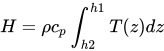 where [FONT=MathJax_Math]ρ[/FONT] is the water density, [FONT=MathJax_Math]
[/FONT] is the specific heat capacity, and [FONT=MathJax_Math]T[/FONT][FONT=MathJax_Main]([/FONT][FONT=MathJax_Math]z[/FONT][FONT=MathJax_Main])[/FONT] is the temperature profile from the top depth [FONT=MathJax_Math]h[/FONT][FONT=MathJax_Main]1[/FONT] to the bottom depth [FONT=MathJax_Math]h[/FONT][FONT=MathJax_Main]2[/FONT]. The additive shift is a bit ambiguous; we want to talk about the changes of the ocean heat content only.
Now, in the first graph, 0-2000 meters, the change between 1968 and 2013 was the difference between [FONT=MathJax_Main]+[/FONT][FONT=MathJax_Main]17[/FONT] and [FONT=MathJax_Main]−[/FONT][FONT=MathJax_Main]9[/FONT] "units" used in the graph. That's [FONT=MathJax_Main]26[/FONT] units. Looking at the [FONT=MathJax_Math]y[/FONT]-axis, you see that the unit is [FONT=MathJax_Main]10[/FONT][FONT=MathJax_Main]22[/FONT] joules. So the change of the ocean heat content of this layer during the last 45 years was[FONT=MathJax_Main] 2.6[/FONT][FONT=MathJax_Main]×[/FONT][FONT=MathJax_Main]10^[/FONT][FONT=MathJax_Main]23[/FONT][FONT=MathJax_Main]J[/FONT][FONT=MathJax_Main].[/FONT]
That's nice. How much is it? We want to translate it to the average temperature change of this layer of water. To do so, we have to know the volume of the layer and multiply it by the heat capacity.
The total volume of the world's oceans is about [FONT=MathJax_Main]1.4[/FONT] billion cubic kilometers which is[FONT=MathJax_Main] 1.4[/FONT][FONT=MathJax_Main]×[/FONT][FONT=MathJax_Main]10[/FONT][FONT=MathJax_Main]^8[/FONT][FONT=MathJax_Main] m³ [/FONT][FONT=MathJax_Main][/FONT][FONT=MathJax_Main]→ [/FONT][FONT=MathJax_Main]1.4[/FONT][FONT=MathJax_Main]×[/FONT][FONT=MathJax_Main]10[/FONT][FONT=MathJax_Main]^21[/FONT][FONT=MathJax_Main]k[/FONT][FONT=MathJax_Main]g
[/FONT]
where the mass in kilograms was obtained by the multiplication by [FONT=MathJax_Main]1[/FONT][FONT=MathJax_Main],[/FONT][FONT=MathJax_Main]000[/FONT][FONT=MathJax_Main]k[/FONT][FONT=MathJax_Main]g[/FONT][FONT=MathJax_Main]/[/FONT][FONT=MathJax_Main]m³[/FONT][FONT=MathJax_Main][/FONT] and one cubic kilometer was translated to one billion cubic meters, OK? The heat capacity of the world's ocean is this number multiplied by [FONT=MathJax_Main]4[/FONT][FONT=MathJax_Main],[/FONT][FONT=MathJax_Main]200[/FONT][FONT=MathJax_Main]J[/FONT][FONT=MathJax_Main]/[/FONT][FONT=MathJax_Main]([/FONT][FONT=MathJax_Main]k[/FONT][FONT=MathJax_Main]g[/FONT][FONT=MathJax_Main]⋅[/FONT][FONT=MathJax_Main]K[/FONT][FONT=MathJax_Main])[/FONT] which is[FONT=MathJax_Main] 5.9[/FONT][FONT=MathJax_Main]×[/FONT][FONT=MathJax_Main]10[/FONT][FONT=MathJax_Main]^24[/FONT][FONT=MathJax_Main] J[/FONT][FONT=MathJax_Main]/[/FONT][FONT=MathJax_Main]K[/FONT][FONT=MathJax_Main].
[/FONT]
The same page tells us that the average depth of the ocean is [FONT=MathJax_Main]3.8[/FONT] kilometers. The layer we consider is slightly more than one-half of that but this layer will carry more water than one-half of the world oceans' water simply because at many/most places, the restriction that the layers beneath 2 kilometers of depth are omitted is inconsequential. (Or did I get it backwards and the deep places are more relevant for the nonlinearity?) So I estimate the heat capacity of the layer between 0 and 2 kilometers of depth to be around 4 [FONT=MathJax_Main]×[/FONT][FONT=MathJax_Main]10[/FONT][FONT=MathJax_Main]^24[/FONT][FONT=MathJax_Main]J[/FONT][FONT=MathJax_Main]/[/FONT][FONT=MathJax_Main]K[/FONT][FONT=MathJax_Main].
[/FONT]
Plus minus 20 percent. I am just calculating an estimate. The last step is a simple division. We take the change of the ocean heat content from the NOAA graph, [FONT=MathJax_Main]2.6[/FONT][FONT=MathJax_Main]×[/FONT][FONT=MathJax_Main]10[/FONT][FONT=MathJax_Main]^23[/FONT][FONT=MathJax_Main]J[/FONT], and divide it by the figure above. We obtain[FONT=MathJax_Main] 2.6[/FONT][FONT=MathJax_Main]×[/FONT][FONT=MathJax_Main]10[/FONT][FONT=MathJax_Main]^23[/FONT][FONT=MathJax_Main]J[/FONT][FONT=MathJax_Main]/4[/FONT][FONT=MathJax_Main]×[/FONT][FONT=MathJax_Main]10[/FONT][FONT=MathJax_Main]^24[/FONT][FONT=MathJax_Main]J[/FONT][FONT=MathJax_Main]/[/FONT][FONT=MathJax_Main]K[/FONT][FONT=MathJax_Main]=[/FONT][FONT=MathJax_Main]0.065[/FONT][FONT=MathJax_Main]K [/FONT]plus minus 20 percent. In the last 45 years, the average temperature of that layer of the ocean increased by [FONT=MathJax_Main]0.065[/FONT] Celsius degrees only! That would give you 0.14 °C per century, about 20 times smaller temperature difference than the changes of the global mean temperature predicted for the surface.
(Update: Paul Matthews informed me via Twitter about this ARGO page where they confirm that since the 1960s, the warming of that layer was 0.06 °C [search for 0.06 on that page]. Just to be sure, the zero following the decimal point is not a typo.)
If you include the oceans up to the depth of 2 kilometers, oceans' message is unequivocal: the change of the temperature in the recent decades is completely negligible – a whopping sixteenth of a degree per half a century.
You might rightfully object that the ocean heat content primarily changes because of the changes in the surface layers while the deeper layers mostly keep their temperature. You would be partly right. We may consider a thinner graph, the water between 0 meters and 700 meters of depth. I estimate its heat capacity as one-half of the layer at 0-2000 meters i.e. as [FONT=MathJax_Main]2[/FONT][FONT=MathJax_Main]×[/FONT][FONT=MathJax_Main]10^[/FONT][FONT=MathJax_Main]24[/FONT][FONT=MathJax_Main]J[/FONT][FONT=MathJax_Main]/[/FONT][FONT=MathJax_Main]K[/FONT] due to the same nonlinear bias.
The NOAA graph for the 0-700 meter layer gives us a jump from [FONT=MathJax_Main]−[/FONT][FONT=MathJax_Main]7[/FONT] to [FONT=MathJax_Main]+[/FONT][FONT=MathJax_Main]11[/FONT] units, so the ratio [FONT=MathJax_Main]2.6[/FONT][FONT=MathJax_Main]/[/FONT][FONT=MathJax_Main]4[/FONT] from the previous calculation is replaced by [FONT=MathJax_Main]1.8[/FONT][FONT=MathJax_Main]/[/FONT][FONT=MathJax_Main]2[/FONT] and you get [FONT=MathJax_Main]0.09[/FONT][FONT=MathJax_Main]K[/FONT], a larger amount than before (by about 50 percent). However, it's still a completely negligible amount.
The depth 700 meters is already relatively low and circulation at the decadal scale is able to transfer much of the heat to this depth. Nevertheless, we still obtained the averaging warming just by [FONT=MathJax_Main]0.2[/FONT] Celsius degrees per century! Even if you were assuming that only the upper 350 meters "do something" while the temperature of the lower 350 meters "remains the same", you could justify a trend by at most [FONT=MathJax_Main]0.4[/FONT] Celsius degrees per century.
One may also convert the temperature changes to forcing and one gets less than 0.5 watts per squared meter, almost an order of magnitude less than the forcing 3.7 watts per squared meter commonly associated with the CO2 doubling.
I would like to point out that these are the temperature changes that the greenhouse effect in principle predicts for the land, too. While the land's temperature is more variable due to the shortage of water with a high capacity, the equilibrium climate sensitivity (temperature increase after reaching equilibrium caused by a doubling of CO2) should be the same above the land and above the ocean because the greenhouse effect only considers the temperature profiles of the atmosphere and the absorption/emission by the atmosphere, not any modifications on the surface. For the quantification of the greenhouse effect itself, it doesn't really matter what the surface is.
(In this treatment, I subtract the ice-albedo feedback and similar feedbacks and the justification is that they're local in character. We're talking about the temperature change at places without these special feedbacks.)
So I think that the ocean heat data are pretty cool, convincing, and show a rather uniformly increasing total heat. But the same data also seem to imply that the climate sensitivity is well below one Celsius degree per CO2 doubling.
Corrections welcome. I challenge you to find any global ocean heat data, from any layer (but considered globally), that would support the idea of a warming trend exceeding 1.5 (or at least 1) °C per century in any decade of the 20th or 21st century.
https://motls.blogspot.co.uk/2013/09/ocean-heat-content-relentless-but.html
Last edited: