limited nuclear war?

Don Quixote

cancer survivor
Contributor
trump has directed the pentagon to develop lower yield nuclear weapons such that a 'limited' nuclear war could be waged

There’s No Such Thing as ‘Limited’ Nuclear War (March 5, 2017)
By Dianne Feinstein, Washington Post
“Last month, it was revealed that a Pentagon advisory committee authored a report calling for the United States to invest in new nuclear weapons and consider resuming nuclear testing. The report even suggested researching less-powerful nuclear weapons that could be deployed without resorting to full-scale nuclear war. This is terrifying and deserves a swift, full-throated rebuke.” To read the op-ed, CLICK HERE
 
I thought that was that limited nuclear war was the entire concept they were doing before? The idea was you hit a couple of targets but the other guy wouldnt respond because it would be a MAD scenario?
 
trump has directed the pentagon to develop lower yield nuclear weapons such that a 'limited' nuclear war could be waged

There’s No Such Thing as ‘Limited’ Nuclear War (March 5, 2017)
By Dianne Feinstein, Washington Post
“Last month, it was revealed that a Pentagon advisory committee authored a report calling for the United States to invest in new nuclear weapons and consider resuming nuclear testing. The report even suggested researching less-powerful nuclear weapons that could be deployed without resorting to full-scale nuclear war. This is terrifying and deserves a swift, full-throated rebuke.” To read the op-ed, CLICK HERE

Wrong, the fact is that a tactical nuke can now be produced using new technology that is not being tested because of treaties that do not have the USA's best interest in mind. A tactical nuke can also be carried by a fighter jet vs a C5 for a daisy cutter
 
Russia deploys cruise missile, threatens NATO
Russia has deployed a land-based cruise missile that violates the "spirit and intent" of an arms control treaty and poses a threat to NATO, Vice Chairman of the U.S. Joint Chiefs of Staff General Paul Selva said on Wednesday.

It was the first public accusation by the U.S. military of the deployment after reports said last month that Russia had secretly deployed the ground-launched SSC-8 cruise missile that Moscow has been developing and testing for several years, despite U.S. complaints that it violated sections of the 1987 Intermediate-range Nuclear Forces (INF) treaty.

"The system itself presents a risk to most of our facilities in Europe and we believe that the Russians have deliberately deployed it in order to pose a threat to NATO and to facilities within the NATO area of responsibility," Selva said during a House Armed Services Committee hearing. The Air Force general did not say whether the missile was capable of carrying a nuclear weapon.

Selva said the United States had brought up the issue with Russia. He did not say what options were being considered if the discussions did not lead to results, but added that "we have been asked to incorporate a set of options into the nuclear posture review."

http://www.reuters.com/article/us-usa-russia-missiles-idUSKBN16F23V

John McCain is a happy man today..all the Russiaphobia is yielding results!
 
I thought that was that limited nuclear war was the entire concept they were doing before? The idea was you hit a couple of targets but the other guy wouldnt respond because it would be a MAD scenario?

nope smaller (lower yield) bombs like 50 kilo ton instead of 5 megaton
 
the point is if you LOVED the old Cold War , you are gonna ADORE the NEW Cold War 2.0 !

not only are we not going to reduce tensions,and weapons escalations -
we're going to prepare for land war with nuclear battlefield capability.


ISN'T THAN NIFTY??????????????????

*the Russians hacked the election* grr grr
 
A tactical nuclear weapon (TNW) or non-strategic nuclear weapon is a nuclear weapon which is designed to be used on a battlefield in military situations, mostly with friendly forces in proximity and perhaps even on contested friendly territory.
This is opposed to strategic nuclear weapons which are designed to be mostly targeted in the enemy interior away from the war front against military bases, cities, towns, arms industries, and other hardened or larger-area targets to damage the enemy's ability to wage war.
Tactical nuclear weapons were a large part of the peak nuclear weapons stockpile levels during the Cold War.
https://en.wikipedia.org/wiki/Tactical_nuclear_weapon
 
Do we want to be the only ones not looking into this?
all out MADness?
Mutual Assured Destruction?
Or do you mean tactical nukes? bring it on! :palm:

Selva said the United States had brought up the issue with Russia. He did not say what options were being considered if the discussions did not lead to results, but added that "we have been asked to incorporate a set of options into the nuclear posture review."
 
This is not a new concept at all. We had (and probably still do) nukes that are sized for a battlefield only.
 
all you dumbass leftists saying 'government needs more power', until you end up with someone you feel will abuse that power. MORONS!!!!!!!!!!!!!!!!11
 
recent report from the Bulletin of Atomic Scientists details how the US massively upgraded the lethality of its submarine-based nuclear missiles — and US adversaries like Russia may be spooked to the point of considering countermeasures.

Essentially, the US's latest update to its Trident missiles aboard US Navy submarines ensures that each and every single missile will explode at precisely the right moment to devastate any target.

Because of this new "super fuze," or timing element, the US's submarine-launched ballistic missile fleet has tripled in destructive potential, according to the report.

This is important because US military planners previously only relied on submarine-launched missiles to strike soft targets like military bases. Now these missiles could be used to wipe out Russia's nukes buried deep underground.

"Because of improvements in the killing power of US submarine-launched ballistic missiles, those submarines now patrol with more than three times the number of warheads needed to destroy the entire fleet of Russian land-based missiles in their silos," wrote Hans M. Kristensen, Matthew McKinzie, and Theodore A. Postol, the authors of the report.

But the US has even bigger nukes which sit in missile silos underground as ICBMs. Historically, these missiles would have been used for destroying Russia's ICBMs, but since submarines can handle that now, the US can focus its big nukes on obliterating underground hardened nuclear shelters — the kind Kremlin officials would hide out in during an attack.

From a US perspective, submarine-launched nuclear missile capability has surged, but don't expect Russia to share the enthusiasm.

Unlike the US, which can spot missile launches from space, Russia would have virtually no warning of an incoming missile besides its ground-based radars, which have limited range.

"Russian military and political leaders would have no 'situational awareness' to help them assess whether an early-warning radar indication of a surprise attack is real or the result of a technical error," the scientists write.
 
recent report from the Bulletin of Atomic Scientists details how the US massively upgraded the lethality of its submarine-based nuclear missiles — and US adversaries like Russia may be spooked to the point of considering countermeasures.

Essentially, the US's latest update to its Trident missiles aboard US Navy submarines ensures that each and every single missile will explode at precisely the right moment to devastate any target.

Because of this new "super fuze," or timing element, the US's submarine-launched ballistic missile fleet has tripled in destructive potential, according to the report.

This is important because US military planners previously only relied on submarine-launched missiles to strike soft targets like military bases. Now these missiles could be used to wipe out Russia's nukes buried deep underground.


But the US has even bigger nukes which sit in missile silos underground as ICBMs. Historically, these missiles would have been used for destroying Russia's ICBMs, but since submarines can handle that now, the US can focus its big nukes on obliterating underground hardened nuclear shelters — the kind Kremlin officials would hide out in during an attack.

From a US perspective, submarine-launched nuclear missile capability has surged, but don't expect Russia to share the enthusiasm.

Unlike the US, which can spot missile launches from space, Russia would have virtually no warning of an incoming missile besides its ground-based radars, which have limited range.

"Russian military and political leaders would have no 'situational awareness' to help them assess whether an early-warning radar indication of a surprise attack is real or the result of a technical error," the scientists write.

sounds like an argument for a first strike by the us and MAD is out the window. I hope that trump has not read this...
 
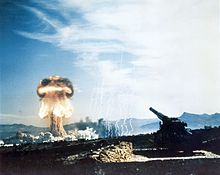
M65 atomic cannon

The M65 atomic cannon, often called "Atomic Annie",[3] was a towed artillery piece built by the United States and capable of firing a nuclear device. It was developed in the early 1950s, at the beginning of the Cold War, and fielded, by 1953, in Europe and South Korea.

History


Picatinny Arsenal was tasked to create a nuclear capable artillery piece in 1949. Robert Schwartz, the engineer who created the preliminary designs, essentially scaled up the 240mm shell (then the maximum in the arsenal) and used the German K5 railroad gun as a point of departure for the carriage.[2] (The name "Atomic Annie" likely derives from the nickname "Anzio Annie" given to a pair of German K5 guns which were employed against the American landings in Italy.[1]) The design was approved by the Pentagon, largely through the intervention of Samuel Feltman,[2] chief of the ballistics section of the ordnance department's research and development division. A three-year developmental effort followed. The project proceeded quickly enough to produce a demonstration model to participate in Dwight Eisenhower's inaugural parade in January 1953.
The cannon was transported by two specially designed tractors, both capable of independent steering in the manner of some extra-long fire trucks. Each of the tractors was rated at 375*hp, and the somewhat awkward combination could achieve speeds of 35 miles an hour and negotiate right angle turns on 28*ft wide, paved or packed roads.[1] The artillery piece could be unlimbered in 15 minutes, then returned to traveling configuration in another 15 minutes.
On May 25, 1953 at 8:30am, the atomic cannon was tested at the Nevada Test Site (specifically Frenchman Flat) as part of the Upshot–Knothole series of nuclear tests. The test — codenamed "Grable" — was attended by the Chairman of the Joint Chiefs of Staff, Admiral Arthur W. Radford and Secretary of Defense Charles Erwin Wilson; it resulted in the successful detonation of a 15 kt shell (W9 warhead) at a range of seven miles. This was the first and only nuclear shell to be fired from a cannon [1] (the Little Feller 1 test shot of an M388 used a Davy Crockett weapon system which was a recoilless smooth bore gun firing the warhead mounted on the end of a spigot inserted in the barrel of the weapon.)
After the successful test, there were at least 20 of the cannons manufactured at Watervliet and Watertown Arsenals, at a cost of $800,000 each.[1] They were deployed overseas to Europe and Korea, often continuously shifted around to avoid being detected and targeted by opposing forces. Due to the size of the apparatus, their limited range, the development of nuclear shells compatible with existing artillery pieces (the W48 for the 155mm and the W33 for the 203mm), and the development of rocket and missile based nuclear artillery, the M65 was effectively obsolete soon after it was deployed. However, it remained a prestige weapon and was not retired until 1963.

Survivors

Of the twenty M65s produced, at least seven survive on display, plus the 240mm prototype. Most no longer have their "prime movers".
U.S. Army Artillery Museum, Fort Sill, Oklahoma (This is the original "Atomic Annie" that fired the live nuclear shot. It was restored in 2010[4] and is now displayed with prime movers replacing those that were lost in an accident when the cannon was retrieved from Germany by the museum in 1964.[5])
United States Army Ordnance Museum, Aberdeen, Maryland (still has the two large prime movers attached)
National Museum of Nuclear Science & History, Albuquerque, New Mexico (has two prime movers)
Freedom Park, Junction City, Kansas, overlooking Fort Riley
Rock Island Arsenal, Memorial Field, Rock Island, Illinois
Virginia War Museum, Newport News, Virginia, 240mm prototype
Watervliet Arsenal Museum, Watervliet Arsenal, Watervliet, New York, where they were all manufactured
Yuma Proving Ground, Yuma, Arizona

220px-Nuclear_artillery_test_Grable_Event_-_Part_of_Operation_Upshot-Knothole.jpg
190px-M65_Atomic_canon_1.jpg
 
Saudi Arabia and Iran need to develop an independent nuclear deterrent to defend themselves from fanatical Trumpists. America won't ever dare to nuke Mecca in an act of aggression if the arabs respond in kind.
 
sounds like an argument for a first strike by the us and MAD is out the window. I hope that trump has not read this...
truely you've lost all objectivity my friend.
This point came back to the essential paradox of Russia’s position on nuclear weapons. It is the very real feeling of weakness and vulnerability that makes Russia cling to its most destructive and dangerous arms. And until Russia’s leaders are made to believe that the U.S. does not wish them any harm, visions of a nuclear free world will never be realized.
http://time.com/4280169/russia-nuclear-security-summit/
 
Back
Top