After a multi-month, politically charged investigation, German intelligence agencies could find no good evidence of Moscow-directed cyber-attacks or a disinformation campaign aimed at subverting the democratic process in Germany. Undaunted, Chancellor Angela Merkel has commissioned a new investigation.
Last year, Berlin’s two main intelligence agencies, the BND and BfV (counterparts of the CIA and FBI) launched a joint investigation to substantiate allegations that Russia was meddling in German political affairs and attempting to shape the outcome of Germany’s elections next September.
Like the vast majority of Americans malnourished on “mainstream media,” most Germans have been led to believe that, by hacking and “propaganda,” the Kremlin interfered in the recent U.S. election and helped Donald Trump become president.
German intelligence agencies rarely bite the hand that feeds them and realize that the most bountiful part of the trough is at the CIA station in Berlin with ultimate guidance coming from CIA headquarters in Langley, Virginia. But this time, in an unusual departure from past practice, analysts at the BND and BfV decided to act like responsible adults.
Whereas former CIA Director John Brennan prevailed on his analysts to resort to anemic, evidence-light reasoning “assessing” that Russia tried to tip the U.S. election to Donald Trump, Berlin’s intelligence agencies found the evidence lacking and have now completed their investigation.
Better still, the conclusions have been reported in a mainstream German newspaper, Sueddeutsche Zeitung, apparently because a patriotic insider thought the German people should also know.
Lemmings No Longer?
If BND President Bruno Kahl thought that his own analysts could be depended upon to follow their American counterparts lemming-like and find evidence – Curveball-style – to support the U.S. allegations, he now has had a rude awakening
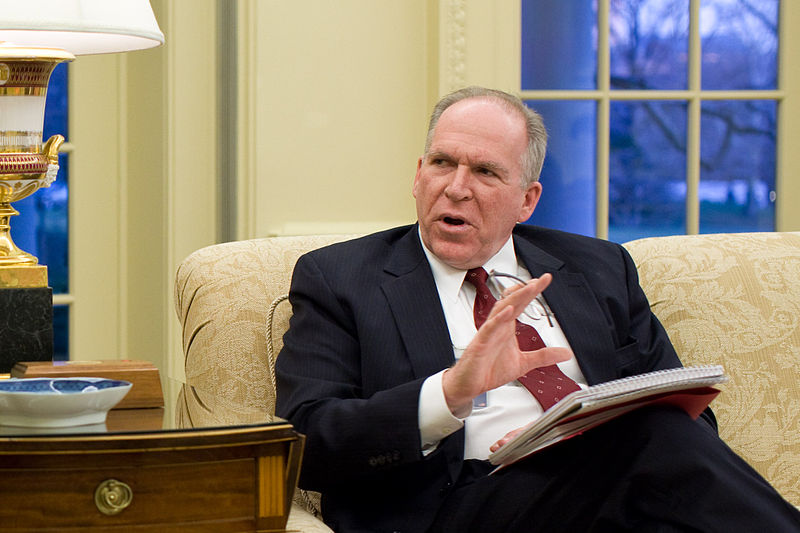
CIA Director John Brennan at a White House meeting during his time as President Barack Obama’s counterterrorism adviser
When the joint investigation was under way with his analysts doing their best to come up with reliable evidence of Russian perfidy, Kahl had behaved like his BND predecessors, parroting the charges made by his CIA counterpart, that the Russians were fomenting uncertainty and instability in Germany and elsewhere in Europe.
In a rare interview with the mainstream newspaper, Sueddeutsche Zeitung, on Nov. 28, 2016, Kahl went out on what he probably thought was a safe limb, denouncing subversive “interference” by the Russians (“as they did in the U.S.”). He was just a few months into his job and may have been naïve enough to consider what John Brennan said as gospel truth. (If he really is that gullible, Kahl is in the wrong profession.)
So it must have come as an unwelcome surprise to Kahl when he found out that, this time, BND analysts would stand on principle and refuse to be as malleable as their Washington counterparts. His analysts could find no proof that the Kremlin was working hard to undermine the democratic process in Germany, and said so.
Worse still from the U.S. point of view, the two German intelligence agencies resisted the usual pressure from some senior leaders in Berlin (perhaps including Kahl himself) to jam whatever innocuous information they could find into the anti-Russian mosaic that Washington was constructing, a kind of Cubist version of distorted reality.
And So, a Do-Over
According to the Sueddeutsche, “Chancellor Merkel’s office has now ordered a new inquiry. Notably, a ‘psychological operations group’ jointly run by the BND and BfV will specifically look at Russian news agencies’ coverage in Germany.” We can expect that any articles that don’t portray Vladimir Putin in a devil’s costume will be judged “Russian propaganda.”
Last year, Berlin’s two main intelligence agencies, the BND and BfV (counterparts of the CIA and FBI) launched a joint investigation to substantiate allegations that Russia was meddling in German political affairs and attempting to shape the outcome of Germany’s elections next September.
Like the vast majority of Americans malnourished on “mainstream media,” most Germans have been led to believe that, by hacking and “propaganda,” the Kremlin interfered in the recent U.S. election and helped Donald Trump become president.
German intelligence agencies rarely bite the hand that feeds them and realize that the most bountiful part of the trough is at the CIA station in Berlin with ultimate guidance coming from CIA headquarters in Langley, Virginia. But this time, in an unusual departure from past practice, analysts at the BND and BfV decided to act like responsible adults.
Whereas former CIA Director John Brennan prevailed on his analysts to resort to anemic, evidence-light reasoning “assessing” that Russia tried to tip the U.S. election to Donald Trump, Berlin’s intelligence agencies found the evidence lacking and have now completed their investigation.
Better still, the conclusions have been reported in a mainstream German newspaper, Sueddeutsche Zeitung, apparently because a patriotic insider thought the German people should also know.
Lemmings No Longer?
If BND President Bruno Kahl thought that his own analysts could be depended upon to follow their American counterparts lemming-like and find evidence – Curveball-style – to support the U.S. allegations, he now has had a rude awakening
CIA Director John Brennan at a White House meeting during his time as President Barack Obama’s counterterrorism adviser
When the joint investigation was under way with his analysts doing their best to come up with reliable evidence of Russian perfidy, Kahl had behaved like his BND predecessors, parroting the charges made by his CIA counterpart, that the Russians were fomenting uncertainty and instability in Germany and elsewhere in Europe.
In a rare interview with the mainstream newspaper, Sueddeutsche Zeitung, on Nov. 28, 2016, Kahl went out on what he probably thought was a safe limb, denouncing subversive “interference” by the Russians (“as they did in the U.S.”). He was just a few months into his job and may have been naïve enough to consider what John Brennan said as gospel truth. (If he really is that gullible, Kahl is in the wrong profession.)
So it must have come as an unwelcome surprise to Kahl when he found out that, this time, BND analysts would stand on principle and refuse to be as malleable as their Washington counterparts. His analysts could find no proof that the Kremlin was working hard to undermine the democratic process in Germany, and said so.
Worse still from the U.S. point of view, the two German intelligence agencies resisted the usual pressure from some senior leaders in Berlin (perhaps including Kahl himself) to jam whatever innocuous information they could find into the anti-Russian mosaic that Washington was constructing, a kind of Cubist version of distorted reality.
And So, a Do-Over
According to the Sueddeutsche, “Chancellor Merkel’s office has now ordered a new inquiry. Notably, a ‘psychological operations group’ jointly run by the BND and BfV will specifically look at Russian news agencies’ coverage in Germany.” We can expect that any articles that don’t portray Vladimir Putin in a devil’s costume will be judged “Russian propaganda.”