Five minutes with Prof. Richard Lindzen on 'climate change'

cancel2 2022

Canceled
I’m an atmospheric physicist. I’ve published more than 200 scientific papers. For 30 years I taught at MIT, during which time the climate has changed remarkably little. But the cry of “global warming” has grown ever more shrill. In fact, it seems that the less the climate changes, the louder the voices of the climate alarmists get. So, let’s clear the air and create a more accurate picture of where we really stand on the issue of global warming or, as it is now called—“climate change.”

There are basically three groups of people dealing with this issue. Groups one and two are scientists. Group three consists mostly, at its core, of politicians, environmentalists and the media.
Group one is associated with the scientific part of the United Nation’s International Panel on Climate Change or IPCC (Working Group 1). These are scientists who mostly believe that recent climate change is primarily due to man’s burning of fossil fuels—oil, coal and natural gas. This releases C02, carbon dioxide, into the atmosphere and, they believe, this might eventually dangerously heat the planet.

Group two is made up of scientists who don’t see this as an especially serious problem. This is the group I belong to. We’re usually referred to as skeptics. We note that there are many reasons why the climate changes—the sun, clouds, oceans, the orbital variations of the earth, as well as a myriad of other inputs. None of these is fully understood, and there is no evidence that CO2 emissions are the dominant factor. But actually there is much agreement between both groups of scientists. The following are such points of agreement:


1) The climate is always changing.
2) CO2 is a greenhouse gas without which life on earth is not possible, but adding it to the atmosphere should lead to some warming.
3) Atmospheric levels of CO2 have been increasing since the end of the Little Ice Age in the 19th century.
4) Over this period (the past two centuries), the global mean temperature has increased slightly and erratically by about 1.8 degrees Fahrenheit or one degree Celsius; but only since the 1960’s have man’s greenhouse emissions been sufficient to play a role.
5) Given the complexity of climate, no confident prediction about future global mean temperature or its impact can be made. The IPCC acknowledged in its own 2007 report that “The long-term prediction of future climate states is not possible.”

Most importantly, the scenario that the burning of fossil fuel leads to catastrophe isn’t part of what either group asserts. So why are so many people worried, indeed, panic stricken about this issue. Here’s where Group Three comes in—the politicians, environmentalists, and media.

Global warming alarmism provides them, more than any other issue, with the things they most want: For politicians it’s money and power. For environmentalists it’s money for their organizations and confirmation of their near religious devotion to the idea that man is a destructive force acting upon nature. And for the media it’s ideology, money, and headlines. Doomsday scenarios sell.

Meanwhile, over the last decade, scientists outside of climate physics have jumped on the bandwagon, publishing papers blaming global warming for everything from acne to the Syrian civil war. And crony capitalists have eagerly grabbed for the subsidies that governments have so lavishly provided.

Unfortunately, group three is winning the argument because they have drowned out the serious debate that should be going on. But while politicians, environmentalists and media types can waste a lot of money and scare a lot of people, they won’t be able to bury the truth. The climate will have the final word on that.

I’m Richard Lindzen, emeritus professor of atmospheric sciences at MIT, for Prager University.


https://www.prageru.com/courses/environmental-science/climate-change-what-do-scientists-say
 
For much of my life I have been a science writer. That means I eavesdrop on what’s going on in laboratories so I can tell interesting stories. It’s analogous to the way art critics write about art, but with a difference: we “science critics” rarely criticise. If we think a scientific paper is dumb, we just ignore it. There’s too much good stuff coming out of science to waste time knocking the bad stuff.

Sure, we occasionally take a swipe at pseudoscience—homeopathy, astrology, claims that genetically modified food causes cancer, and so on. But the great thing about science is that it’s self-correcting. The good drives out the bad, because experiments get replicated and hypotheses put to the test. So a really bad idea cannot survive long in science. Or so I used to think. Now, thanks largely to climate science, I have changed my mind. It turns out bad ideas can persist in science for decades, and surrounded by myrmidons of furious defenders they can turn into intolerant dogmas.

This should have been obvious to me. Lysenkoism, a pseudo-biological theory that plants (and people) could be trained to change their heritable natures, helped starve millions and yet persisted for decades in the Soviet Union, reaching its zenith under Nikita Khrushchev. The theory that dietary fat causes obesity and heart disease, based on a couple of terrible studies in the 1950s, became unchallenged orthodoxy and is only now fading slowly.

What these two ideas have in common is that they had political support, which enabled them to monopolise debate. Scientists are just as prone as anybody else to “confirmation bias”, the tendency we all have to seek evidence that supports our favoured hypothesis and dismiss evidence that contradicts it—as if we were counsel for the defence. It’s tosh that scientists always try to disprove their own theories, as they sometimes claim, and nor should they. But they do try to disprove each other’s. Science has always been decentralised, so Professor Smith challenges Professor Jones’s claims, and that’s what keeps science honest.

What went wrong with Lysenko and dietary fat was that in each case a monopoly was established. Lysenko’s opponents were imprisoned or killed. Nina Teicholz’s book The Big Fat Surprise shows in devastating detail how opponents of Ancel Keys’s dietary fat hypothesis were starved of grants and frozen out of the debate by an intolerant consensus backed by vested interests, echoed and amplified by a docile press.

Cheerleaders for alarm
This is precisely what has happened with the climate debate and it is at risk of damaging the whole reputation of science. The “bad idea” in this case is not that climate changes, nor that human beings influence climate change; but that the impending change is sufficiently dangerous to require urgent policy responses. In the 1970s, when global temperatures were cooling, some scientists could not resist the lure of press attention by arguing that a new ice age was imminent. Others called this nonsense and the World Meteorological Organisation rightly refused to endorse the alarm. That’s science working as it should. In the 1980s, as temperatures began to rise again, some of the same scientists dusted off the greenhouse effect and began to argue that runaway warming was now likely.

At first, the science establishment reacted sceptically and a diversity of views was aired. It’s hard to recall now just how much you were allowed to question the claims in those days. As Bernie Lewin reminds us in one chapter of a fascinating new book of essays called Climate Change: The Facts(hereafter The Facts), as late as 1995 when the second assessment report of the Intergovernmental Panel on Climate Change (IPCC) came out with its last-minute additional claim of a “discernible human influence” on climate, Nature magazine warned scientists against overheating the debate.

Since then, however, inch by inch, the huge green pressure groups have grown fat on a diet of constant but ever-changing alarm about the future. That these alarms—over population growth, pesticides, rain forests, acid rain, ozone holes, sperm counts, genetically modified crops—have often proved wildly exaggerated does not matter: the organisations that did the most exaggeration trousered the most money. In the case of climate, the alarm is always in the distant future, so can never be debunked.

These huge green multinationals, with budgets in the hundreds of millions of dollars, have now systematically infiltrated science, as well as industry and media, with the result that many high-profile climate scientists and the journalists who cover them have become one-sided cheerleaders for alarm, while a hit squad of increasingly vicious bloggers polices the debate to ensure that anybody who steps out of line is punished. They insist on stamping out all mention of the heresy that climate change might not be lethally dangerous.

Today’s climate science, as Ian Plimer points out in his chapter in The Facts, is based on a “pre-ordained conclusion, huge bodies of evidence are ignored and analytical procedures are treated as evidence”. Funds are not available to investigate alternative theories. Those who express even the mildest doubts about dangerous climate change are ostracised, accused of being in the pay of fossil-fuel interests or starved of funds; those who take money from green pressure groups and make wildly exaggerated statements are showered with rewards and treated by the media as neutral.

Look what happened to a butterfly ecologist named Camille Parmesan when she published a paper on “ Climate and Species Range” that blamed climate change for threatening the Edith checkerspot butterfly with extinction in California by driving its range northward. The paper was cited more than 500 times, she was invited to speak at the White House and she was asked to contribute to the IPCC’s third assessment report.

Unfortunately, a distinguished ecologist called Jim Steele found fault with her conclusion: there had been more local extinctions in the southern part of the butterfly’s range due to urban development than in the north, so only the statistical averages moved north, not the butterflies. There was no correlated local change in temperature anyway, and the butterflies have since recovered throughout their range. When Steele asked Parmesan for her data, she refused. Parmesan’s paper continues to be cited as evidence of climate change. Steele meanwhile is derided as a “denier”. No wonder a highly sceptical ecologist I know is very reluctant to break cover.

Jim Hansen, recently retired as head of the Goddard Institute of Space Studies at NASA, won over a million dollars in lucrative green prizes, regularly joined protests against coal plants and got himself arrested while at the same time he was in charge of adjusting and homogenising one of the supposedly objective data sets on global surface temperature. How would he be likely to react if told of evidence that climate change is not such a big problem?

Michael Oppenheimer, of Princeton University, who frequently testifies before Congress in favour of urgent action on climate change, was the Environmental Defense Fund’s senior scientist for nineteen years and continues to advise it. The EDF has assets of $209 million and since 2008 has had over $540 million from charitable foundations, plus $2.8 million in federal grants. In that time it has spent $11.3 million on lobbying, and has fifty-five people on thirty-two federal advisory committees. How likely is it that they or Oppenheimer would turn around and say global warming is not likely to be dangerous?

Why is it acceptable, asks the blogger Donna Laframboise, for the IPCC to “put a man who has spent his career cashing cheques from both the World Wildlife Fund (WWF) and Greenpeace in charge of its latest chapter on the world’s oceans?” She’s referring to the University of Queensland’s Ove Hoegh-Guldberg.

These scientists and their guardians of the flame repeatedly insist that there are only two ways of thinking about climate change—that it’s real, man-made and dangerous (the right way), or that it’s not happening (the wrong way). But this is a false dichotomy. There is a third possibility: that it’s real, partly man-made and not dangerous. This is the “lukewarmer” school, and I am happy to put myself in this category. Lukewarmers do not think dangerous climate change is impossible; but they think it is unlikely.

Read more: http://www.rationaloptimist.com/blog/what-the-climate-wars-did-to-science.aspx
 
Dr. Judith Curry Explains The Reality Of Bad Climate Science And Bad Politics

Judith A. Curry is an American climatologist and former chair of the School of Earth and Atmospheric Sciences at the Georgia Institute of Technology. Her research interests include hurricanes, remote sensing, atmospheric modeling, polar climates, air-sea interactions, and the use of unmanned aerial vehicles for atmospheric research. She is a member of the National Research Council's Climate Research Committee. As of 2017, she has retired from academia.

Curry is the co-author of Thermodynamics of Atmospheres and Oceans (1999), and co-editor of Encyclopedia of Atmospheric Sciences (2002), as well as over 140 scientific papers. Among her awards is the Henry G. Houghton Research Award from the American Meteorological Society in 1992. Regarding climate change, she thinks that the IPCC reports typically neglect what she calls the "Uncertainty Monster" in projecting future climate trends, which she calls a "wicked problem. "Curry also hosts a popular science blog in which she writes on topics related to climate science and the science-policy interface.

Judith Curry has argued that climatologists should be more accommodating of those skeptical of the scientific consensus on climate change. Curry has stated she is troubled by what she calls the "tribal nature" of parts of the climate-science community, and what she sees as stonewalling over the release of data and its analysis for independent review. In February 2010 Curry published an essay called "On the Credibility of Climate Change, Towards Rebuilding Trust" on Watts Up With That? and other blogs. Writing in The New York Times, Andrew Revkin calls the essay a message to young scientists who may have been disheartened by the November 2009 climate change controversy known as "Climategate".

In September 2010, she created Climate Etc., a blog related to climate change and hosted by Curry. She wrote that "Climate Etc. provides a forum for climate researchers, academics and technical experts from other fields, citizen scientists, and the interested public to engage in a discussion on topics related to climate science and the science-policy interface."[8] She wrote: "I have a total of 12,000 citations of my publications (since my first publication in 1983). Climate Etc. gets on average about 12,000 ‘hits’ per day, and 300-400 comments." She gets " zero academic credit or incentives for my blogging and tweeting," but hopes that " social media and the associated skill set [will become] better recognized within the academic system."

Curry testified before the US House Subcommittee on Environment in 2013, remarking on the many large uncertainties in forecasting future climate. In October 2014, Curry wrote an op-ed for the Wall Street Journal where she argued that human-caused warming near the end of the 21st century should be less than the 2-degrees-Celsius “danger” level for all but the IPCC’s most extreme emission scenario, which is far later than the IPCC prediction of a 2-degrees-Celsius warming before 2040.

 
Last edited:
Too much text, not enough pictures for warmists.

Besides, they don't want to read, hear or see anything that detracts from their confirmation bias.

A measure of their sincerity is the undeniable fact that none of the JPP warmers have eschewed electricity, and I very much doubt they have given up anything else.

Virtue-signaling is about all they can manage.
 
Not a one of the warmists are going to listen to Doctor Shaviv, Professor Kirby, or anyone who doesn't agree with their "consensus".

The only response you'll likely get - if that - is a post debunking the source, if you're lucky.
 
The 52% ‘consensus’


A comprehensive survey has been conducted of the American Meteorological Society membership to elicit their views on global warming.

Meteorologists’ views about global warming: A survey of American Meteorological Society professional members

Neil Stenhouse, Edward Maibach, Sara Cobb, Ray Ban, Andrea Bleistein, Paul Croft, Eugene Bierly, Keith Seitter, Gary Rasmussen

Abstract. Meteorologists and other atmospheric science experts are playing important roles in helping society respond to climate change. However, members of this professional community are not unanimous in their views of climate change, and there has been tension among members of the American Meteorological Society (AMS) who hold different views on the topic. In response, AMS created the Committee to Improve Climate Change Communication to explore and, to the extent possible, resolve these tensions. To support this committee, in January 2012 we surveyed all AMS members with known email addresses, achieving a 26.3% response rate (n=1,854). In this paper we tested four hypotheses: (1) perceived conflict about global warming will be negatively associated — and (2) climate expertise, (3) liberal political ideology, and (4) perceived scientific consensus will be positively associated — with (a) higher personal certainty that global warming is happening, (b) viewing the global warming observed over the past 150 years as mostly human-caused, and (c) perception of global warming as harmful. All four hypotheses were confirmed. Expertise, ideology, perceived consensus and perceived conflict were all independently related to respondents’ views on climate, with perceived consensus and political ideology being most strongly related. We suggest that AMS should: attempt to convey the widespread scientific agreement about climate change; acknowledge and explore the uncomfortable fact that political ideology influences the climate change views of meteorology professionals; refute the idea that those who do hold non-majority views just need to be “educated” about climate change; continue to deal with the conflict among members of the meteorology community

In press, Bulletin of the American Meteorological Society [abstract] [preliminarysurvey results].

The introduction provides an interesting survey of previous analysis of scientific views on this topic, excerpts:

Research conducted to date with meteorologists and other atmospheric scientists has shown that they are not unanimous in their views of climate change. In a survey of earth scientists, Doran and Zimmerman (2009) found that while a majority of meteorologists surveyed are convinced humans have contributed to global warming (64%), this was a substantially smaller majority than that found among all earth scientists (82%). Another survey, by Farnsworth and Lichter (2009), found that 83% of meteorologists surveyed were convinced human-induced climate change is occurring, again a smaller majority than among experts in related areas such as ocean sciences (91%) and geophysics (88%).

I suspect that the higher level of belief among ocean sciences and particularly geophysics represents second order belief (i.e. support for a perceived consensus) rather than personal research on AGW detection/attribution or a careful survey of the literature.

How to square this with the oft reported 97% consensus? Well, ‘climate scientists’ in these surveys typically includes economists, ecologists etc., nearly all probably representing second order belief.

The article attempts to explain ‘disbelief’ in context of lower expertise, political ideology, and perceptions on the existence of a consensus. I don’t think the methodology used is particularly useful in distinguishing these influences, but here are the results:

Confirming all four hypotheses, the regression analyses showed that greater expertise, more liberal ideology, greater perceived consensus, and lower perceived conflict each predicted higher levels of certainty global warming was occurring, higher likelihood of viewing it as mostly human caused, and greater ratings of future harm. Together, the independent variables explained 37% of the variation in certainty that global warming is occurring, and 29% of the variation in views on global warming harm, which is considered a moderate amount of explained variance in social science research (Cohe 342 n, 1992). Due to the nature of logistic regression, an equivalent statistic is unavailable for the proportion of explained variation in views on global warming causation.

In terms of strength of the relationship between the independent and dependent variables, perceived consensus was the strongest predictor of all three types of global warming views – certainty, causation, and harm/benefit. Political ideology was the second strongest predictor of view certainty and causation, and was equivalent to perceived consensus as predictor of harm/benefit. Expertise and perceived conflict were both less strong predictors of global warming views. Expertise was the second weakest predictor of global warming certainty, and the weakest predictor of causation and harm/benefit.Perceived conflict was the weakest predictor of global warming view certainty, and the second weakest predictor of causation and harm/benefit. For details of the regression analyses, see the online supplementary material.

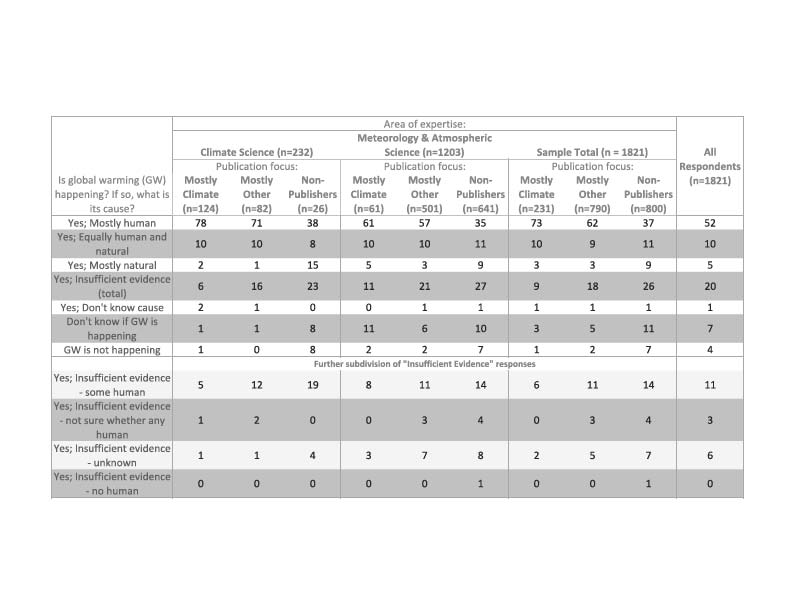
The most interesting finding is this table:

Table 1. Meteorologists’ assessment of human-712 caused global warming by area and level of expertise. Figures are percentages rounded to the nearest whole number. Numbers in the bottom four rows represent percentage of respondents giving each possible response to the follow-up email question, including non-response to the email (labeled “insufficient evidence – unknown”). These responses together add to the same number as displayed in the insufficient evidence (total) row; some differences occur due to rounding. Similarly, columns total to 100% if all numbers except those in the bottom four rows are added, and differences from 100 are due to rounding.
Although 1854 people completed some portion of the survey, this table only displays the results for 1821 respondents, since 33 (less than 2% of the sample) did not answer one or more of the questions on expertise and global warming causation
.
on.

Look at the views in column 1, then look at the % in the rightmost column: 52% state the the warming since 1850 is mostly anthropogenic. One common categorization would categorize the other 48% as ‘deniers’.


The table seeks to discriminate between those whose expertise is in climate science vs meteorology/atmospheric science. In the context of the AMS membership, I think this distinction is ambiguous. With regards to myself, I would have checked atmospheric science (most of my research is related to physical processes, not to climate change per se). I suspect that those focusing on climate impacts would check the box for climate expertise (note, only 222 checked the box for climate science). The distinction between publishing vs non publishing members probably is meaningful; only 52% of the respondents held Ph.Ds. Non Ph.D. members may be in the private sector or government employees.

JC comments
Some background information about the American Meteorological Society. The website for the AMS is [here]. The Wikipedia has a good overview article, including the AMS Statement on Climate Change, and a list of journals published by the AMS. A list of Fellows of the American Meteorological Society is found at [link].

A year ago, the AMS issued a Statement on Climate Change, see my blog post on this. Excerpts from their statement:
It is clear from extensive scientific evidence that the dominant cause of the rapid change in climate of the past half century is human-induced increases in the amount of atmospheric greenhouse gases, including carbon dioxide (CO2), chlorofluorocarbons, methane, and nitrous oxide.

The ongoing warming will increase risks and stresses to human societies, economies, ecosystems, and wildlife through the 21st century and beyond, making it imperative that society respond to a changing climate.

Mitigation will reduce the amount of future climate change and the risk of impacts that are potentially large and dangerous.

I was harshly critical of this statement, which was written by a group of volunteers and then approved by the AMS Council.

This study is an important one, in spite of its methodological flaws and not-quite-adequate list of questions.

Members of the American Meteorological Society generally have better expertise for assessing issues related to climate change detection and attribution than the AGU (with substantial numbers of geophysicists, geochemists, etc), the AAAS, the APS, etc. And this is in spite of the fact that a substantial number of members do not have a Ph.D. We have discussed previously on the Joe Bastardi thread the value of the perspectives of forecast meteorologists, including those without Ph.D.s — they certainly understand limitations of forecasting and general circulation models.

To their credit, the AMS is taking on the issue of disagreement on this topic, hopefully in a meaningful way. Information about the AMS Committee to Improve Climate Change Communication can be found [here]. I have also discussed this issue with Bill Gail, AMS President-elect – he seems to want to have a meaningful dialogue on this topic across the spectrum. Fingers crossed.

https://judithcurry.com/2013/11/10/the-52-consensus/

 
Last edited:
Your information is right on the mark and interesting....especially to me because for the 10 years I've been on this site I've been telling
the fools the keep posting about the sea rising and temperatures changing and the storms being cause by man how they are being
taken in with scientific con men....and all because of Al Gore....him being a Democrat makes all liberal fools here go along without thinking
for themselves....like the lemmings they are, they follow Gore and Democrats, because Big Al is a Democrat.....

I've forgotten what Jpp was named before but if we could go back that far....I was still telling them it was all a hoax...for money and grants and
power to control the people.....

This certainly does NOT mean I am against clear air and clean water and promoting pollution. I am not....That is a different subject all together...
and promote a clean environment as much as anyone.....
 
Your information is right on the mark and interesting....especially to me because for the 10 years I've been on this site I've been telling
the fools the keep posting about the sea rising and temperatures changing and the storms being cause by man how they are being
taken in with scientific con men....and all because of Al Gore....him being a Democrat makes all liberal fools here go along without thinking
for themselves....like the lemmings they are, they follow Gore and Democrats, because Big Al is a Democrat.....

I've forgotten what Jpp was named before but if we could go back that far....I was still telling them it was all a hoax...for money and grants and
power to control the people.....

This certainly does NOT mean I am against clear air and clean water and promoting pollution. I am not....That is a different subject all together...
and promote a clean environment as much as anyone.....

Yes CO2 does cause warming but it is a weak effect, that's the truth but it is drowned out by the bullshit produced by environmentalists, politicianss and the media. They all have a vested interest in ramping up the fear, uncertainty and doubt aka the FUD factor.
 
Back
Top