

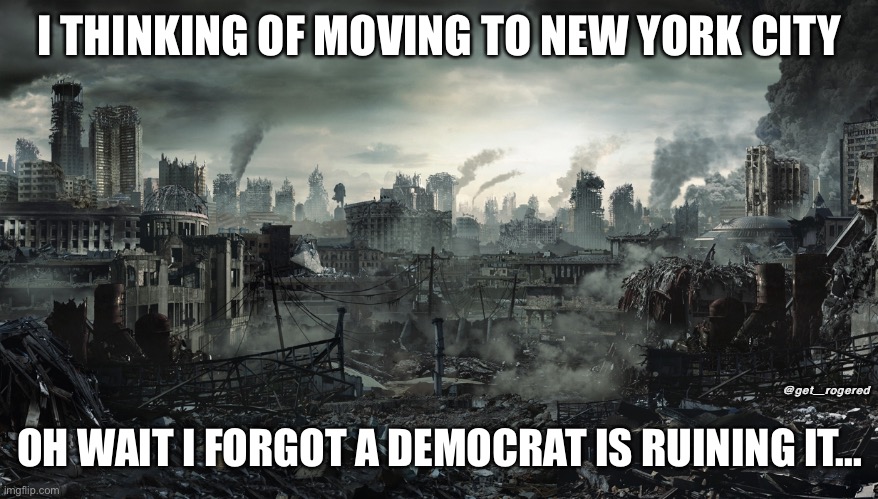
Years of leftist policy have left our cities unlivable, high-crime slums, and certainly non-profitable for business investment.
BXMT: Existential Risk From 'Detroitification' Across U.S. Cities
~Commercial office properties face unprecedented challenges due to the rise in work-from-home trends and urban decay, impacting REITs like Blackstone Mortgage Trust.
~BXMT has lost around a third of its value since its 2021 peak and faces growing loan losses on some of its office loans, with the market bracing for a ~10-15% non-performance rate in its portfolio.
~The "doom loop" issue may eventually turn many downtown areas into ghost towns, posing a risk for BXMT's long-term value, but it is not strong enough to consider it a short opportunity.
~Alternative REITs focused on smaller properties in "satellite" central business districts may be a haven against the "Detroitification" trend, plaguing office and non-office properties alike.
Early this week, Federal Reserve Chair Jerome Powell incidentally spurred drawdowns for many REITs after warning of an expected increase in bank loan losses on commercial properties. This event came after a similar warning from Wells Fargo's CEO (WFC) and a meteoric rise in vacancy rates in many major US cities. Most large cities boast 16-26% office vacancy rates. Particular areas like Manhattan have stupendously high vacancy rates of around 50%.
Since leases expire over a 5-10 year timeframe, vacancy rates will likely continue to rise over the coming years as more companies choose to save money by shifting toward a work-from-home or hybrid work schedule. At this point, it is not a question as to whether or not the "work from home" trend will reverse (after stabilizing in 2022) but if it will become a more significant systemic trend as more firms make the shift. Generally, companies with offices in more expensive areas, such as Manhattan and San Francisco, are quicker to adopt the change. In contrast, those in less costly regions have been slower (due to lower cost savings).
More importantly, companies that maintain an "office work" policy face more significant difficulties as the urban ecosystem and environment deteriorate due to growing vacancies. As more downtowns become "ghost towns," they're left with increasing crime rates and fewer retailers and services, creating general "urban decay" that encourages a broader work-from-home shift. This trend is becoming known as the "commercial office 'doom loop,' which virtually guarantees a prolonged vacancy increase. Decreased employee safety in urban areas may be a more significant deterrent to in-office work than anything else.
https://seekingalpha.com/article/46...urce=msn.com.com&utm_medium=referral' target=

BXMT: Existential Risk From 'Detroitification' Across U.S. Cities
~Commercial office properties face unprecedented challenges due to the rise in work-from-home trends and urban decay, impacting REITs like Blackstone Mortgage Trust.
~BXMT has lost around a third of its value since its 2021 peak and faces growing loan losses on some of its office loans, with the market bracing for a ~10-15% non-performance rate in its portfolio.
~The "doom loop" issue may eventually turn many downtown areas into ghost towns, posing a risk for BXMT's long-term value, but it is not strong enough to consider it a short opportunity.
~Alternative REITs focused on smaller properties in "satellite" central business districts may be a haven against the "Detroitification" trend, plaguing office and non-office properties alike.
Early this week, Federal Reserve Chair Jerome Powell incidentally spurred drawdowns for many REITs after warning of an expected increase in bank loan losses on commercial properties. This event came after a similar warning from Wells Fargo's CEO (WFC) and a meteoric rise in vacancy rates in many major US cities. Most large cities boast 16-26% office vacancy rates. Particular areas like Manhattan have stupendously high vacancy rates of around 50%.
Since leases expire over a 5-10 year timeframe, vacancy rates will likely continue to rise over the coming years as more companies choose to save money by shifting toward a work-from-home or hybrid work schedule. At this point, it is not a question as to whether or not the "work from home" trend will reverse (after stabilizing in 2022) but if it will become a more significant systemic trend as more firms make the shift. Generally, companies with offices in more expensive areas, such as Manhattan and San Francisco, are quicker to adopt the change. In contrast, those in less costly regions have been slower (due to lower cost savings).
More importantly, companies that maintain an "office work" policy face more significant difficulties as the urban ecosystem and environment deteriorate due to growing vacancies. As more downtowns become "ghost towns," they're left with increasing crime rates and fewer retailers and services, creating general "urban decay" that encourages a broader work-from-home shift. This trend is becoming known as the "commercial office 'doom loop,' which virtually guarantees a prolonged vacancy increase. Decreased employee safety in urban areas may be a more significant deterrent to in-office work than anything else.
https://seekingalpha.com/article/46...urce=msn.com.com&utm_medium=referral' target=