Overwhelming Majority Of Americans Think The Economy Is ‘Poor’: POLL

Grokmaster

Well-known member
Contributor
NO ONE IS BUYING THE DUNCE-O-CRATS "EVERYTHING IS WONDERFUL!!" BULLSHIT, AS AMERICANS BELEIVE THEOR OWN ETYES AND LIVES OVER LIE-O-CRAT GASLIGHTING.


Overwhelming Majority Of Americans Think The Economy Is ‘Poor’: POLL


Over four-fifths of Americans think the state of the economy is “poor” or “not good,” according to a Wall Street Journal-NORC Poll released Monday.


Approximately 83% of respondents said they had a negative outlook on the economy, while 35% said they were not at all satisfied with their current financial situation, The Wall Street Journal reported. The latter is the highest percentage recorded since NORC began asking the question in 1972.

Only 27% of respondents said they think they have a good chance of improving their standard of living, representing a 20-point decline from 2021. Almost 40% said their financial situation had worsened over the past couple of years.

The rise of inflation was the most common reason given for the negative economic perspective, Jennifer Benz, vice president of public affairs and media research at NORC, told the WS Journal.


The annual rate of inflation was 8.3% in April, which represented the largest year-over-year increase since January 1982, excluding March of this year. The cost of gas is a major factor in the increase, with the price at the pump surging to all-time records, according to AAA data.


https://dailycaller.com/2022/06/06/80-percent-americans-economy-bad-inflation-poll/

6eiejb.jpg
 
All true and it is interesting to see all the malcontent lefties try and defend anything Brandon has done to make life better for Americans on every level. Complete and total disaster and the hope for me is the republican take the house with a huge majority and start defunding Brandon's pet projects.
 
..... 35% said they were not at all satisfied with their current financial situation, The Wall Street Journal reported. The latter is the highest percentage recorded since NORC began asking the question in 1972

That really speaks to the impact of media coverage. By nearly any measurable indicator, most are doing quite well right now.

For example, right now the unemployment rate is 3.6%. Since 1972, there have been 605 months on record, of which exactly three had lower unemployment rates than we have right now (less than one half of one percent). In that time, unemployment rates got into double digits repeatedly, including a high of 14.7%. We also have a near-record high for median real income and a near record low for poverty rates. Household debt levels are currently lower, as a share of disposable income, than at any point prior to the pandemic. Household net worth is at a record high. A record high percentage of Americans are covered by health insurance. And those very high incomes are despite Americans now working fewer hours per year than in the past -- in '72, the average worker in the US worked 1890 hours per year, versus 1767 these days, which is like getting an extra 15 vacation days per year. Home ownership rates are also higher than normal, and median home sizes are much larger.

Yet, despite people being at or near the best point Americans have ever been at, economically, we have record dissatisfaction with that situation. The relentless negativity of the media really impacts people's perceptions.
 
That really speaks to the impact of media coverage. By nearly any measurable indicator, most are doing quite well right now.

For example, right now the unemployment rate is 3.6%. Since 1972, there have been 605 months on record, of which exactly three had lower unemployment rates than we have right now (less than one half of one percent). In that time, unemployment rates got into double digits repeatedly, including a high of 14.7%. We also have a near-record high for median real income and a near record low for poverty rates. Household debt levels are currently lower, as a share of disposable income, than at any point prior to the pandemic. Household net worth is at a record high. A record high percentage of Americans are covered by health insurance. And those very high incomes are despite Americans now working fewer hours per year than in the past -- in '72, the average worker in the US worked 1890 hours per year, versus 1767 these days, which is like getting an extra 15 vacation days per year. Home ownership rates are also higher than normal, and median home sizes are much larger.

Yet, despite people being at or near the best point Americans have ever been at, economically, we have record dissatisfaction with that situation. The relentless negativity of the media really impacts people's perceptions.

We had a 1st Qtr with negative GDP growth, we came close to a bear market in equities and we have massive inflation that has overtaken wage gains people received (thus making them poorer). Throw in concern over whether the Fed can engineer a soft landing or not and you blame the media for people not understanding their own economic reality?
 
That really speaks to the impact of media coverage. By nearly any measurable indicator, most are doing quite well right now.

For example, right now the unemployment rate is 3.6%. Since 1972, there have been 605 months on record, of which exactly three had lower unemployment rates than we have right now (less than one half of one percent). In that time, unemployment rates got into double digits repeatedly, including a high of 14.7%. We also have a near-record high for median real income and a near record low for poverty rates. Household debt levels are currently lower, as a share of disposable income, than at any point prior to the pandemic. Household net worth is at a record high. A record high percentage of Americans are covered by health insurance. And those very high incomes are despite Americans now working fewer hours per year than in the past -- in '72, the average worker in the US worked 1890 hours per year, versus 1767 these days, which is like getting an extra 15 vacation days per year. Home ownership rates are also higher than normal, and median home sizes are much larger.

Yet, despite people being at or near the best point Americans have ever been at, economically, we have record dissatisfaction with that situation. The relentless negativity of the media really impacts people's perceptions.


So much for your Big Announcement that you put me on "IGNORE". :laugh:

Horse shit. Were are nowhere near as well off as we were before the CHINADEM pandemic shutdowns.


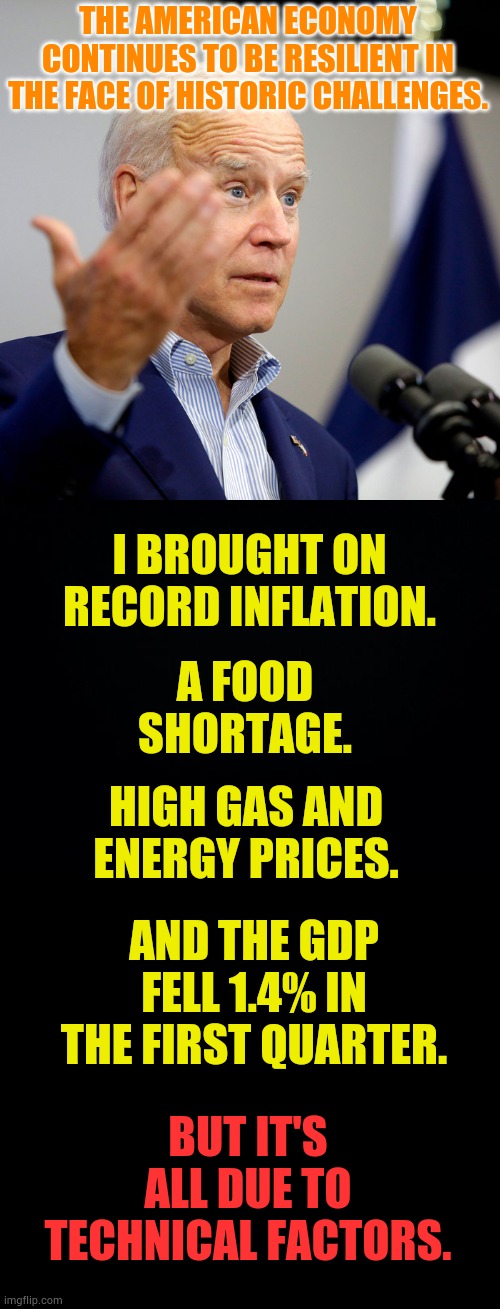
There are over SIX MILLION LESS PEOPLE IN THE WORKFORCE, and "Bidenomics" haven't even come CLOSE to replacing the jobs the CHINADEM SHUTDOWNS cost us, yet they laughbly squawk about "creating jobs", and "economic growth" when the 1st quarter of this year was a RETRACTION of 1.4%.


Save the Leftgoofuworld Fantasy View for your fellow morons.
 
We had a 1st Qtr with negative GDP growth

Yes. If you look just at that single quarter, it wasn't great.... the 20th-worst quarter since 1972 (201 quarters). So, it was definitely below normal. But was it the WORST, as you'd expect from record low satisfaction? No. It was -1.5% growth. The worst was -37.4%, and we had four other quarters with over 5% shrinkage in a single quarter. And it appears to have just been a one-off blip. The prior year had the best economic growth in almost 40 years, and the Fed is estimating Q2 saw renewed economic growth. So, you can't explain record-low dissatisfaction by that single meh quarter.

we came close to a bear market in equities

Yes, again, we came close. Yet, since 1972, we've had many examples of not just "coming close" to a bear market, but plunging very deeply into bear territory. For example, the Bush years were so awful stocks were actually down over an eight-year period. Yet it's not any of those other actual bear markets that triggered this record low satisfaction -- not all the times that people were truly wiped out. Instead, it's this one "near miss." Even with the recent trouble, people's portfolio's are significantly fatter than they were just recently... up nearly 10% since Biden took office. So, why all the negativity?

and we have massive inflation that has overtaken wage gains people received (thus making them poorer)

As discussed in another recent post, it's not clear that inflation has outpaced income growth. The media is focused on real wages, but those are not a good indicator, since new hiring tends to bring in junior workers, who earn less (driving down averages). There's a reason that the most rapid increase in real wages on record was between February and April 2020, even as the economy went into total melt-down and unemployment surged to over 14%: when you're laying workers off, you tend to disproportionately lay off lower-end workers (e.g., waiters or landscapers), which drives average wages up, just as when you're rehiring you disproportionately bring those lower-end workers back, which drives average wages down. The real test will be real income levels, where the decline in unemployment will help instead of hurting. Time will tell with that.

you blame the media for people not understanding their own economic reality?

Yes, I do. I think most people are incredibly economically ignorant. There's a reason pyramid schemes work, for example.
 
That really speaks to the impact of media coverage. By nearly any measurable indicator, most are doing quite well right now.

For example, right now the unemployment rate is 3.6%. Since 1972, there have been 605 months on record, of which exactly three had lower unemployment rates than we have right now (less than one half of one percent). In that time, unemployment rates got into double digits repeatedly, including a high of 14.7%. We also have a near-record high for median real income and a near record low for poverty rates. Household debt levels are currently lower, as a share of disposable income, than at any point prior to the pandemic. Household net worth is at a record high. A record high percentage of Americans are covered by health insurance. And those very high incomes are despite Americans now working fewer hours per year than in the past -- in '72, the average worker in the US worked 1890 hours per year, versus 1767 these days, which is like getting an extra 15 vacation days per year. Home ownership rates are also higher than normal, and median home sizes are much larger.

Yet, despite people being at or near the best point Americans have ever been at, economically, we have record dissatisfaction with that situation. The relentless negativity of the media really impacts people's perceptions.

More smoke and mirrors from you.

The unemployment rate is meaningless as it only measures those actively looking for work in the last 30 days. That leaves out those that have stopped looking, etc. The employment rate is a better measure and that has remained relatively flat. Earning power of most of the workforce is down--and significantly down--in the last year even as wages rise. This is because the cost of goods and services has risen faster than wages.

Home ownership has plummeted since Obama took office and hasn't come close to recovery as shown:

OVBlogFigure_4QtrMovingAvgHomeownership.png


Eviction rates are skyrocketing with the end of rent moratoriums the Democrats forced on states and landlords. With more people renting, this is only going to get worse in the coming months.

Then there's the predicted massive increases in the cost of Obamacare and Medicare policies to hit in October with the 2022 open season.

Toss in the massive increase in the cost of food and energy and it's a perfect storm of economic disaster for the Democrats.

Fuck Joke Biden! Vote every last Democrat out of office!
 
We had a 1st Qtr with negative GDP growth, we came close to a bear market in equities and we have massive inflation that has overtaken wage gains people received (thus making them poorer). Throw in concern over whether the Fed can engineer a soft landing or not and you blame the media for people not understanding their own economic reality?
thanks for the reality check..inflation kills any other metrics, including those wage gains
 
Ah, I didn't know this was yet another sock puppet account for Into the Night. How many accounts are you running?
Good grief. Another, silliass, delusional JPP little girl calling other people "sock puppets".

Feel free to ask the mods how many accounts I am running, you TWIT.

I have been Grokmaster all over the net, not just here, silly little girl...none of which lessens the embarrassment of you getting caught posting on my thread after your "Big Announcement" of putting me on ignore.


What a desperate, ignorant little ditz you are ...who is CLUELESS about economics ,obviouisly.

1st quarter was -1.4% dumbass.
 
The unemployment rate is meaningless as it only measures those actively looking for work in the last 30 days.

No. Actually it factors in anyone who either worked or looked for work during the reference week. I'm pretty sure I've explained that to you before, but maybe this time it will stick.

That leaves out those that have stopped looking

Yes, and as HUGE as the improvement to the unemployment rate has been, it's been even more impressive when you recall that it's been despite millions of discouraged workers returning to the labor force. When Trump slunk out of office in disgrace, the labor force participation rate was 61.4%. Today it's 62.3%. Even with all those extra people looking for work, the unemployment rate has STILL declined dramatically, because we've had by far the greatest number of jobs added over a period of this length in American history.

The employment rate is a better measure and that has remained relatively flat

It has not. At the end of Trump's Reign of Error, the employment-population ratio was 57.5%. Now it's 60.1%. Before the pandemic, the all-time fastest increase in the employment-population ratio over a period of that length was 2.8 points (back when women were streaming into the workforce rapidly and the Boomers were in their peak working years, in the early 1980's), and we just had 2.6 points of growth. So, it's not "relatively flat." It's the most rapid increase in the employment rate in almost four decades.

Earning power of most of the workforce is down--and significantly down-

Assuming you're referring to real wages, that's a misleading stat. The most rapid increases in real wages are during recessions, because mass layoff actually drive up wages (since lower-end workers tend to be laid off disproportionately). Then, during the first year or two of recovery, real wages fall (since new hiring is disproportionately replacing those previously laid-off lower-end workers). The indicator that matters isn't wages, but rather income, since household and family income stats actually go DOWN, not UP when employment falls, then reverse that when employment rises.

Home ownership has plummeted since Obama took office and hasn't come close to recovery as shown:
Home ownership was much lower at points since 1972, though, which is the period we're talking about with the poll. So, low homeownership isn't available as an explanation for why we have record-low satisfaction.
 
Last edited:
Yes. If you look just at that single quarter, it wasn't great.... the 20th-worst quarter since 1972 (201 quarters). So, it was definitely below normal. But was it the WORST, as you'd expect from record low satisfaction? No. It was -1.5% growth. The worst was -37.4%, and we had four other quarters with over 5% shrinkage in a single quarter. And it appears to have just been a one-off blip. The prior year had the best economic growth in almost 40 years, and the Fed is estimating Q2 saw renewed economic growth. So, you can't explain record-low dissatisfaction by that single meh quarter.


Yes, again, we came close. Yet, since 1972, we've had many examples of not just "coming close" to a bear market, but plunging very deeply into bear territory. For example, the Bush years were so awful stocks were actually down over an eight-year period. Yet it's not any of those other actual bear markets that triggered this record low satisfaction -- not all the times that people were truly wiped out. Instead, it's this one "near miss." Even with the recent trouble, people's portfolio's are significantly fatter than they were just recently... up nearly 10% since Biden took office. So, why all the negativity?


As discussed in another recent post, it's not clear that inflation has outpaced income growth. The media is focused on real wages, but those are not a good indicator, since new hiring tends to bring in junior workers, who earn less (driving down averages). There's a reason that the most rapid increase in real wages on record was between February and April 2020, even as the economy went into total melt-down and unemployment surged to over 14%: when you're laying workers off, you tend to disproportionately lay off lower-end workers (e.g., waiters or landscapers), which drives average wages up, just as when you're rehiring you disproportionately bring those lower-end workers back, which drives average wages down. The real test will be real income levels, where the decline in unemployment will help instead of hurting. Time will tell with that.


Yes, I do. I think most people are incredibly economically ignorant. There's a reason pyramid schemes work, for example.

Why the negativity? Because these things are all happening at once, on top of the 40 year inflation high. If you're rich higher gas, food, car, travel etc. expenses are less likely to affect you. For everyone else it's a big deal.

You won't get an argument from me about people's lack of economic understanding, for example how many people even know what the Fed does and how monetary policy works? But I think people understand their own circumstances and if inflation is making you poorer they are well aware of it.

And from a 30K sq.ft. level this is not surprising. If there would no negative repercussions we would forever print money and have massive fiscal stimulus. It doesn't work that way however. This is the repercussions of that.
 
I have no desire to argue if one point in the labor participation rate is meaningful or not.
But when I hear inflation is 8.5% - it's meaningless
food and energy are higher, and everyone needs those..rents are way up -that's shelter.
Home prices are maybe falling a bit, but they just skyrocketed

trying to parse this economy is a fools game. everything is more expensive,the FDA fucked up on a simple thing like baby formula, Biden is clueless - still pushing renewable which are less reliant and more expensive then fossil fuel

If you think it's bad even with wage gains, try getting by on a fixed income.
 
.... these things are all happening at once....

Falling unemployment, rising GDP, rising stock values, etc. Yes, they're all happening at once.

If there would no negative repercussions we would forever print money and have massive fiscal stimulus

Keep in mind that deficits are falling and interest rates are up.

The real issue was 2019. That year, with unemployment low and inflation a little above the Fed's target, orthodox economic policy, even among Keynesians, would say it was the time to raise interest rates and to reduce deficits. Instead, the Fed lowered interest rates and the government increased deficits. That was terribly reckless and left us with fewer tools to use when a crisis hit.
 
If you think it's bad even with wage gains, try getting by on a fixed income.

Fortunately, there are few people on a truly fixed income. Those who live off investments have seen their investments grow (even with recent turbulence, most stocks are up from where they were when Trump left office). Those who live off the taxpayer, like elderly people with Social Security, or military retirees, also get adjustments which are based on an inflation calculation. In fact, they tend to gain ground over time, since they get upticks when there's inflation, but don't get cuts if there's deflation.
 
We had a 1st Qtr with negative GDP growth, we came close to a bear market in equities and we have massive inflation that has overtaken wage gains people received (thus making them poorer). Throw in concern over whether the Fed can engineer a soft landing or not and you blame the media for people not understanding their own economic reality?

read between the lines and Powell said there was no soft landing and nobody can guess just how hard it will be as we've never been in this boat before... ever... anywhere...
 
More smoke and mirrors from you.

The unemployment rate is meaningless as it only measures those actively looking for work in the last 30 days. That leaves out those that have stopped looking, etc. The employment rate is a better measure and that has remained relatively flat. Earning power of most of the workforce is down--and significantly down--in the last year even as wages rise. This is because the cost of goods and services has risen faster than wages.

Home ownership has plummeted since Obama took office and hasn't come close to recovery as shown:

OVBlogFigure_4QtrMovingAvgHomeownership.png


Eviction rates are skyrocketing with the end of rent moratoriums the Democrats forced on states and landlords. With more people renting, this is only going to get worse in the coming months.

Then there's the predicted massive increases in the cost of Obamacare and Medicare policies to hit in October with the 2022 open season.

Toss in the massive increase in the cost of food and energy and it's a perfect storm of economic disaster for the Democrats.

Fuck Joke Biden! Vote every last Democrat out of office!

Tell ya what - the unemployment rate is ALWAYS meaningless when it's good under Dems.

When it's bad under Dems? It's everything.
 
Back
Top