
WalterWilson
Verified User
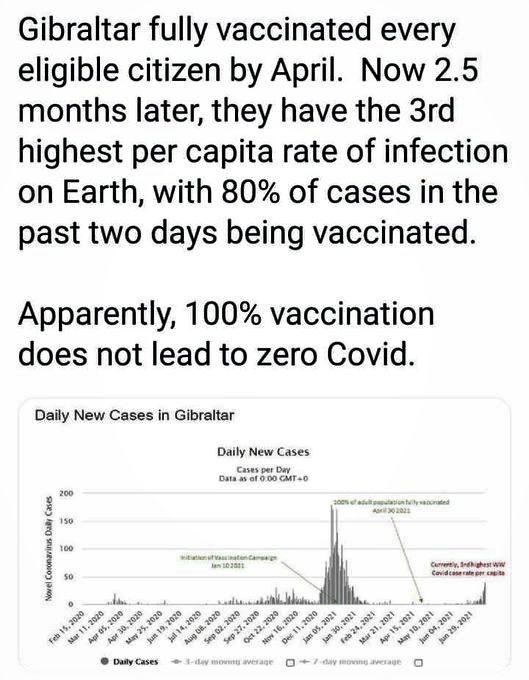
Well this article DIDN'T age well.
What Life Is Like in a Fully Vaccinated Country (Slate)
https://slate.com/news-and-politics/2021/04/gibraltar-covid-vaccination-safe.html
A sense of relief, but also some guilt.
Just as the infections avalanche culminated in mid-January, the first shipment of Pfizer/BioNTech vaccines arrived from Britain. Then soon came another, and another.
Authorities didn’t leave anything to chance this time. The registration was simple and inoculations moved at a blistering pace. By the end of March, about 85 percent of the adult population had received both jabs, well over the strictest thresholds of herd immunity. Several thousand cross-border workers from Spain got vaccinated, too. (This is why Gibraltar confusingly has a 106.7 percent vaccination rate.) With the arguable exception of the even smaller Vatican City, Gibraltar became and to this day still remains the only fully vaccinated country in the world.
We feel blessed and safe. Some of us also feel a bit strange, though. The rest of the world scrambles to get every available dose of the vaccine. My septuagenarian mother back in Czech Republic is still waiting for her second round. Why did we of all people enjoy the luxury of enough jabs to protect even nonresidents? More importantly, does my vaccine mean that someone else who needed it more died unnecessarily?
Perhaps this is too harsh. I didn’t twist the arm of some guy in Soweto to give up his jab. My 9-year-old son deserves a healthy, living dad just as much as kids in the favelas of Manaus. I did nothing wrong.
Yet here it is, a slightly chilling sensation that my luck is someone else’s death sentence. A single COVID vaccine can easily be the difference between life and death. Many of the most vulnerable people in most parts of the world are still desperately waiting to be protected, while my current homeland somehow had enough to vaccinate all the thirtysomething yuppies from gambling companies, shouting their boozy odes to Friday night under my terrace as I write this text.
Our city-state now looks almost as if the pandemic was just a bad dream. Nonessential shops have been opened since mid-February, followed by schools one week later and finally restaurants and bars at the beginning of March. The bars here are packed again. Facial coverings are still required indoors, but not anymore on the streets. Spectators are allowed to attend sport events, albeit in limited numbers.
After two months of more or less unrestricted life, one thing is clear: Vaccines do work. There have been no active cases among Gibraltarian residents for three weeks now. The COVID ward of St. Bernard’s Hospital has seen two hospitalizations and zero deaths since March 14. If anyone still needs convincing that vaccination is worth it, they won’t find a better case study than “Gib.” Forget about the light at the end of the tunnel. It’s about leaving the tunnel far behind.
What Life Is Like in a Fully Vaccinated Country (Slate)
https://slate.com/news-and-politics/2021/04/gibraltar-covid-vaccination-safe.html
A sense of relief, but also some guilt.
Just as the infections avalanche culminated in mid-January, the first shipment of Pfizer/BioNTech vaccines arrived from Britain. Then soon came another, and another.
Authorities didn’t leave anything to chance this time. The registration was simple and inoculations moved at a blistering pace. By the end of March, about 85 percent of the adult population had received both jabs, well over the strictest thresholds of herd immunity. Several thousand cross-border workers from Spain got vaccinated, too. (This is why Gibraltar confusingly has a 106.7 percent vaccination rate.) With the arguable exception of the even smaller Vatican City, Gibraltar became and to this day still remains the only fully vaccinated country in the world.
We feel blessed and safe. Some of us also feel a bit strange, though. The rest of the world scrambles to get every available dose of the vaccine. My septuagenarian mother back in Czech Republic is still waiting for her second round. Why did we of all people enjoy the luxury of enough jabs to protect even nonresidents? More importantly, does my vaccine mean that someone else who needed it more died unnecessarily?
Perhaps this is too harsh. I didn’t twist the arm of some guy in Soweto to give up his jab. My 9-year-old son deserves a healthy, living dad just as much as kids in the favelas of Manaus. I did nothing wrong.
Yet here it is, a slightly chilling sensation that my luck is someone else’s death sentence. A single COVID vaccine can easily be the difference between life and death. Many of the most vulnerable people in most parts of the world are still desperately waiting to be protected, while my current homeland somehow had enough to vaccinate all the thirtysomething yuppies from gambling companies, shouting their boozy odes to Friday night under my terrace as I write this text.
Our city-state now looks almost as if the pandemic was just a bad dream. Nonessential shops have been opened since mid-February, followed by schools one week later and finally restaurants and bars at the beginning of March. The bars here are packed again. Facial coverings are still required indoors, but not anymore on the streets. Spectators are allowed to attend sport events, albeit in limited numbers.
After two months of more or less unrestricted life, one thing is clear: Vaccines do work. There have been no active cases among Gibraltarian residents for three weeks now. The COVID ward of St. Bernard’s Hospital has seen two hospitalizations and zero deaths since March 14. If anyone still needs convincing that vaccination is worth it, they won’t find a better case study than “Gib.” Forget about the light at the end of the tunnel. It’s about leaving the tunnel far behind.


 Ok, buddy