
signalmankenneth
Verified User
White Like Me: New Poll Finds Republicans Have Growing Fondness for Russia, Vladimir Putin and Wikileaks
Sympathies for Russia follow white supremacist rise in the GOP.
Significant numbers of Republicans, who for the past half-century have elected presidents who've unleashed America’s military against communists and especially the Soviet Union, have pirouetted like a Nutcracker ballerina and are now saying they like Russia, Vladimir Putin, and his use of Wikileaks to attack Democrats.
This history-erasing, principle-abandoning reversal was noted by an Economist-YouGov poll released[3] Wednesday, finding Republicans now favor Wikileaks by a 27 percent margin—a 74 percentage point swing from the summer of 2013. That is undoubtedly related to Trump’s repeated speeches praising[4] Wikileaks, which dumped stolen Clinton campaign emails for 33 days[4] in a row before Novermber's Election Day.
But it is the Russia and Putin turnaround that is most striking, which pollster Kathy Frankovic said reflects a willingness among Republicans to follow their leader.
“Trump voters today are somewhat more positive towards Russia than his supporters were just after the party conventions last summer,” she said[3]. “Today, the percentage of Trump supporters viewing Russia as either unfriendly or as an enemy has dropped 11 points, from 67% then to 56% now… Nearly half of his own voters say Trump views Russia as a friend or ally.”
Putin, who holds the title of president but is clearly an authoritarian ruler consistent with that country’s long history of embracing strongmen, dictators and czars, is seen by Republicans with skepticism, Frankovic said, but his favorability is increasing among Trump voters.
“When it comes to Russia’s leader, Vladimir Putin, Trump voters are more positive than the country as a whole, but there is still skepticism and dislike for Putin (though that has lessened since July),” she said[3]. “By three to one Putin is viewed as a strong leader, but only 21% have a favorable assessment of him. Among Trump voters more than a third are favorable, an increase of nine points since July.”
The Economist-YouGov poll was done before Trump announced his appointment of Exxon-Mobile CEO Rex Tillerson as Secretary of State. The corporate chieftain has negotiated major deals with Putin and Russian oil producers. Among those polled, Republicans and Democrats, only about one in three were confident about Trump’s “ability to handle Russia.”
The poll also split along partisan lines when it came to confidence in the CIA, which concluded that Russia was actively taking sides to elect Trump and defeat Clinton. That secret assessment was disclosed last Friday by the Washington Post after the Obama White House announced it was reopening an intelligence agency review of Russian interference in the election.
“The CIA conclusion that Russia hacked the Democratic National Committee and the Clinton campaign during the election has been received with a partisan eye,” the pollsters said. “Two-thirds of Clinton voters, but only 12% of Trump voters believe Russia was responsible for the hacks.”
“Many Democrats may have lost faith in the CIA after weapons of mass destruction (a major justification for the 2003 Iraq War) were not found in Iraq following the overthrow of Saddam Hussein,” they continued. “In a 2007 Gallup/USA Today Poll, for example, Democrats were more likely than Republicans to place blame on the CIA for that war not going well. But today, Republicans have less confidence than Democrats in the CIA.”
White Like Me?
The question of why growing numbers of Republicans are warming to Russia and Putin was not answered by the poll. But other analysts at legitimate news organizations have been reporting that a serious slice of Trump’s base are white supremacists, including people who see Russia as a white country with a proud nationalist leader willing to assert and protect that identity.
“Russian President Vladimir Putin has emerged as a hero of several prominent alt-right figures,” wrote[5] Natasha Bertrand for Business Insider. “Whether Russia has played a direct role in awakening the American alt-right, whose resurgence as a crusade against establishment politics coincided with the rise of President-elect Donald Trump, is debatable. But the extent to which the alt-right has found a natural ally in Russia's current zeitgeist — which perceives the US as a globalist, imperialist power working on behalf of liberal elites — is hard to overstate.”
Bertrand cited[5] white nationalist Matthew Heimbach, who said, “Russia is the leader of the free world right now.” She mentioned Richard Spencer, head of the far-right National Policy Institute, who praised Trump, his reset with Russia, and said it is the “sole white power in the world.” Her report didn’t stop there, but noted that some white supremacists who are anti-Semitic are also pro-Russia, starting with David Duke, former grand wizard of the Klu Klux Klan.
“Preston Wiginton, a white supremacist from Texas who sublets Duke's Moscow apartment when he travels to Russia, has written that his ‘best friends’ in Russia — ‘the only nation that understands RAHOWA [Racial Holy War] — are ‘leading skinheads,’” she wrote[5].
Meanwhile, Russian op-ed writers are more than intrigued with Trump, Juan Cole reported[6] in late November, citing BBC translations of their commentaries. “Leonid Radzikhovsky writes in an editorial for Rossiyskaya Gazeta on 15 November, according to BBC Monitoring, that a ‘Washington is ours’ euphoria has washed over Moscow. He is skeptical of that idea but admits that the election results were ‘a definite psychological victory for the Kremlin.’”
One would think the Economist-You Gov poll finding growing sympathies for Russia and Putin is an anomaly turning American history and longstanding Republican Party principles on its head. But with Trump’s campaign bringing white supremacists in from the farthest right fringes and attracting supporters who are overwhelming[7] white, it’s not surprising that a sizable slice applaud the white nationalism and nation building of Putin’s Russia. This isn’t a brave new world. It’s an increasingly dangerous one.
By Steven Rosenfeld
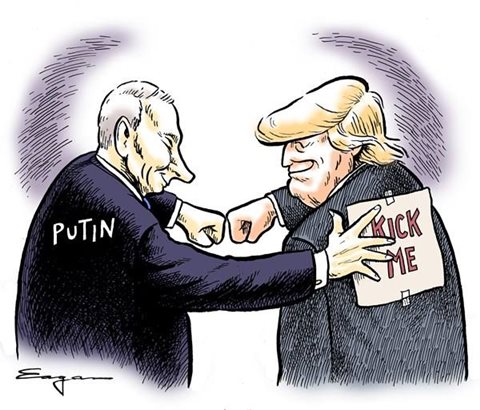
Sympathies for Russia follow white supremacist rise in the GOP.
Significant numbers of Republicans, who for the past half-century have elected presidents who've unleashed America’s military against communists and especially the Soviet Union, have pirouetted like a Nutcracker ballerina and are now saying they like Russia, Vladimir Putin, and his use of Wikileaks to attack Democrats.
This history-erasing, principle-abandoning reversal was noted by an Economist-YouGov poll released[3] Wednesday, finding Republicans now favor Wikileaks by a 27 percent margin—a 74 percentage point swing from the summer of 2013. That is undoubtedly related to Trump’s repeated speeches praising[4] Wikileaks, which dumped stolen Clinton campaign emails for 33 days[4] in a row before Novermber's Election Day.
But it is the Russia and Putin turnaround that is most striking, which pollster Kathy Frankovic said reflects a willingness among Republicans to follow their leader.
“Trump voters today are somewhat more positive towards Russia than his supporters were just after the party conventions last summer,” she said[3]. “Today, the percentage of Trump supporters viewing Russia as either unfriendly or as an enemy has dropped 11 points, from 67% then to 56% now… Nearly half of his own voters say Trump views Russia as a friend or ally.”
Putin, who holds the title of president but is clearly an authoritarian ruler consistent with that country’s long history of embracing strongmen, dictators and czars, is seen by Republicans with skepticism, Frankovic said, but his favorability is increasing among Trump voters.
“When it comes to Russia’s leader, Vladimir Putin, Trump voters are more positive than the country as a whole, but there is still skepticism and dislike for Putin (though that has lessened since July),” she said[3]. “By three to one Putin is viewed as a strong leader, but only 21% have a favorable assessment of him. Among Trump voters more than a third are favorable, an increase of nine points since July.”
The Economist-YouGov poll was done before Trump announced his appointment of Exxon-Mobile CEO Rex Tillerson as Secretary of State. The corporate chieftain has negotiated major deals with Putin and Russian oil producers. Among those polled, Republicans and Democrats, only about one in three were confident about Trump’s “ability to handle Russia.”
The poll also split along partisan lines when it came to confidence in the CIA, which concluded that Russia was actively taking sides to elect Trump and defeat Clinton. That secret assessment was disclosed last Friday by the Washington Post after the Obama White House announced it was reopening an intelligence agency review of Russian interference in the election.
“The CIA conclusion that Russia hacked the Democratic National Committee and the Clinton campaign during the election has been received with a partisan eye,” the pollsters said. “Two-thirds of Clinton voters, but only 12% of Trump voters believe Russia was responsible for the hacks.”
“Many Democrats may have lost faith in the CIA after weapons of mass destruction (a major justification for the 2003 Iraq War) were not found in Iraq following the overthrow of Saddam Hussein,” they continued. “In a 2007 Gallup/USA Today Poll, for example, Democrats were more likely than Republicans to place blame on the CIA for that war not going well. But today, Republicans have less confidence than Democrats in the CIA.”
White Like Me?
The question of why growing numbers of Republicans are warming to Russia and Putin was not answered by the poll. But other analysts at legitimate news organizations have been reporting that a serious slice of Trump’s base are white supremacists, including people who see Russia as a white country with a proud nationalist leader willing to assert and protect that identity.
“Russian President Vladimir Putin has emerged as a hero of several prominent alt-right figures,” wrote[5] Natasha Bertrand for Business Insider. “Whether Russia has played a direct role in awakening the American alt-right, whose resurgence as a crusade against establishment politics coincided with the rise of President-elect Donald Trump, is debatable. But the extent to which the alt-right has found a natural ally in Russia's current zeitgeist — which perceives the US as a globalist, imperialist power working on behalf of liberal elites — is hard to overstate.”
Bertrand cited[5] white nationalist Matthew Heimbach, who said, “Russia is the leader of the free world right now.” She mentioned Richard Spencer, head of the far-right National Policy Institute, who praised Trump, his reset with Russia, and said it is the “sole white power in the world.” Her report didn’t stop there, but noted that some white supremacists who are anti-Semitic are also pro-Russia, starting with David Duke, former grand wizard of the Klu Klux Klan.
“Preston Wiginton, a white supremacist from Texas who sublets Duke's Moscow apartment when he travels to Russia, has written that his ‘best friends’ in Russia — ‘the only nation that understands RAHOWA [Racial Holy War] — are ‘leading skinheads,’” she wrote[5].
Meanwhile, Russian op-ed writers are more than intrigued with Trump, Juan Cole reported[6] in late November, citing BBC translations of their commentaries. “Leonid Radzikhovsky writes in an editorial for Rossiyskaya Gazeta on 15 November, according to BBC Monitoring, that a ‘Washington is ours’ euphoria has washed over Moscow. He is skeptical of that idea but admits that the election results were ‘a definite psychological victory for the Kremlin.’”
One would think the Economist-You Gov poll finding growing sympathies for Russia and Putin is an anomaly turning American history and longstanding Republican Party principles on its head. But with Trump’s campaign bringing white supremacists in from the farthest right fringes and attracting supporters who are overwhelming[7] white, it’s not surprising that a sizable slice applaud the white nationalism and nation building of Putin’s Russia. This isn’t a brave new world. It’s an increasingly dangerous one.
By Steven Rosenfeld


